


What Happens If You file Your Income Tax Return and Forget to E-Verify It?
What Happens If You file Your Income Tax Return and Forget to E-Verify It?
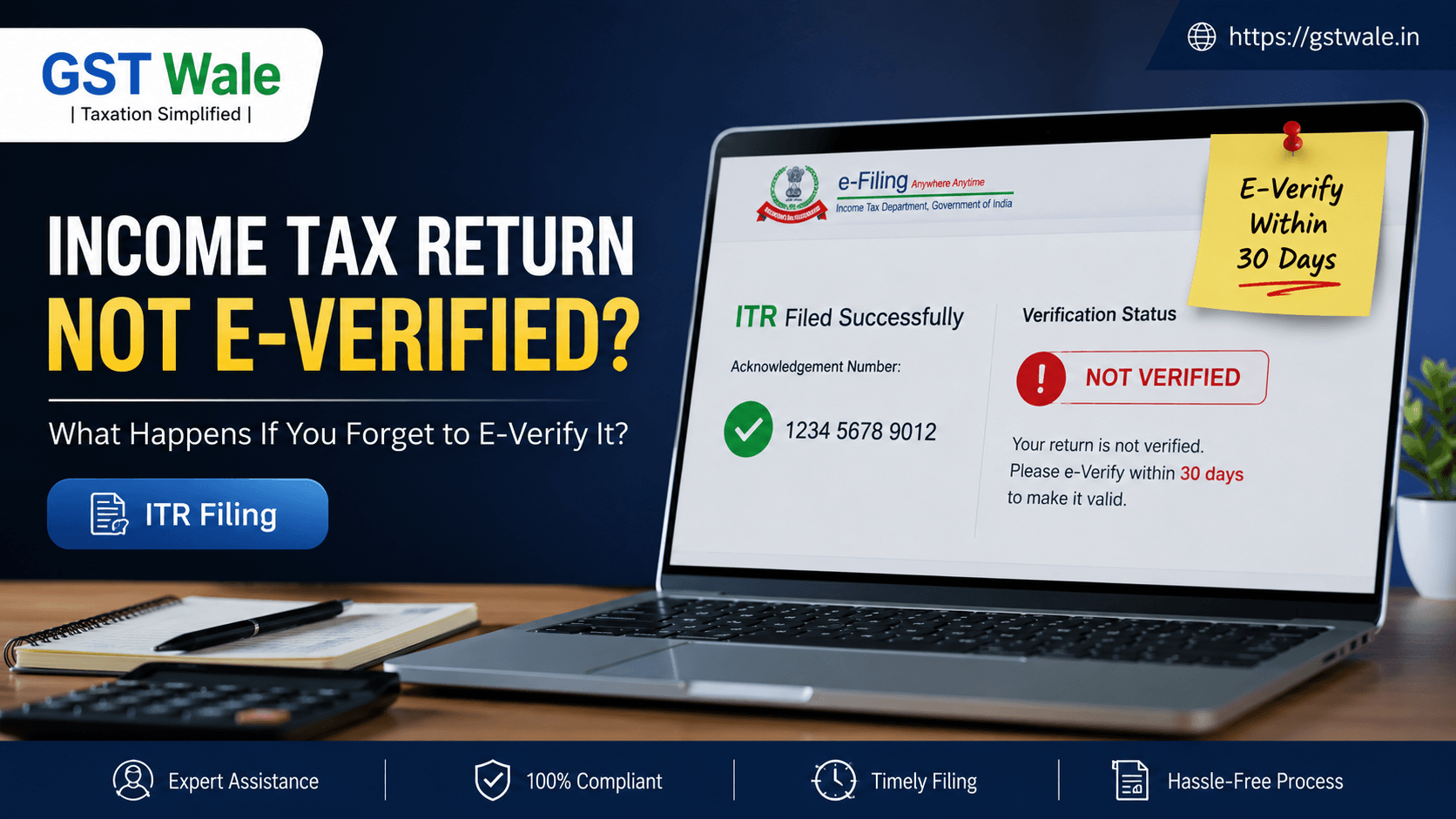
Filing your income tax return is not the final step. Many taxpayers upload their return successfully and assume the process is complete, only to realise later that they forgot to e-verify it. This is more common than you may think, especially when people file close to the due date and get busy with other work. If you have filed your income tax return but have not completed verification, your return may not be treated as a validly filed return.
If you need professional assistance with your ITR Filing, GST Wale can help you complete the process correctly and avoid unnecessary complications.
The good news is that forgetting to verify does not always mean you have lost your opportunity to file. However, you need to understand the time limit for verification and act quickly if that period has already passed.
What Happens After You File Your Income Tax Return?
When you submit an income tax return online, the filing process is not considered fully complete merely because the return has been uploaded successfully. Verification is an essential part of the process.
The Income Tax Department currently provides a 30-day period from the date of filing for e-verification or submission of ITR-V. This 30-day requirement applies to returns filed under the current rules.
You can verify your return electronically through methods such as:
- Aadhaar OTP
- Electronic Verification Code (EVC) through a pre-validated bank account
- EVC through a pre-validated demat account
- Net banking
- Digital Signature Certificate (DSC)
Alternatively, you can send a duly signed physical ITR-V to the Centralised Processing Centre in Bengaluru.
The simplest option for most individual taxpayers is e-verification because it is quick and does not require sending documents by post.
What If You Forget to E-Verify Your Income Tax Return?
If you forget to verify your income tax return within the prescribed 30 days, there can be significant consequences.
The Income Tax Department states that where an income tax return is uploaded but verification is completed after 30 days, the date of verification is treated as the date of furnishing the return. Consequently, the return may attract the consequences applicable to a late-filed return. If the return remains unverified, it is treated as invalid.
In simple terms, uploading your return is not enough. You need to complete the verification process.
For example, suppose Rahul files his income tax return on 20 July. He assumes everything is finished and forgets to e-verify it. If he verifies it within the permitted 30-day period, the original filing date can generally be considered the date of furnishing the return.
However, if he verifies it after the prescribed period, the verification date may become the effective filing date, subject to the applicable rules. This can potentially result in late-filing consequences.
Does an Unverified Return Become an Invalid Return?
Yes, an unverified return can ultimately be treated as an invalid return.
This is one of the most important points taxpayers should understand. Many people believe that receiving an acknowledgement number means their income tax return has been successfully filed for all purposes. That is not necessarily the case.
The Income Tax Department specifically clarifies that where a return is uploaded but remains unverified after the specified period, it is treated as invalid.
An invalid return can create several practical problems, particularly if you were expecting a refund, wanted to carry forward certain losses, or needed the return as proof of timely compliance.
Therefore, after filing your income tax return, always check its status on the e-filing portal rather than assuming the process is complete.
What Is the Time Limit for Verification?
The current time limit for e-verification or submission of ITR-V is 30 days from the date of filing the return.
This rule was introduced through the applicable CBDT notification and is reflected in the Income Tax Department's current guidance.
For example:
If you file your income tax return on 5 August and complete verification on 15 August, the original filing date is generally considered the date of furnishing the return.
If you file on 5 August but verify it after the 30-day period, the later verification date can be treated as the date of furnishing, and applicable late-filing consequences may follow.
That is why taxpayers should not treat e-verification as an optional final formality.
What Happens If the 30-Day Period Has Already Passed?
Do not panic if you discover the problem after 30 days.
The Income Tax Department provides a mechanism for requesting condonation of delay in appropriate cases. A taxpayer who has missed the verification deadline can submit a condonation request explaining the reason for the delay. The return becomes valid only after the competent authority approves the request.
A condonation request should be made as soon as you realise that the return has remained unverified.
How to Handle a Delayed Verification
Follow these practical steps:
- Log in to the Income Tax e-filing portal.
- Check the status of your filed return.
- Identify whether the return is still awaiting verification.
- If the 30-day period has expired, follow the portal's process for submitting a condonation request.
- Clearly mention the genuine reason for the delay.
- After the condonation request is approved, complete e-verification as required.
- Keep the acknowledgement and transaction details safely for your records.
The Income Tax Department's current instructions provide a specific service-request facility for delays in submission of ITR-V and related verification issues.
Is There a Non-Filing Penalty If You Forget Verification?
Potentially, yes.
If your income tax return is not verified within the prescribed period and is consequently treated as not filed or invalid, the consequences applicable to non-filing or late filing may arise, depending on your circumstances.
The Income Tax Department explains that failure to verify in time can result in the return being treated as not filed and can attract consequences under the Income Tax Act.
The exact financial impact depends on factors such as your income, filing circumstances, applicable due date and whether the return can subsequently be regularised.
Therefore, do not assume that forgetting verification is merely an administrative mistake with no tax implications.
Can You Send a Physical ITR-V by Post?
Yes. E-verification is not the only method of verification.
A taxpayer can sign the prescribed ITR-V and send it to the Centralised Processing Centre, Income Tax Department, Bengaluru. The current Income Tax Department guidance permits submission through ordinary post, speed post or another prescribed mode.
However, there is an important point to remember: the relevant date for physical verification is based on the ITR-V being received at CPC, not merely the date on which you put it in the post.
For this reason, e-verification is generally more convenient and provides immediate confirmation.
What Should You Do If You Have Just Forgotten to Verify?
If you filed your income tax return recently and suddenly realised that you have not verified it, do not wait.
Check the return status immediately and complete e-verification if the return is still within the applicable verification period.
After successful verification, the portal generally displays a confirmation along with a transaction ID. You should retain this confirmation for your records.
It is also a good practice to check your registered mobile number and email notifications after filing. These can help you identify whether the verification process has been completed successfully.
A Practical Example
Consider Priya, a salaried professional who files her income tax return on 25 July. She downloads the acknowledgement and assumes her work is finished.
A few weeks later, she checks her e-filing account and discovers that the return is still unverified.
If she is still within the 30-day period, she can simply complete e-verification and finish the process.
If more than 30 days have passed, she should not simply ignore the return. She may need to submit a condonation request explaining the genuine reason for the delay and then complete verification as permitted after the request is dealt with.
This simple example shows why checking the return status after filing is extremely important.
FAQs About Income Tax Return Verification
1. Is e-verification mandatory after filing an income tax return?
Verification is mandatory to complete the return filing process. You can either e-verify electronically or use the prescribed physical ITR-V process. If verification is not completed within the applicable period, the return can be treated as invalid.
2. What is the current time limit for verification?
The current time limit for e-verification or submission of ITR-V is 30 days from the date of filing the income tax return. Taxpayers should complete verification within this period to avoid late-filing consequences.
3. What if I forgot to verify my return for more than 30 days?
You may need to submit a condonation request explaining the genuine reason for the delay. The return is treated as valid after the required approval and subsequent verification process.
4. Can I still verify an old unverified return?
In appropriate cases, the Income Tax Department allows taxpayers to submit a condonation request for delayed verification. Approval is not automatic, so taxpayers should provide a genuine and reasonable explanation for the delay.
5. Is sending physical ITR-V by post still allowed?
Yes. A duly signed physical ITR-V can be sent to the Centralised Processing Centre in Bengaluru through the prescribed postal method. However, taxpayers should carefully follow the current instructions and ensure that it reaches CPC within the applicable period.
Do Not Let Your Income Tax Return Remain Unverified
Filing your income tax return is only one part of completing your tax compliance. If you forget to e-verify it, the return can become an invalid return, and late-filing or non-filing consequences may follow depending on the circumstances.
The safest approach is simple: after submitting your return, immediately check whether verification has been completed. If you have missed the time limit for verification, take action promptly instead of waiting for the return to become a bigger compliance issue.
At GST Wale, we believe tax compliance should be simple, transparent and stress-free. Whether you are filing your return for the first time or dealing with a delayed verification, getting professional guidance can help you avoid unnecessary mistakes and penalties.
Need help with your income tax return or verification? Connect with GST Wale and get your ITR compliance handled with the attention it deserves.
 Previous