


Understanding the Difference Between a Goods and Services Tax Filing and Direct Tax
Understanding the Difference Between a Goods and Services Tax Filing and Direct Tax
Understanding Goods and Services Tax Filing and Direct Tax
For many Indian business owners, taxation can feel confusing because GST and income tax operate differently, even though both are important parts of the tax system. A proper goods and services tax filing helps businesses report their taxable sales, purchases, input tax credit, and GST liability correctly. At the same time, direct taxes such as income tax are calculated primarily on income or profits. If you are starting a business, completing your GST Registration is one of the first important steps toward maintaining proper tax compliance.
At GST Wale, we often see taxpayers mixing up these two systems. The easiest way to understand them is to look at who ultimately bears the tax, how it is collected, what is being taxed, and which returns or documents need to be maintained.
What Is GST and What Is a Goods and Services Tax Filing?
Before comparing GST with direct tax, let us understand the basics. If you are wondering, whatis gst, GST stands for Goods and Services Tax. It is an indirect tax charged on the supply of goods and services in India.
A goods and services tax filing is the process through which a registered taxpayer reports relevant business transactions and GST liabilities to the government. Depending on the taxpayer's registration and circumstances, GST compliance can involve reporting outward supplies, purchases, input tax credit, tax payable, and tax payments.
In simple terms, a goods and services tax filing tells the tax authorities what taxable business activity has taken place during a particular period and how much GST is applicable.
For example, suppose a trader sells goods worth ₹5 lakh during a tax period. GST may be collected from customers on taxable supplies, while eligible GST paid on business purchases may be available as input tax credit. The taxpayer's goods and services tax filing helps reconcile these transactions and determine the appropriate tax liability.
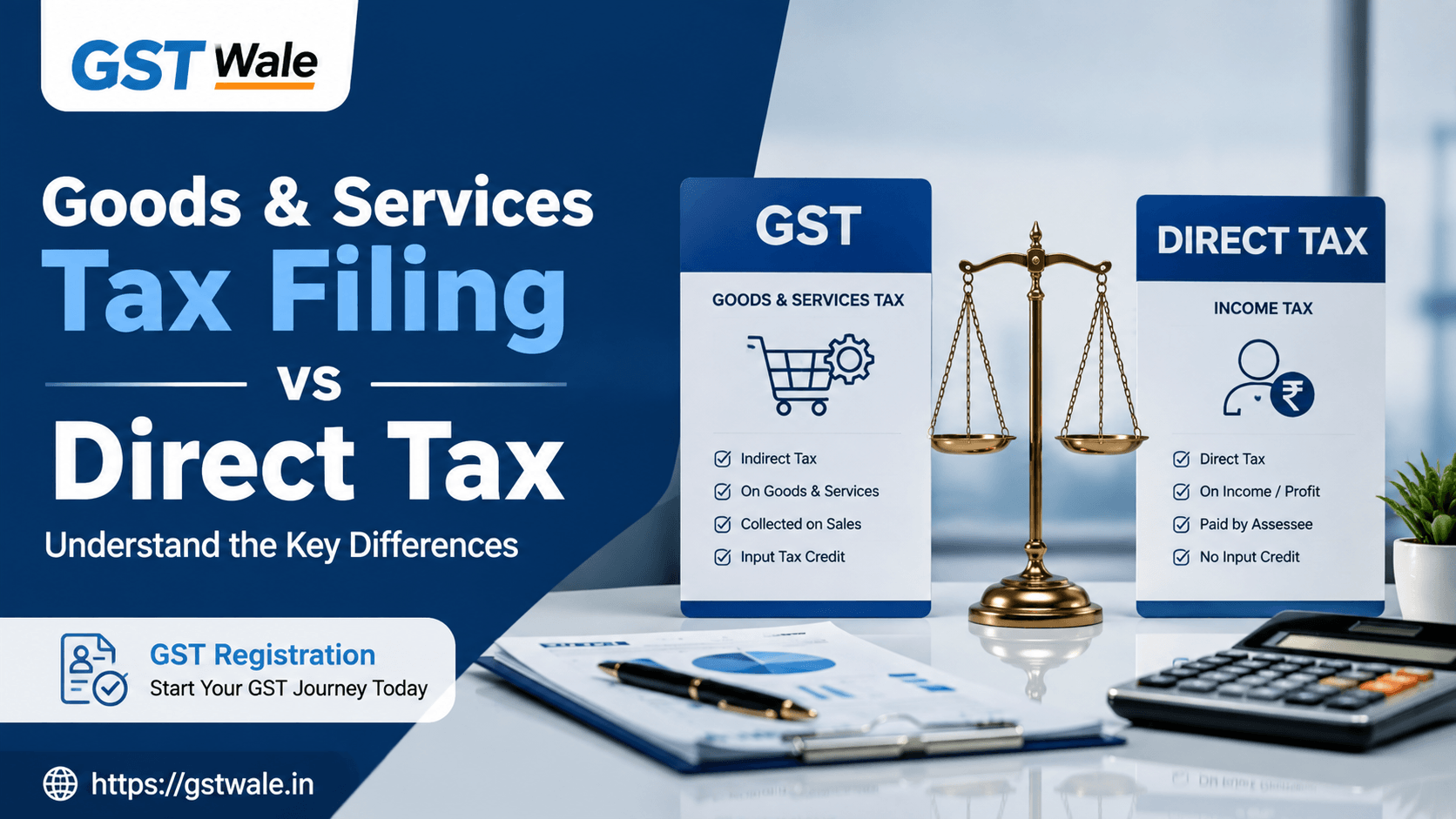
Goods and Services Tax Filing vs Direct Tax
The most important distinction between GST and direct tax is the way the tax burden works.
GST is an indirect tax. The business generally collects GST from the customer and pays the applicable amount to the government after considering eligible input tax credit.
Income tax is a direct tax. The person or business earning taxable income generally bears the tax directly.
This difference becomes easier to understand with an example.
Imagine a business sells furniture for ₹1,00,000 plus applicable GST. The customer pays the GST along with the purchase price. The business collects that tax and reports it through its GST compliance process. This is why goods and services tax filing is closely connected with sales and purchases.
Now consider the same business earning a taxable profit after deducting eligible business expenses. Income tax is calculated based on the applicable provisions and taxable income. Here, the business itself bears the direct tax burden.
Income Tax vs GST: What Is Actually Taxed?
The difference between income tax vs gst becomes clearer when we identify the tax base.
GST primarily concerns the supply of goods and services. It is transaction-oriented.
Income tax focuses on income earned during the relevant financial year. For businesses, taxable income is generally determined after considering applicable income and deductions under the Income-tax Act.
Therefore, a business can have GST transactions without necessarily having the same amount of taxable income for income-tax purposes.
For instance, a company may have substantial sales but comparatively low profits because of high operating costs. Its GST obligations and income-tax obligations can therefore be very different.
This is why a goods and services tax filing should never be treated as a substitute for income-tax compliance.
Understanding the Dual GST Structure
India follows a dual GST structure, under which both the Centre and the states have a role in GST collection.
The commonly discussed components are:
- CGST – Central Goods and Services Tax
- SGST – State Goods and Services Tax
- IGST – Integrated Goods and Services Tax
For an intra-state supply, CGST and SGST generally apply together. For an inter-state supply, IGST generally applies.
For example, if a Delhi-based seller supplies taxable goods to a customer in Uttar Pradesh, the transaction may attract IGST because it is an inter-state supply.
Understanding cgst sgst igst is particularly important for businesses operating across multiple states. Incorrect classification of transactions can create reconciliation issues, tax differences, interest exposure, and unnecessary compliance problems.
A careful goods and services tax filing therefore requires businesses to correctly identify the nature and location of their supplies.
How Goods and Services Tax Filing Differs From Income Tax Return Filing
Although both involve reporting information to the government, the underlying process is different.
A goods and services tax filing is generally linked to business transactions and GST registration. Depending on the taxpayer and applicable scheme, GST returns or statements may be filed periodically.
Income-tax return filing, on the other hand, generally focuses on income, deductions, taxes paid, and the final tax position for the relevant financial year.
Some major differences include:
1. Tax Base
GST is connected with the supply of goods and services, while direct tax is connected primarily with taxable income.
2. Tax Collection
GST is generally collected from the customer as part of a taxable transaction. Income tax is paid by the taxpayer on taxable income.
3. Compliance Frequency
GST compliance can occur monthly or quarterly depending on the taxpayer and applicable scheme. Income-tax return filing is generally annual, although advance-tax and other obligations may arise during the year.
4. Input Tax Credit
GST provides an input tax credit mechanism subject to applicable conditions. There is no equivalent general input-tax-credit mechanism under income tax.
5. Business Records
A goods and services tax filing requires accurate sales, purchase, tax invoice, credit-note, debit-note, and input-tax-credit records. Income-tax compliance requires proper books and supporting records to establish income, expenses, deductions, and taxable profit.
Why Businesses Need to Coordinate Both Tax Systems
One common mistake is maintaining GST and accounting records separately without proper reconciliation.
For example, a business may report ₹20 lakh of sales in its books but have differences in GST records because of credit notes, timing differences, exempt supplies, or other adjustments. Such differences do not automatically mean tax evasion, but they should be identified and properly explained.
Regular reconciliation between accounting records, GST data, invoices, and tax returns can make goods and services tax filing much smoother.
It is also useful to maintain a compliance calendar covering GST return due dates, tax payments, income-tax return deadlines, advance-tax dates, TDS requirements, and other applicable obligations.
Practical Tips for Better GST and Direct Tax Compliance
A business can reduce avoidable tax problems by following a few practical habits:
- Keep sales and purchase invoices properly organised.
- Reconcile GST records with accounting books regularly.
- Verify eligible input tax credit before claiming it.
- Separate personal and business transactions wherever possible.
- Track tax payments and filing deadlines through a compliance calendar.
- Review unusual differences in turnover or tax figures before filing.
- Preserve supporting documents for transactions and expenses.
- Take professional advice when a transaction involves complex tax treatment.
A good goods and services tax filing is not simply about submitting a return before the deadline. It is about ensuring that the information reported is accurate, supported by records, and consistent with the business's accounting data.
Common Mistakes in Goods and Services Tax Filing
Businesses often face avoidable problems because of simple errors. Some common examples include incorrect GST rates, wrong place-of-supply treatment, missed invoices, incorrect input tax credit claims, and failure to reconcile data.
Another frequent issue is assuming that GST and income tax figures should always be identical. They can differ for legitimate reasons, but significant unexplained differences should be investigated.
Before completing a goods and services tax filing, businesses should review their transaction records rather than relying blindly on previously used figures.
FAQs About Goods and Services Tax Filing and Direct Tax
Is GST a direct or indirect tax?
GST is an indirect tax because the tax is generally collected from the customer by the supplier and subsequently paid to the government. The registered business acts as the intermediary responsible for collection, reporting, and payment according to applicable GST provisions.
Is GST the same as income tax?
No. GST and income tax are separate taxes with different purposes and mechanisms. GST is primarily associated with supplies of goods and services, whereas income tax is imposed on taxable income. Businesses may therefore have both GST compliance and income-tax obligations.
Why are CGST, SGST and IGST different?
CGST and SGST generally apply to intra-state supplies, with the central and state governments receiving their respective portions. IGST generally applies to inter-state supplies. The correct tax depends on the nature and location of the transaction.
How often should GST compliance be reviewed?
Businesses should ideally review GST records regularly instead of waiting until the filing deadline. Monthly reconciliation can help identify missing invoices, incorrect input tax credit, tax differences, and other issues before the goods and services tax filing is submitted.
Can a business have GST liability but low income-tax liability?
Yes. GST and income tax are calculated using different principles. A business may have substantial taxable sales and GST obligations while having relatively low taxable profit because of eligible business expenses and other applicable provisions.
Get Your Goods and Services Tax Filing Right
Understanding the difference between GST and direct tax is essential for every business owner. GST focuses largely on the supply of goods and services, while income tax focuses on taxable income. Treating both systems as separate but connected areas of compliance can help businesses maintain cleaner records and avoid unnecessary tax complications.
A timely and accurate goods and services tax filing, supported by proper invoices, reconciliations, and records, can make GST compliance significantly easier. At the same time, businesses should maintain a clear compliance calendar for their income-tax and other statutory responsibilities.
At GST Wale, our goal is to make taxation easier to understand and manage. Whether you are setting up your business, managing regular GST compliance, or trying to understand the difference between GST and direct tax, professional guidance can help you make better decisions and stay compliant. Get in touch with GST Wale and make your tax compliance simpler, more organised, and stress-free.
 Previous