


GST Slab Updates: Why Small Automobiles and Durables Dropped to 18%
GST Slab Updates: Why Small Automobiles and Durables Dropped to 18%
GST Slab Updates: What Has Changed?
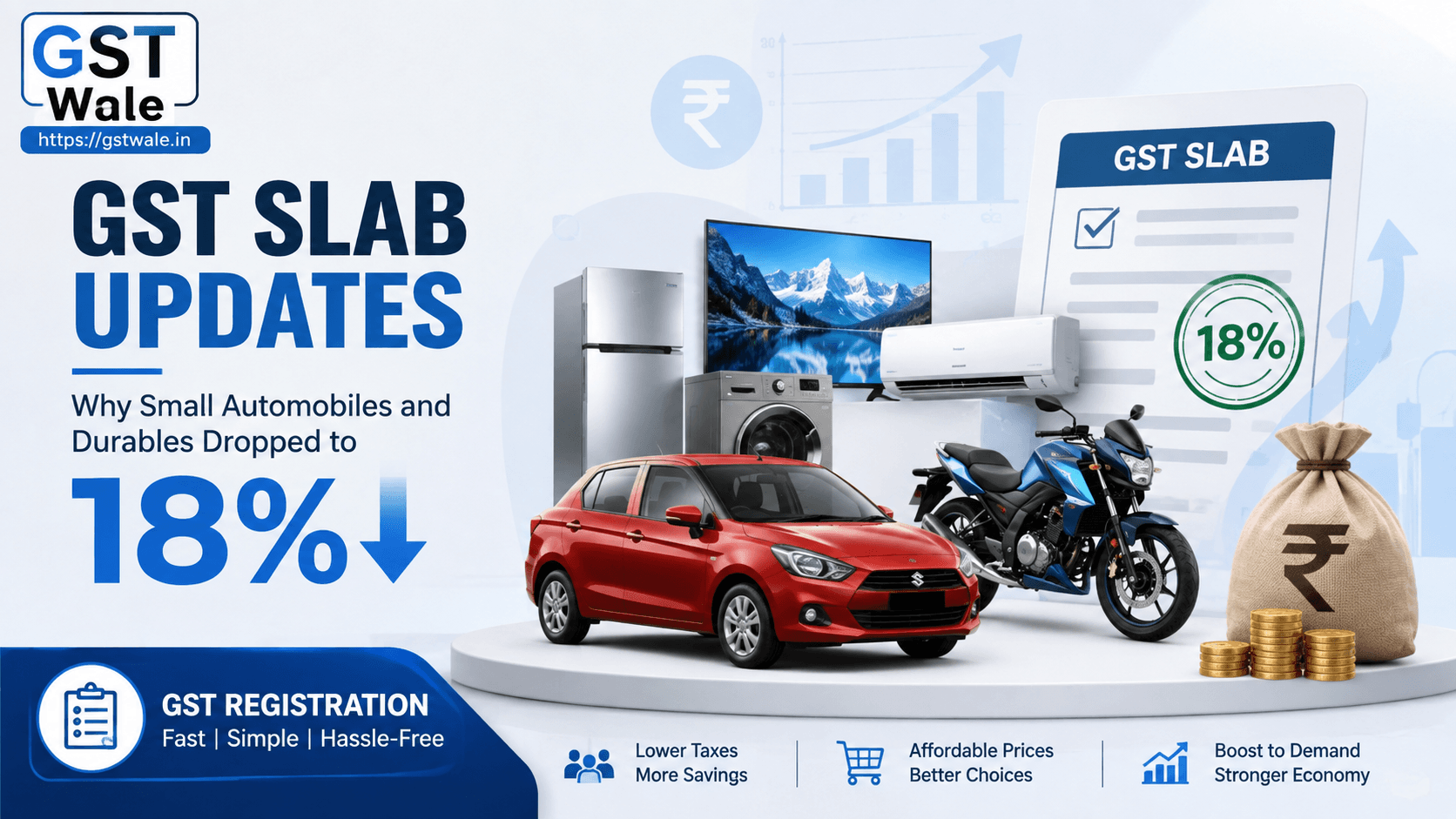
India’s gst slab structure has seen an important round of rationalisation, with several everyday products and mobility options becoming more affordable. Under the GST reforms approved by the 56th GST Council meeting in September 2025, GST on small cars, motorcycles up to 350 cc, air conditioners, televisions up to 32 inches, and dishwashers was reduced from 28% to 18%.
For consumers as well as businesses, this is more than just a lower tax rate. It can influence retail prices, purchasing decisions, working capital and demand across multiple industries. Businesses also need to ensure that their tax registrations and invoicing systems correctly reflect the applicable gst slab. If you are starting or formalising a business, getting your GST Registration right is an important first step.
What Does the New GST Slab Mean for Small Automobiles?
The automobile sector is one of the biggest beneficiaries of the revised gst slab.
Small cars that meet the specified size and engine-capacity conditions have moved from 28% GST to 18%. For GST purposes, small petrol, LPG and CNG cars generally cover vehicles up to 4,000 mm in length and up to 1,200 cc engine capacity. Diesel cars qualify up to 1,500 cc, subject to the same 4,000 mm length limit.
Motorcycles up to and including 350 cc have also moved to the 18% gst slab, while motorcycles above 350 cc attract the higher 40% rate.
Why Small Engine Cars Got a Tax Benefit
The policy objective is straightforward: make mass-market mobility more affordable.
Small engine cars are generally purchased by first-time buyers, middle-income households, small businesses and families looking for practical transportation. A lower gst slab reduces the tax component in the final price and can make vehicle ownership more accessible.
Consider a simplified example.
Suppose the pre-tax value of a qualifying car is ₹8 lakh:
- At 28% GST, GST would be ₹2.24 lakh.
- At 18% GST, GST would be ₹1.44 lakh.
- Difference in GST = ₹80,000.
The actual on-road saving can vary because vehicle pricing, dealer discounts, registration charges, insurance and other components also affect the final price. Still, the tax reduction creates meaningful room for price adjustment by manufacturers and dealers.
Why Consumer Durables Moved to the 18% GST Slab
The revised gst slab is not limited to automobiles. Several consumer durables that previously attracted 28% GST have also been brought down to 18%.
The announced changes include:
- Air-conditioning machines
- Televisions, including TVs up to 32 inches, with all TVs now at 18%
- Dishwashing machines
These products are often considered aspirational or semi-essential household purchases. Bringing them into the 18% gst slab can reduce the tax burden on consumers while potentially supporting demand.
How the Tax Reduction Can Affect Prices
A GST reduction does not automatically mean the final retail price will fall by exactly the same percentage.
Businesses consider several factors, including:
- Product cost
- Distributor and retailer margins
- Promotional discounts
- Input tax credit
- Inventory purchased before the rate change
- Logistics and financing costs
Therefore, businesses need to make a proper price adjustment rather than simply reducing the invoice value by 10%.
For example, when a product moves from 28% to 18%, the tax rate falls by 10 percentage points. But the effective reduction in the tax-inclusive price is approximately 7.81% if the base price remains unchanged.
That distinction is important for both consumers and businesses.
What Is GST and Why Does the GST Slab Matter?
If you are searching for “whatis gst”, GST or Goods and Services Tax is an indirect tax charged on the supply of goods and services in India. Instead of having multiple indirect taxes at different stages, GST provides a common tax framework with input tax credit mechanisms.
The gst slab determines how much GST is applicable to a particular product or service.
A rate change can therefore have a direct effect on:
- Selling prices
- Purchase costs
- Input tax credit calculations
- Inventory valuation
- Tax invoices
- GST returns
- Business margins
This is why businesses should not treat a GST rate notification as merely an accounting update.
Business Impact of the New GST Slab
For manufacturers, dealers and retailers, the revised gst slab can influence demand and cash flows.
1. Higher Consumer Demand
Lower taxation can make products more affordable. Consumers who were postponing purchases may reconsider their decisions, particularly in categories such as cars, motorcycles and home appliances.
2. Better Manufacturing Activity
Higher demand can encourage manufacturers to increase production. This can have a positive impact on suppliers, logistics companies, component manufacturers and service providers.
3. Support for Industrial Growth
The automobile and consumer-durable sectors have extensive supply chains. More demand at the retail level can therefore create additional activity across manufacturing and distribution networks, supporting broader industrial growth. Government communications around the reforms also highlighted stronger auto-component supply chains, MSME activity and employment as potential benefits.
4. Inventory and Pricing Challenges
Businesses holding stock purchased under the earlier gst slab need to carefully evaluate how the rate change affects their pricing and tax records.
This is particularly important for dealers who have significant inventory around the effective date of a rate change.
What Should Businesses Do After a GST Rate Change?
If your business sells or purchases products affected by the revised gst slab, take these practical steps:
- Identify affected HSN codes
Confirm whether your exact product falls within the revised category. - Verify the applicable rate
Do not rely only on product names. Classification, specifications and notifications matter. - Update billing software
Your invoices should apply the correct GST rate. - Review product prices
Check whether customer-facing prices require adjustment. - Review inventory
Examine stock purchased before and after the rate change. - Check input tax credit records
Ensure purchase invoices and GST returns reflect the correct tax treatment. - Train your accounts team
Even a small billing error repeated across hundreds of invoices can become expensive.
For businesses dealing in automobiles or consumer durables, professional review is especially useful because GST classification can sometimes depend on technical specifications.
Does the 18% GST Slab Apply to Every Vehicle?
No. The revised gst slab should not be interpreted as a blanket 18% rate for all automobiles.
For example, mid-size and large cars exceeding the prescribed specifications attract 40% GST. Utility vehicles such as specified SUVs, MUVs, MPVs and XUVs meeting the higher-engine-capacity, length and ground-clearance criteria can also fall under the 40% rate.
Similarly, motorcycles above 350 cc are taxed at 40%, while motorcycles up to 350 cc are at 18%.
This makes correct classification essential before applying any gst slab to an invoice.
FAQs About the New GST Slab
1. What is the new GST rate on small cars?
Qualifying small cars have been moved from 28% to 18% GST. Petrol, LPG and CNG cars generally qualify up to 1,200 cc, while diesel cars qualify up to 1,500 cc, subject to the 4,000 mm length condition.
2. Are motorcycles up to 350 cc taxed at 18% GST?
Yes. Motorcycles with engine capacity up to and including 350 cc attract 18% GST. Motorcycles above 350 cc attract 40%.
3. Which consumer durables were reduced to 18%?
The reforms reduced GST from 28% to 18% on air-conditioning machines, televisions and dishwashing machines, among other specified goods.
4. Does a GST reduction automatically mean a 10% reduction in the selling price?
No. GST is charged on the taxable value, and the final retail price also depends on margins, discounts, costs and other components. Businesses should calculate the correct price adjustment.
5. Should businesses update their accounting software after a GST rate change?
Absolutely. The correct gst slab should be reflected in invoices, accounting systems and GST return reporting to minimise compliance errors.
Understanding the GST Slab Is a Business Advantage
The move of qualifying small automobiles and selected consumer durables from 28% to 18% represents a significant gst slab rationalisation. For consumers, it can improve affordability; for businesses, it can support demand, simplify pricing in selected categories and contribute to industrial growth.
However, the benefit comes with a responsibility: businesses must correctly identify applicable products, update billing systems, review inventory and ensure accurate GST compliance.
At GST Wale, we help businesses understand GST changes practically rather than treating compliance as just paperwork. Whether you need guidance on registration, invoicing, tax rates or ongoing GST compliance, our team can help you stay on the right side of the rules while making the most of legitimate tax benefits.
 Previous