


Is it Possible to Claim a Refund on GST for Car If You Export the Vehicle?
Is it Possible to Claim a Refund on GST for Car If You Export the Vehicle?
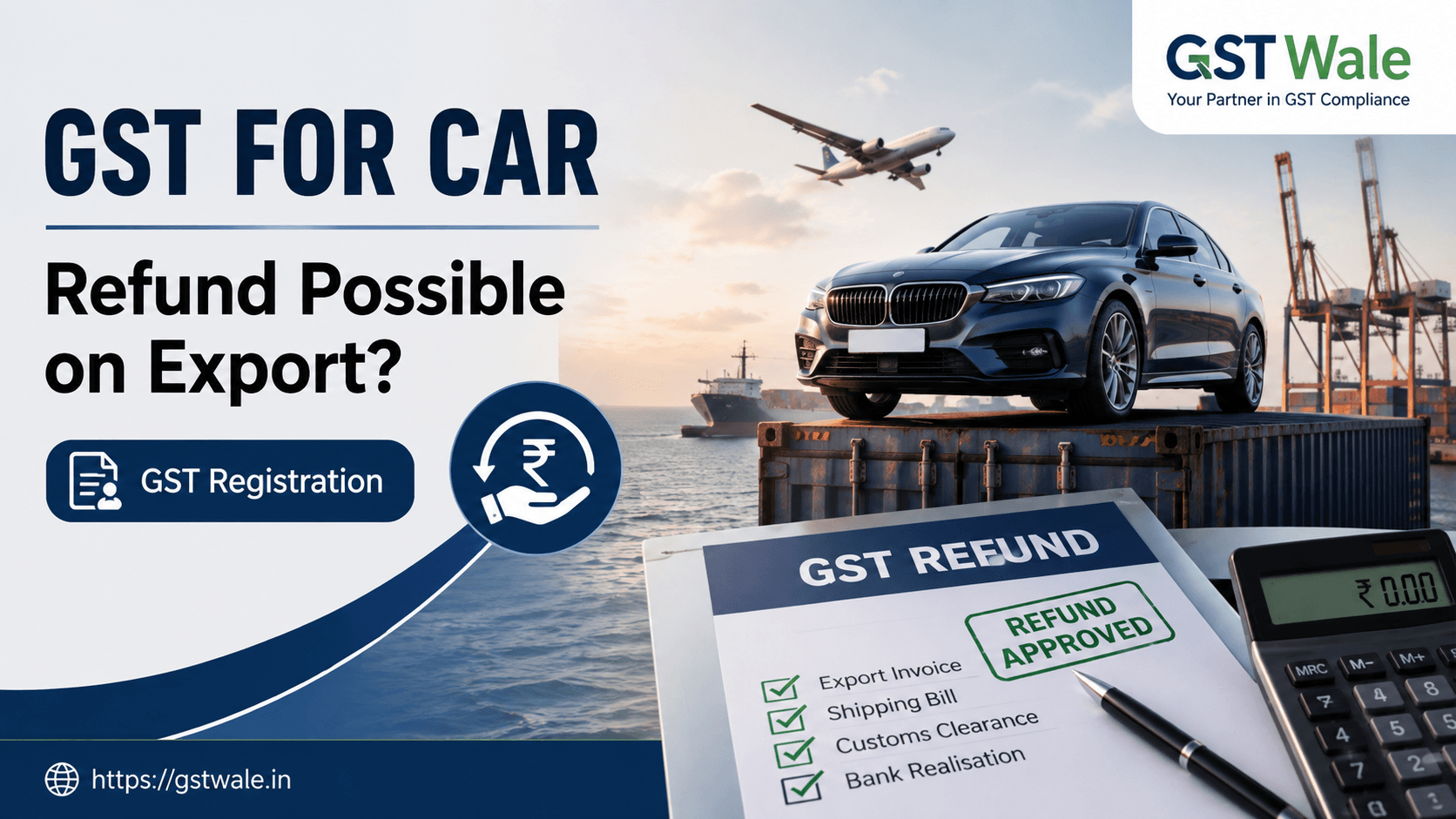
If you are planning to export a car from India, one common question is whether you can recover the GST paid on the vehicle. The answer depends mainly on who purchased the car, why it was purchased, and how the export is structured. Understanding the rules around gst for car can help exporters avoid paying tax unnecessarily or making an incorrect refund claim.
For businesses entering the export market, proper compliance is important from the beginning. Getting GST Registration can be an important part of setting up a compliant export business, particularly where the business is making taxable supplies and wants to use GST mechanisms available to exporters.
Under GST law, exports are generally treated as zero-rated supplies. This means an eligible registered exporter can export goods without paying IGST under an LUT and claim eligible accumulated input tax credit, or export after paying IGST and claim a refund of that IGST, subject to the applicable conditions.
But does this automatically mean that every person who exports a car can get back the gst for car paid at the time of purchase? No. This is where the distinction between personal purchase and business export becomes important.
Is GST for Car Refundable When a Car Is Exported?
The basic principle is simple: exporting a vehicle can qualify as a zero-rated supply, but the GST paid on purchasing the vehicle is not automatically refundable merely because the vehicle later leaves India.
Suppose a registered automobile dealer purchases cars specifically for resale and exports one of them to a customer outside India. The transaction can fall within the framework of zero-rated exports. Since the dealer is making a taxable further supply of the vehicle, the GST treatment can be different from that of an individual purchasing a car for personal use.
Section 17(5) of the CGST Act generally restricts ITC on motor vehicles, but it specifically allows credit in certain situations, including where the vehicles are used for making further taxable supplies of such vehicles.
Therefore, gst for car becomes a business tax-compliance issue rather than simply a question of whether the vehicle crossed the Indian border.
GST for Car: Business Exporter vs Individual Owner
This is probably the most important distinction to understand.
Car Purchased by an Export Business
If a registered business purchases cars as trading stock for the purpose of further supply and subsequently exports them, the business may be able to avail eligible ITC, subject to the normal GST conditions.
The exporter can generally choose between two broad export routes:
- Export under LUT without payment of IGST and claim refund of eligible unutilised ITC.
- Export on payment of IGST and claim refund of the IGST paid on the export.
Section 16 of the IGST Act provides the zero-rated framework for exports and these refund options.
Car Purchased for Personal Use
The situation is very different when an individual buys a car for personal use and later decides to export it.
Simply exporting your privately owned car does not automatically create a right to claim back the gst for car originally paid to the dealer. The input tax credit restrictions applicable to motor vehicles and the absence of a taxable business supply are important considerations.
For example, imagine that Rahul purchases a new car for ₹12 lakh plus applicable GST and uses it personally for two years. He then moves abroad and decides to take the vehicle with him.
Rahul cannot simply approach the GST portal and say, “I exported my car, so please refund the GST I paid when I purchased it.” The export itself does not automatically convert the original personal purchase into an eligible GST refund claim.
How Zero-Rated Auto Shipping Works
When a registered business exports a vehicle as part of its taxable business activity, the export can be treated as a zero-rated supply. This is why understanding zero rated auto shipping is useful for automobile traders and exporters.
The important point is that the export must be properly documented. Customs documentation, GST returns, invoices and export evidence should all support the transaction.
For IGST-paid exports of goods, the shipping bill is generally treated as the refund application after the prescribed export and return requirements are fulfilled. CBIC also explains that the export manifest/report and relevant GST return information are important for processing the refund.
GST for Car and LUT Route
An eligible exporter may export goods under a Letter of Undertaking, commonly called LUT, without paying IGST at the time of export.
This route can be useful because the exporter does not first have to pay IGST and then wait for its refund. Instead, eligible accumulated ITC can be claimed as a refund according to the prescribed rules and formula.
For an automobile exporter, this can make a significant difference to working capital.
However, an LUT is not a shortcut for recovering every amount of gst for car paid in the past. The ITC itself must be legally available, properly recorded and attributable to eligible business activity.
What About Car Exporter Registration?
Anyone planning regular commercial exports should look beyond simply purchasing a vehicle and sending it overseas. A proper car exporter registration and compliance structure may involve GST registration, an Importer Exporter Code (IEC), appropriate business documentation, export invoices and Customs compliance.
The exact registrations required depend on the nature and structure of the business.
Before buying expensive inventory, an exporter should determine:
- Whether the vehicle is being purchased for business resale or personal use.
- Whether GST input tax credit is legally available.
- Whether the export will be made under LUT or with payment of IGST.
- Whether the supplier's invoice and GST details are correct.
- Whether the Customs export documentation matches the GST records.
- Whether any refund restriction applies to the particular transaction.
Getting these points right before the export is much easier than trying to correct an incorrectly structured transaction later.
GST for Car Refund: A Practical Example
Consider ABC Auto Exports, a GST-registered business dealing in automobile exports.
The company purchases a vehicle from a registered supplier for resale to a customer outside India. The vehicle is treated as business inventory rather than a personal asset. The company maintains the purchase invoice, records eligible ITC and completes the export through proper Customs documentation.
ABC Auto Exports then exports the vehicle under an eligible zero-rated mechanism.
In such a situation, the company may be able to use the applicable refund mechanism, subject to the conditions under GST law.
Now compare this with an individual who buys a vehicle for personal use and later exports it after moving abroad. The individual does not automatically become entitled to recover the original gst for car merely because the vehicle was subsequently exported.
The commercial purpose and GST treatment of the original purchase matter.
GST for Car, Duty Drawback Connections and Other Taxes
Exporters should also be careful when considering duty drawback connections. GST refunds and Customs-related export benefits are not interchangeable. Certain refund provisions contain restrictions where particular drawback or tax-refund benefits have already been claimed.
CBIC specifically states that refund of unutilised ITC is restricted in circumstances involving certain drawback claims or refund of IGST paid on exports.
Similarly, border security taxes and other charges imposed under Customs or destination-country laws should not be confused with Indian GST. A vehicle exporter may face different taxes, duties, registration charges and compliance requirements in the importing country.
This is why the global vehicle sales process needs to be reviewed as a complete transaction rather than looking only at the Indian GST invoice.
Documents You Should Keep for GST Refund
If you are operating a genuine vehicle-export business, maintain a complete documentation trail.
Important records generally include:
- GST purchase invoice for the vehicle
- GST registration details
- Export tax invoice
- LUT, where applicable
- Shipping bill
- Bill of lading or other transport documentation, where applicable
- Export manifest or export report
- Relevant GST return details
- Bank and payment records
- Evidence supporting the export transaction
- Reconciliation between invoice, GST return and Customs data
For exports of goods, CBIC's refund rules require the export manifest or export report to be delivered before the refund application is processed in applicable cases.
Common Mistakes to Avoid
Many GST refund problems arise because exporters focus on the export transaction but ignore the original purchase.
Avoid these mistakes:
- Assuming every exported car automatically qualifies for a GST refund.
- Claiming ITC on a vehicle purchased purely for personal use.
- Using incorrect GST details on invoices.
- Failing to reconcile shipping bill information with GST returns.
- Claiming overlapping export benefits without checking the applicable restrictions.
- Treating Customs duties and GST refunds as the same benefit.
- Waiting until after export to determine the correct tax structure.
A professional review before the transaction can prevent expensive corrections later.
FAQs
Can I get a refund of GST if I export my personal car?
Generally, exporting a personally owned car does not by itself create an automatic right to recover the GST originally paid on purchase. The eligibility depends on the nature of the transaction and whether the person is making an eligible zero-rated business supply.
Can a car dealer claim GST refund when exporting a vehicle?
A registered automobile dealer or exporter may be eligible for the applicable export refund mechanism where the vehicle is purchased for further taxable supply and the required ITC and export conditions are satisfied. Motor vehicle ITC restrictions contain an exception for further taxable supply of such vehicles.
Is exporting a car treated as a zero-rated supply?
Export of goods is generally treated as a zero-rated supply under Section 16 of the IGST Act. Eligible registered exporters can use the prescribed export-without-IGST or export-with-IGST refund mechanisms, subject to applicable conditions.
Is LUT required for exporting a car?
LUT can be used by an eligible registered exporter who wants to export goods without payment of IGST and claim eligible refund of accumulated ITC. Whether this is the best route depends on the business's circumstances and available ITC.
Can duty drawback and GST refund both be claimed?
It depends on the specific benefit and tax component involved. Certain GST refund provisions restrict refund where specified drawback benefits or IGST refunds have already been claimed. The exporter should check the exact transaction before making a claim.
Understand GST for Car Before You Export
So, is a gst for car refund possible when you export a vehicle? Yes, in appropriate business-export situations, but not simply because the car has been taken outside India.
A registered automobile exporter making a genuine zero-rated export may be able to claim an eligible refund through the prescribed GST mechanism. However, a person who purchased a car for personal use cannot assume that exporting the vehicle will automatically result in a refund of the GST paid to the dealer.
The safest approach is to decide the GST structure before purchasing and exporting the vehicle. Check ITC eligibility, choose the appropriate export route, maintain accurate Customs and GST documentation, and review any interaction with other export benefits.
At GST Wale, we help businesses understand GST compliance and structure transactions correctly so that tax refunds are claimed lawfully and unnecessary complications are avoided. If you are planning vehicle exports or need help with GST compliance, speak with GST Wale before completing the transaction.
 Previous