



A Technical Analysis of Auto-Drafted Statements: GSTR 3B vs GSTR 2B vs GSTR 2A
A Technical Analysis of Auto-Drafted Statements: GSTR 3B vs GSTR 2B vs GSTR 2A
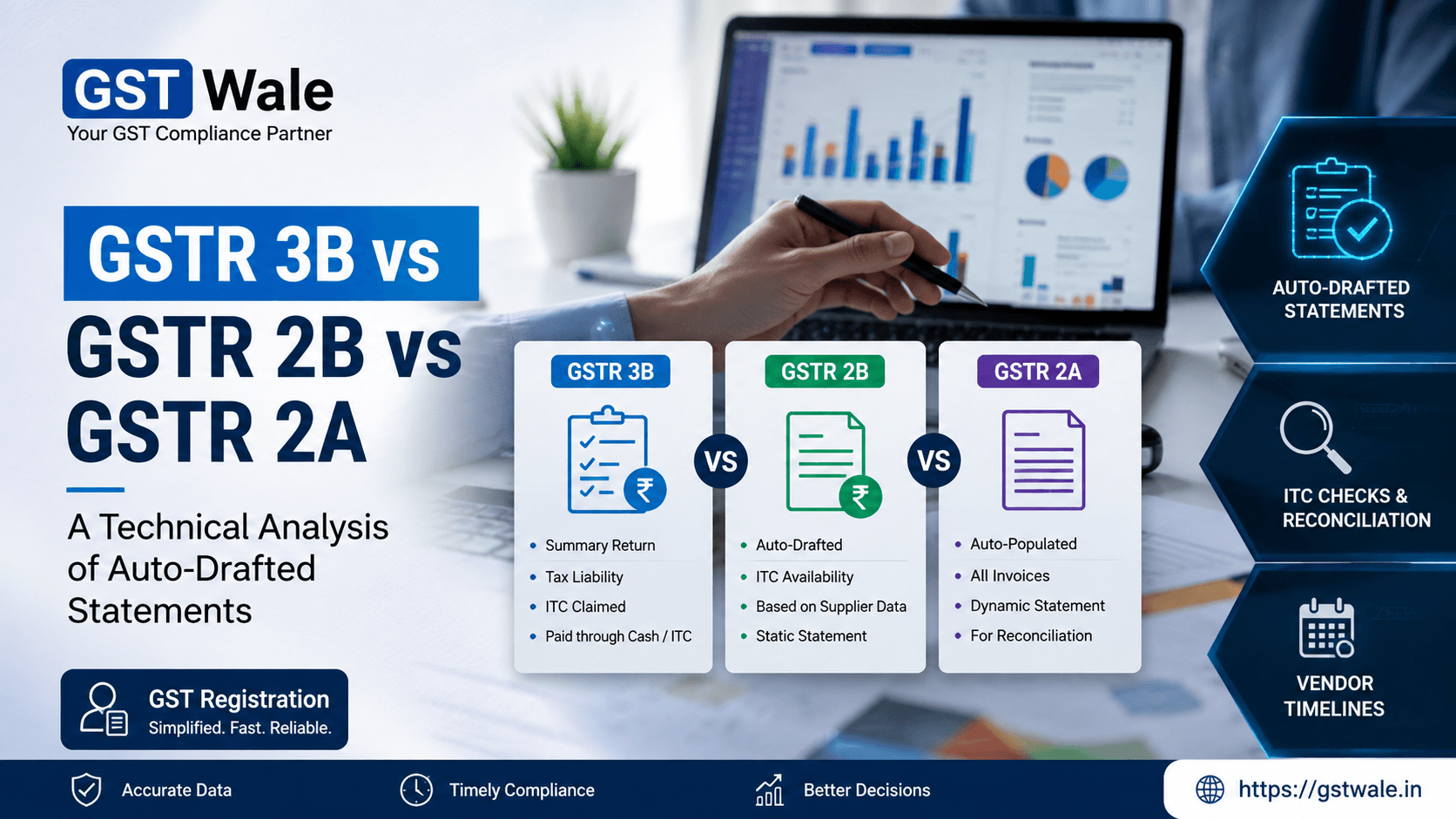
For many Indian businesses, GST compliance is no longer about simply collecting invoices and filing a return every month. The real challenge is understanding how different GST statements interact with each other. Among them, gstr 3b, GSTR 2B and GSTR 2A play very different roles, yet they are often treated as if they are interchangeable. This can result in incorrect Input Tax Credit (ITC), reconciliation issues and unnecessary notices.
If your business is newly registered or you are setting up your tax compliance process, getting your GST Registration structure right is the first step. Once registration is active, understanding auto-drafted statements becomes equally important.
At GST Wale, we regularly see businesses struggle with one basic question: “Which GST statement should I rely on while filing gstr 3b?” The answer requires a little technical understanding because GSTR 2A, GSTR 2B and gstr 3b are generated for different purposes.
What Is GSTR 3B?
GSTR 3B is a summary GST return filed by registered taxpayers to declare their outward taxable supplies, reverse-charge transactions and eligible Input Tax Credit. It also calculates the net GST liability payable for the relevant tax period.
Unlike GSTR 2A and GSTR 2B, gstr 3b is not simply an information statement generated from supplier invoices. It is a return in which the taxpayer reports figures and claims eligible ITC after considering applicable GST rules.
The importance of gstr 3b can be understood from three areas:
- It reports taxable outward supplies.
- It records eligible and ineligible ITC.
- It determines the GST liability payable for the period.
A mistake in gstr 3b can therefore directly affect the amount of tax paid and the ITC claimed.
GSTR 2A vs GSTR 2B: What Is the Difference?
GSTR 2A and GSTR 2B both provide information about purchases and ITC-related invoices reported by suppliers. However, they should not be treated as identical statements.
GSTR 2A Is a Dynamic Statement
GSTR 2A is dynamic in nature. It keeps changing as suppliers upload, amend or file invoice-related information. If a supplier uploads an invoice after you have already reviewed the statement, that transaction may subsequently appear in GSTR 2A.
This makes GSTR 2A useful for ongoing reconciliation and invoice tracking.
For example, suppose a supplier uploads an invoice on 12 August for a transaction relating to July. The invoice may appear in your GSTR 2A after the earlier July data was reviewed. Therefore, GSTR 2A can change over time.
This is the practical difference between dynamic vs static statements.
GSTR 2B Is a Static ITC Statement
GSTR 2B is a static statement generated for a particular period. It provides taxpayers with information about ITC based on supplier filings and the applicable cut-off mechanism.
Because GSTR 2B is static for the relevant period, businesses can use it as an important reference while determining ITC for gstr 3b.
However, “appearing in GSTR 2B” should not automatically be interpreted as “ITC can definitely be claimed.” Eligibility must still be checked under the GST law.
How GSTR 2B Helps in Filing GSTR 3B
The relationship between GSTR 2B and gstr 3b is particularly important for monthly GST compliance.
A taxpayer can use GSTR 2B as a starting point for identifying purchase invoices and available ITC. But before transferring the figures into gstr 3b, the taxpayer should perform appropriate itc availability checks.
These checks should consider:
- Whether the invoice actually belongs to the business.
- Whether goods or services have been received.
- Whether the transaction satisfies ITC eligibility conditions.
- Whether the supplier's invoice details are correct.
- Whether any ITC needs to be reversed.
- Whether the credit relates to blocked or restricted categories.
- Whether duplicate invoices have been recorded.
This is why simply copying the ITC figure from GSTR 2B into gstr 3b is not a good compliance practice.
GSTR 3B and GSTR 2B: A Practical Example
Consider a manufacturing business that purchases raw material worth ₹5,00,000 plus applicable GST from several suppliers during a month.
After the supplier filings are processed, the business finds ₹90,000 of potentially available ITC in GSTR 2B.
At first glance, the accounts team may enter ₹90,000 into gstr 3b. But further verification reveals that:
₹5,000 relates to an invoice that was incorrectly uploaded.
₹10,000 relates to an expense where ITC is restricted under GST provisions.
₹5,000 is a duplicate entry in the accounting records.
The business should not blindly claim the full ₹90,000. After appropriate verification and adjustments, only the eligible amount should be considered while preparing gstr 3b.
This simple example demonstrates why reconciliation is more important than merely downloading a statement.
Why GSTR 2A Still Matters
With GSTR 2B becoming an important reference for ITC reconciliation, some businesses assume that GSTR 2A has become irrelevant. That is not correct.
GSTR 2A can help businesses identify invoices that appear later because of supplier actions, amendments or filing timelines. It can therefore be useful for vendor follow-up and historical reconciliation.
Suppose an invoice is missing from the relevant GSTR 2B but subsequently appears in GSTR 2A after the supplier uploads the details. The accounts team can investigate the reason for the difference and determine the appropriate treatment in a subsequent tax period.
GSTR 2A is therefore useful as a monitoring and reconciliation tool, while GSTR 2B is more suitable as a period-specific ITC reference.
Vendor Trailing Timelines and ITC Reconciliation
One of the biggest practical challenges businesses face is vendor compliance.
Your ITC depends partly on whether suppliers correctly report their invoices. If a supplier delays filing or uploads incorrect information, your purchase records and GST statements may not match.
This is where vendor trailing timelines become important.
A good accounts team should maintain a vendor reconciliation process covering:
- Purchase register comparison.
- GSTR 2B comparison.
- GSTR 2A monitoring.
- Missing invoice identification.
- Vendor communication.
- Correction tracking.
- Final ITC determination before gstr 3b filing.
Instead of contacting vendors randomly, businesses can create a monthly ageing report showing invoices that are missing, mismatched or awaiting correction.
Real-Time Tax Mapping and GST Compliance
Modern accounting systems increasingly support real time tax mapping between purchase transactions, GST classifications and return preparation.
However, automation does not remove the need for professional review.
Real time tax mapping can help identify issues such as incorrect GST rates, wrong tax categories, duplicate invoices and mismatches between accounting data and GST statements.
The ideal process is to connect accounting data with GST reconciliation while retaining human review for exceptions.
A system should flag unusual transactions rather than automatically assume that every transaction is eligible for ITC.
System Generated Returns: Are They Fully Automatic?
GST compliance is becoming increasingly technology-driven, with system generated returns and auto-drafted information reducing manual data entry.
But taxpayers should understand the difference between auto-drafted information and final legal responsibility.
GST portal data can provide valuable information, but the taxpayer remains responsible for reporting the correct figures and claiming only eligible ITC.
Therefore, businesses should follow a simple principle:
Auto-drafted does not mean automatically correct.
The same principle applies when preparing gstr 3b. Technology can reduce errors, but reconciliation and professional judgement remain essential.
A Step-by-Step Process Before Filing GSTR 3B
A practical monthly workflow can look like this:
Step 1: Close the Purchase Register
Ensure that all purchase invoices received during the relevant period are recorded in the accounting system.
Step 2: Download GSTR 2B
Use the relevant GSTR 2B as the primary period-specific reference for ITC reconciliation.
Step 3: Compare Purchase Data
Match the purchase register against GSTR 2B and identify missing or mismatched invoices.
Step 4: Review GSTR 2A
Use GSTR 2A to investigate invoices that may have been uploaded, amended or reflected at a different point in time.
Step 5: Perform ITC Checks
Separate eligible ITC from ineligible, blocked, duplicate or otherwise questionable credits.
Step 6: Follow Up With Vendors
Share missing or incorrect invoice details with vendors and maintain vendor trailing timelines.
Step 7: Prepare GSTR 3B
After reconciliation, prepare the appropriate figures for gstr 3b and verify outward supplies, reverse charge, ITC and tax liability.
Step 8: Conduct a Final Review
Before filing, compare the return with books, reconciliation reports and supporting documents.
Common Mistakes Businesses Should Avoid
Several mistakes repeatedly create GST compliance problems.
First, businesses sometimes assume that every invoice in GSTR 2B is automatically eligible for ITC. This is incorrect.
Second, some taxpayers ignore GSTR 2A completely and lose useful information for vendor reconciliation.
Third, some accounts teams wait until the return filing deadline to identify mismatches. This leaves very little time to contact vendors.
Fourth, businesses may focus only on ITC and overlook outward supply reconciliation. gstr 3b should always be reviewed as a complete return rather than just an ITC statement.
Finally, excessive dependence on system generated returns without reviewing source documents can create compliance risks.
Frequently Asked Questions
Is GSTR 2B more important than GSTR 2A for ITC?
GSTR 2B is generally the more useful period-specific statement for ITC reconciliation because it is static for the relevant period. However, GSTR 2A remains useful for monitoring supplier uploads, amendments and reconciliation differences.
Can I directly copy GSTR 2B figures into GSTR 3B?
No. GSTR 2B should be used as an important reference, but ITC must still be checked for eligibility. Ineligible, blocked, duplicate or otherwise disallowed credits should not be claimed merely because they appear in the statement.
Why does GSTR 2A keep changing?
GSTR 2A is dynamic. It can change when suppliers upload invoices, amend previously reported information or file their relevant GST details. This makes it useful for ongoing reconciliation and vendor follow-up.
What should I check before filing GSTR 3B?
You should reconcile your books with GSTR 2B, review GSTR 2A where necessary, verify eligible ITC, check outward supplies, review reverse-charge transactions and ensure that tax liability is correctly calculated.
Can GST software eliminate reconciliation work?
Good GST software can significantly reduce manual work and identify mismatches faster, but it cannot replace professional judgement. Taxpayers still need to verify whether transactions and ITC are legally eligible.
GSTR 3B Requires More Than Auto-Drafted Data
Understanding the difference between gstr 3b, GSTR 2B and GSTR 2A is essential for accurate GST compliance. GSTR 2A gives you a dynamic view of supplier-reported information, GSTR 2B provides a static period-specific ITC statement, and gstr 3b is the return where the taxpayer ultimately reports the relevant figures and liability.
The safest approach is not to rely blindly on any single statement. Reconcile your books, perform proper itc availability checks, follow up with vendors and review the final figures before filing.
At GST Wale, our objective is to make GST compliance simpler, more accurate and easier to manage. Whether you need help understanding your GST data, managing reconciliations or improving your compliance process, professional guidance can help you avoid costly mistakes and unnecessary tax notices.
For reliable GST support, connect with GST Wale and make every gstr 3b filing a properly reviewed and informed compliance exercise.
 Previous