


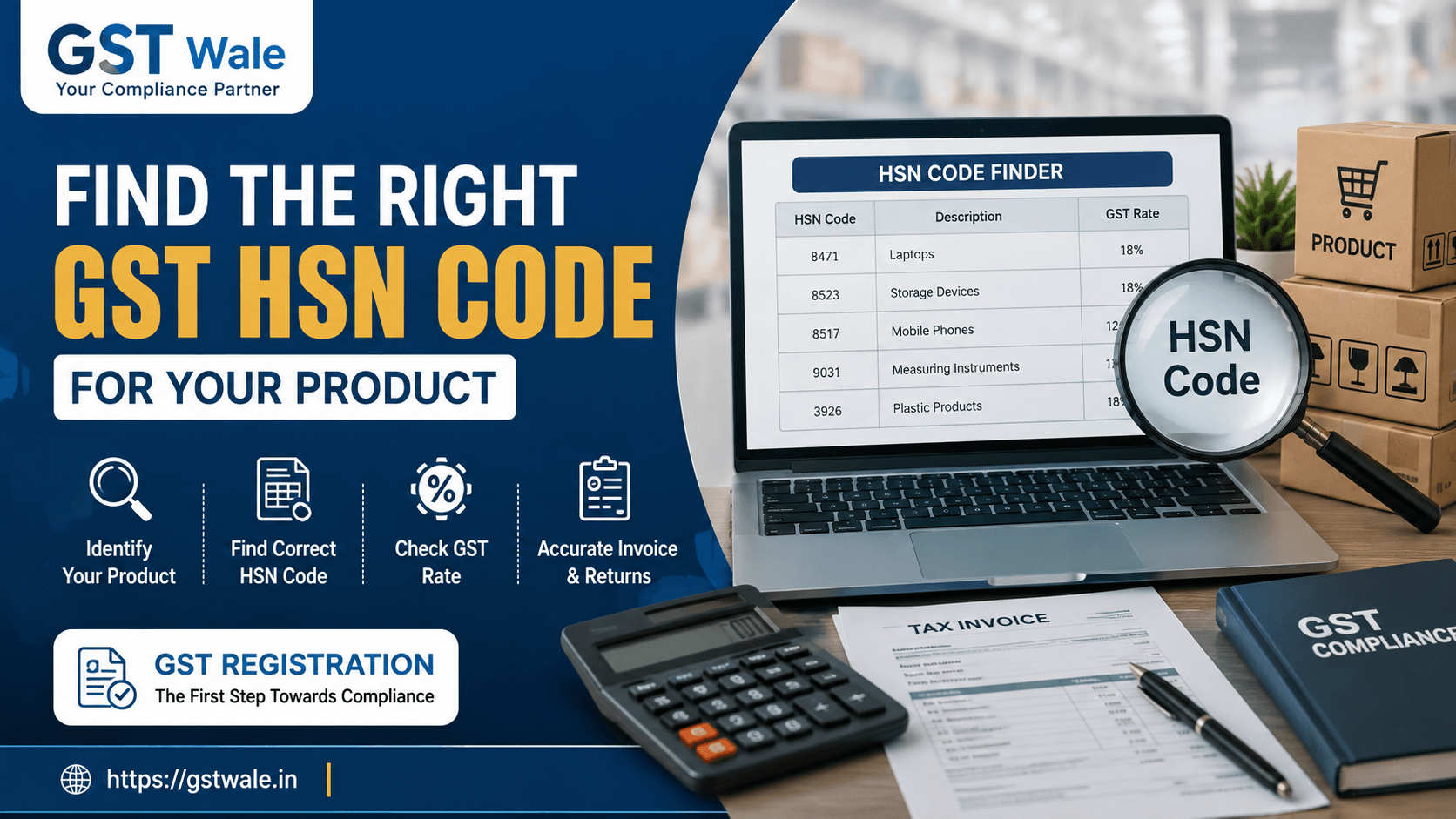
Demystifying GST HSN Code: How to Find the Right Code for Your Product
Demystifying GST HSN Code: How to Find the Right Code for Your Product
Why Understanding the GST HSN Code Matters
For many business owners, the GST HSN code looks like just another number required on an invoice. In reality, it plays an important role in determining how your product is classified under GST and which tax rate applies to it. Choosing the correct gst hsn code can help you avoid incorrect tax calculations, invoice errors, notices, and unnecessary compliance problems.
If you are starting a new business, getting GST Registration is only the first step. Once your business is registered, you also need to understand product classification, GST rates, invoicing, and return filing requirements.
At GST Wale, we often see businesses focus on their GST registration but overlook the importance of selecting the appropriate gst hsn code for their products. This small detail can have a significant impact on your day-to-day GST compliance.
What Is a GST HSN Code?
HSN stands for Harmonized System of Nomenclature. It is an internationally recognised system used to classify goods systematically. Under GST, an HSN code helps identify the nature and category of goods being sold.
The gst hsn code is generally made up of numbers arranged according to chapters, headings, and sub-headings. The more specific the classification, the more precisely the product can be identified.
For example, two products may look similar but have different compositions, uses, or manufacturing processes. They may therefore fall under different HSN classifications and potentially attract different GST rates.
This is why simply searching for a code based on a product's common market name is not always sufficient.
GST and HSN Code: How Do They Work Together?
GST and HSN code are closely connected. GST determines the tax framework, while HSN helps determine the classification of goods within that framework.
When you sell a taxable product, the relevant gst hsn code supports the identification of the product for GST purposes. Once the product is correctly classified, you can determine the applicable GST rate and include the appropriate details on your tax invoice.
This becomes particularly important for businesses selling multiple products. Maintaining an organised list of products and their corresponding HSN codes makes invoice generation and GST return preparation much easier.
A wrong classification can create a chain reaction:
- Incorrect HSN classification
- Incorrect GST rate
- Incorrect tax charged to the customer
- Incorrect figures in GST records
- Potential reconciliation and compliance issues
Therefore, HSN classification should be treated as an important accounting and compliance task rather than a simple formality.
How to Find the Right GST HSN Code for Your Product
Finding the correct gst hsn code requires more than entering the product name into a search box. You should understand exactly what you are selling and how the product is described under the relevant classification.
Step 1: Clearly Identify Your Product
Start with the basics. Write down the exact nature of your product.
Consider:
- What is the product made from?
- What is its primary use?
- Is it finished, semi-finished, or raw material?
- Is it sold individually or as part of a set?
- Does its composition affect its classification?
- Is it designed for a particular industry or purpose?
For instance, describing something simply as "machine parts" may not be enough. The material, function, and type of machinery involved may influence its classification.
Step 2: Check the HSN Classification
Once you understand the product, look for the relevant chapter, heading, and sub-heading under the HSN system.
Do not select a gst hsn code only because its description sounds similar to your product. Read the classification carefully and compare your product's characteristics with the description and applicable notes.
Step 3: Verify the Applicable GST Rate
After identifying a possible gst hsn code, verify the GST rate applicable to that classification.
A useful gst rate finder can help you locate the applicable rate, but you should still verify the classification and rate against reliable official GST-related sources or professional tax advice, particularly where multiple classifications appear possible.
The gst hsn code and GST rate should always be considered together before finalising your product master.
Step 4: Check Whether SAC Code Applies Instead
One common mistake is confusing HSN with SAC.
HSN generally applies to goods, while SAC, or Service Accounting Code, is used for services. If your business provides consulting, professional, technical, advertising, repair, or other services, you may need a SAC code rather than a gst hsn code.
Businesses offering both products and services should maintain separate and accurate classifications for each.
Step 5: Update Your Accounting and Invoice System
Once you have confirmed the correct classification, update your accounting software or billing system.
The gst hsn code should be mapped correctly to the corresponding product. This reduces the risk of manually entering a different code every time an invoice is prepared.
Good invoice generation practices also make it easier to maintain consistent records and prepare your goods and service tax return.
Common GST HSN Code Mistakes Businesses Should Avoid
Even experienced business owners can make classification mistakes. Some of the most common errors include selecting a code based only on the product's popular name or copying a supplier's classification without verification.
Using an Incorrectly Assumed Code
A supplier's HSN classification may not automatically be correct for your specific transaction or product. Always evaluate the product independently.
Choosing the Code Based Only on GST Rate
Never start with the tax rate and then choose an HSN code that matches it. Classification should come first, followed by rate determination.
Using One Code for Similar Products
Products that appear similar may have different compositions, applications, or technical characteristics. Do not assume that one gst hsn code applies to every product in the same broad category.
Ignoring Changes in Classification
GST notifications, rate changes, and classification interpretations can change over time. Businesses should periodically review their product classifications rather than treating them as permanently fixed.
GST HSN Code and GST Returns
Correct HSN reporting is also important when preparing GST returns. Your sales records, invoices, tax amounts, and classification details should remain consistent.
If the gst hsn code appearing in your invoices does not align with your accounting records or return data, it can create unnecessary reconciliation work.
Businesses with a large product catalogue should maintain a central HSN master containing the product name, description, HSN classification, GST rate, and applicable date. This simple practice can significantly improve compliance.
For businesses preparing a goods and service tax return regularly, accurate product classification can save considerable time.
Practical Example of GST HSN Code Selection
Suppose a trader sells different types of electrical equipment. Instead of treating every item as "electrical goods," the business should identify the exact product, its specifications, intended use, and relevant classification.
The trader should then determine the appropriate gst hsn code, verify the applicable GST rate, and map the information into the billing system.
When an invoice is generated, the correct product description, HSN information, taxable value, and GST amount can then be pulled into the invoice consistently.
This approach is much safer than manually selecting an HSN code every time a customer places an order.
When Should You Take Professional Help?
If the classification is straightforward, businesses can research the applicable gst hsn code themselves. However, professional advice is worthwhile when a product could reasonably fall under more than one classification.
This is especially relevant for manufacturers, importers, exporters, businesses dealing in specialised machinery, composite products, chemicals, or products with technical specifications.
A qualified professional can examine the product description, composition, intended use, supporting documents, and applicable GST provisions before recommending the appropriate classification.
At GST Wale, our approach is to look beyond the number itself and understand the actual nature of the transaction before advising on GST compliance.
FAQs About GST HSN Code
What is a GST HSN code used for?
A gst hsn code is used to classify goods under the GST framework. It helps businesses identify products consistently and supports correct GST rate determination, invoicing, and reporting.
Is HSN code mandatory on every GST invoice?
The requirement can depend on factors such as the taxpayer's turnover, type of supply, and prevailing GST rules. Businesses should check the current applicable requirements rather than assuming the same rule applies to everyone.
What is the difference between HSN and SAC code?
HSN is primarily used for classification of goods, whereas SAC is used for services. A business selling goods and providing services may need both an appropriate gst hsn code and SAC classification.
Can the GST HSN code affect the GST rate?
Yes. Product classification can determine which GST rate applies. Therefore, selecting the correct gst hsn code before calculating tax is important.
Can I change an HSN code later?
If you discover that a classification was incorrect, it should be reviewed and corrected appropriately. The impact on previous invoices and GST reporting should also be evaluated before making changes.
Get Your GST HSN Code Right
The gst hsn code is not merely a number printed on your invoice. It is an important part of GST product classification and can influence tax calculation, invoice generation, accounting records, and GST return reporting.
The safest approach is to identify the product correctly, examine the relevant classification, verify the GST rate, distinguish HSN from SAC where necessary, and keep your records updated.
If you are unsure about your gst hsn code or need help with GST compliance, GST Wale can help you understand the requirements in a practical and business-friendly manner. Get the classification right today, keep your invoices accurate, and make your GST compliance much easier with GST Wale.
 Previous