


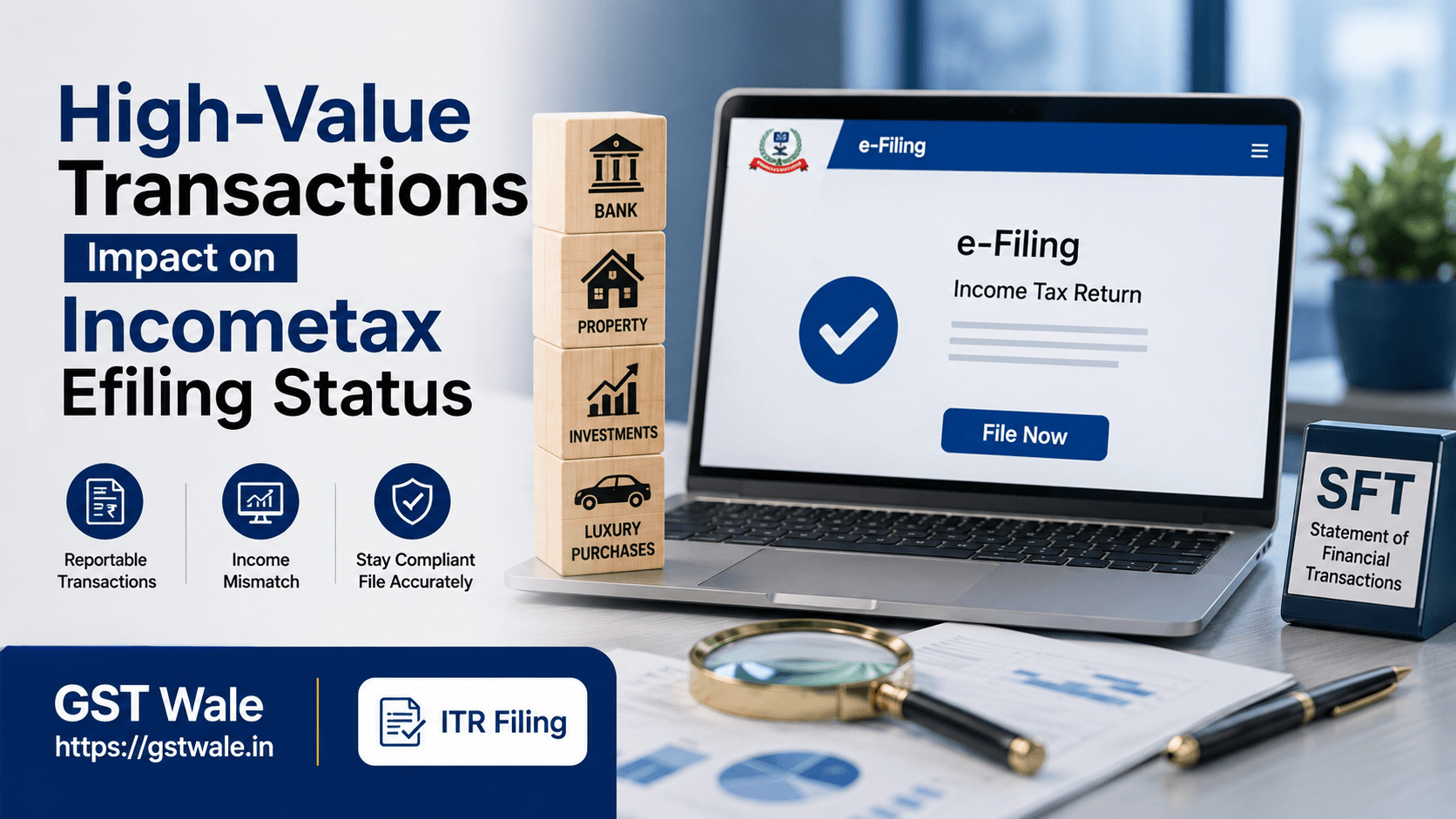
Understanding the Impact of High-Value Transactions (SFT) on Your Incometax Efiling Status
Understanding the Impact of High-Value Transactions (SFT) on Your Incometax Efiling Status
Understanding High-Value Transactions and Incometax Efiling
Have you ever received a message about a high-value transaction in your Annual Information Statement (AIS) and wondered whether it could affect your incometax efiling? If yes, you are not alone. Banks, financial institutions, registrars, mutual funds, stock brokers and other reporting entities share specified financial transaction information with the Income Tax Department under the Statement of Financial Transactions (SFT) framework. The information can then appear in your AIS and influence how your return is reviewed.
When preparing your return, it is therefore important to compare your AIS, Form 26AS, bank records and supporting documents before completing your ITR Filing. A properly prepared incometax efiling should explain your financial activity rather than simply report your income.
What Is SFT and Why Does It Matter for Incometax Efiling?
Statement of Financial Transactions, commonly called SFT, is a reporting mechanism through which specified high-value transactions are reported to the Income Tax Department. The objective is to provide a broader picture of a taxpayer's financial activity and encourage accurate tax reporting.
The information reported through SFT can be reflected in the AIS available on the Income Tax e-Filing portal. The Income Tax Department states that AIS can contain SFT information along with other details such as tax deducted or collected, tax payments, refunds and other information.
This does not mean that every transaction shown in AIS is automatically taxable. That is an important distinction.
For example, receiving money from a genuine loan may not represent taxable income. Similarly, transferring money between your own bank accounts is not automatically income. However, if a transaction appears in AIS and your ITR does not reasonably explain the underlying source or nature of that transaction, it may lead to questions.
That is why reviewing SFT information before incometax efiling has become an important compliance step.
Which High-Value Transactions Can Appear in SFT?
Different types of financial activities can be reported depending on the applicable reporting rules and thresholds. Common examples include:
- Significant cash deposits or withdrawals in specified accounts
- Certain payments towards credit card bills
- Purchase or sale of securities and mutual fund units
- Certain property transactions
- Specified cash payments for goods or services
- Certain foreign currency transactions
- Other reportable financial activities covered by SFT rules
The reporting framework can aggregate transactions of the same nature during the financial year, depending on the applicable category.
For example, an individual's share trading volume may be substantial during a year even if the final taxable profit is comparatively small. The transaction information may still be visible through reporting systems.
Therefore, don't assume that only your taxable income matters during incometax efiling. The tax department can also have information about financial transactions associated with your PAN.
How Credit Card Bills Can Affect Your Tax Profile
Credit card spending is one area where taxpayers sometimes become unnecessarily worried.
Suppose your annual credit card bills are ₹12 lakh, while your salary income is ₹8 lakh. At first glance, this may appear unusual. But it does not automatically mean that you earned ₹12 lakh of undisclosed income.
Perhaps you used accumulated savings, received money from family, sold an investment or made payments on behalf of your business. The important point is whether you can explain the source of funds.
During incometax efiling, taxpayers should therefore review unusually high credit card spending and retain relevant bank statements, payment records and supporting documents.
If the spending is legitimate and properly explainable, the presence of a high-value transaction itself does not necessarily create additional taxable income.
Cash Deposits and the Importance of Source
Cash deposits are another area requiring attention.
Imagine a small business owner deposits ₹15 lakh in cash during the financial year. If the business regularly handles cash sales and the deposits are supported by proper books and sales records, there may be a logical explanation.
On the other hand, if the taxpayer declares a modest income but has substantial unexplained cash deposits, the mismatch can attract attention.
Before incometax efiling, compare your cash deposits with:
- Cash sales and business receipts
- Withdrawals and redeposits
- Cash book records
- Agricultural or other legitimate sources, where applicable
- Supporting invoices and documents
Never create an artificial explanation after receiving a tax notice. Maintain proper documentation throughout the year.
Luxury Purchases and Financial Transactions
Luxury purchases can also become relevant from a financial-profile perspective. Buying an expensive car, jewellery or other high-value goods does not automatically mean that the purchase amount is taxable income.
However, the question is simple: where did the money come from?
For example, suppose a person reports annual taxable income of ₹7 lakh but purchases a luxury vehicle worth ₹25 lakh. The purchase may be perfectly genuine if it was funded through a documented loan, previous savings, sale of an investment or another legitimate source.
The incometax efiling should accurately reflect the taxpayer's income and applicable financial disclosures, while supporting records should establish the source of funds when required.
Property Registration and SFT Reporting
Property transactions are particularly important because property registration involves substantial amounts and information is available with government authorities.
Suppose you purchase a property for ₹70 lakh. The transaction may be reported through the relevant reporting mechanism, and information can subsequently appear in your AIS depending on the applicable rules.
During incometax efiling, ensure that the transaction is consistent with your financial records. If the property was purchased jointly, financed through a home loan or funded partly through earlier investments, maintain documentation showing these facts.
Useful records can include:
- Registered sale deed
- Home loan sanction and disbursement documents
- Bank statements
- Payment receipts
- Evidence of investment redemption
- Documents relating to co-ownership
Good documentation can make the explanation much easier if the transaction is later questioned.
Share Trading Volume Does Not Equal Taxable Profit
Many investors misunderstand this point.
Suppose your share trading volume is ₹80 lakh during the year, but your actual capital gain is ₹3 lakh. The transaction value and taxable profit are two different concepts.
The reporting information may show purchase or sale activity, while your tax calculation depends on the applicable provisions and nature of the transactions.
Before incometax efiling, reconcile your broker statement, contract notes, capital gains statement and bank records. This is especially important for people who trade frequently or have investments across multiple platforms.
A common mistake is to look only at the bank account and ignore the detailed transaction statement.
What Is an Income Mismatch?
An income mismatch occurs when information available with the tax department does not reasonably correspond with the income or transactions reported by the taxpayer.
For example:
AIS shows: High-value securities transactions
ITR shows: Income from salary and a small amount of investment income
This may be completely genuine if the securities transactions relate to investments whose taxable gains are correctly reported.
Another example:
AIS shows: Significant financial activity
ITR shows: Very low income with no supporting explanation
This situation deserves closer review.
An income mismatch does not automatically mean that the taxpayer has committed an offence. It means the information should be examined and reconciled carefully.
How to Check SFT Before Incometax Efiling
A practical approach is to follow these steps.
Step 1: Log in and Review AIS
Access your AIS through the Income Tax e-Filing portal and review the SFT and other reported information. AIS is designed to provide taxpayers with a consolidated view of information available to the department.
Step 2: Compare It With Your Records
Keep your bank statements, broker statements, property documents, loan records, credit card statements and investment statements ready.
Step 3: Identify Differences
Look for transactions that appear unfamiliar, duplicated or incorrect. Do not ignore an unfamiliar entry simply because it is not taxable.
Step 4: Provide Feedback Where Appropriate
AIS provides a mechanism for taxpayers to submit feedback on reported information. The department has stated that AIS can display reported and modified values after considering taxpayer feedback.
Step 5: Reconcile Before Filing
Finally, ensure your income, deductions, capital gains and other relevant disclosures are properly reconciled before submitting your return.
What Should You Do If SFT Information Is Incorrect?
Sometimes information reported in AIS may be incorrect, duplicated or attributable to a transaction that was cancelled or incorrectly linked.
In such cases, first identify the reporting entity and verify the underlying transaction. Keep documentary evidence and use the available AIS feedback mechanism where appropriate.
Do not simply change your ITR to match incorrect information. Your return should reflect your actual tax position, supported by reliable records.
If the difference is significant or complicated, professional advice is sensible before incometax efiling.
Common Mistakes Taxpayers Should Avoid
A few mistakes repeatedly create unnecessary compliance problems:
- Ignoring AIS until after filing the ITR
- Assuming every SFT entry is taxable income
- Failing to reconcile bank and investment transactions
- Treating total transaction value as taxable profit
- Not maintaining documents for large purchases
- Ignoring unexplained income mismatch alerts
- Filing an amended explanation without checking the original records
The safest approach is simple: review first, reconcile second, file third.
FAQs About SFT and Incometax Efiling
Does an SFT entry mean I have to pay tax?
No. An SFT entry generally indicates that a reportable transaction has been communicated to the tax department. Whether it creates taxable income depends on the nature of the transaction and applicable tax provisions.
Can high credit card bills create an income tax problem?
High credit card bills do not automatically become taxable income. However, if your spending is significantly higher than your declared financial resources and there is no reasonable explanation, you should maintain evidence showing the legitimate source of funds.
What should I do if AIS shows an incorrect transaction?
Verify the transaction with the relevant bank, broker or reporting entity. If appropriate, submit feedback through the AIS facility and retain supporting documents. Do not report artificial income merely to match an incorrect entry.
Does high share trading volume mean high taxable income?
No. Trading or transaction volume and taxable profit are different concepts. The correct tax treatment depends on whether the activity represents investments or trading and the applicable tax provisions.
Can property registration information affect my ITR?
Yes, property transactions can be reported through applicable information-reporting systems. You should ensure that the source of funds, ownership details, financing and relevant tax disclosures are properly supported.
Make Your Incometax Efiling Consistent With Your Financial Activity
High-value transactions are not something taxpayers should fear, but they should not be ignored either. The modern tax system uses information from banks, financial institutions, brokers, registrars and other reporting entities to build a broader financial picture.
The key to smooth incometax efiling is consistency. Your declared income, investments, cash deposits, credit card bills, property transactions and other major financial activities should be reasonably explainable and supported by records.
At GST Wale, our approach is simple: understand the numbers, reconcile the information and then file accurately. If you are unsure about an AIS entry, income mismatch or the tax treatment of a high-value transaction, getting professional assistance before filing can save considerable time and unnecessary stress.
For reliable tax compliance and professional support, connect with GST Wale and make your incometax efiling accurate, transparent and hassle-free.
 Previous