


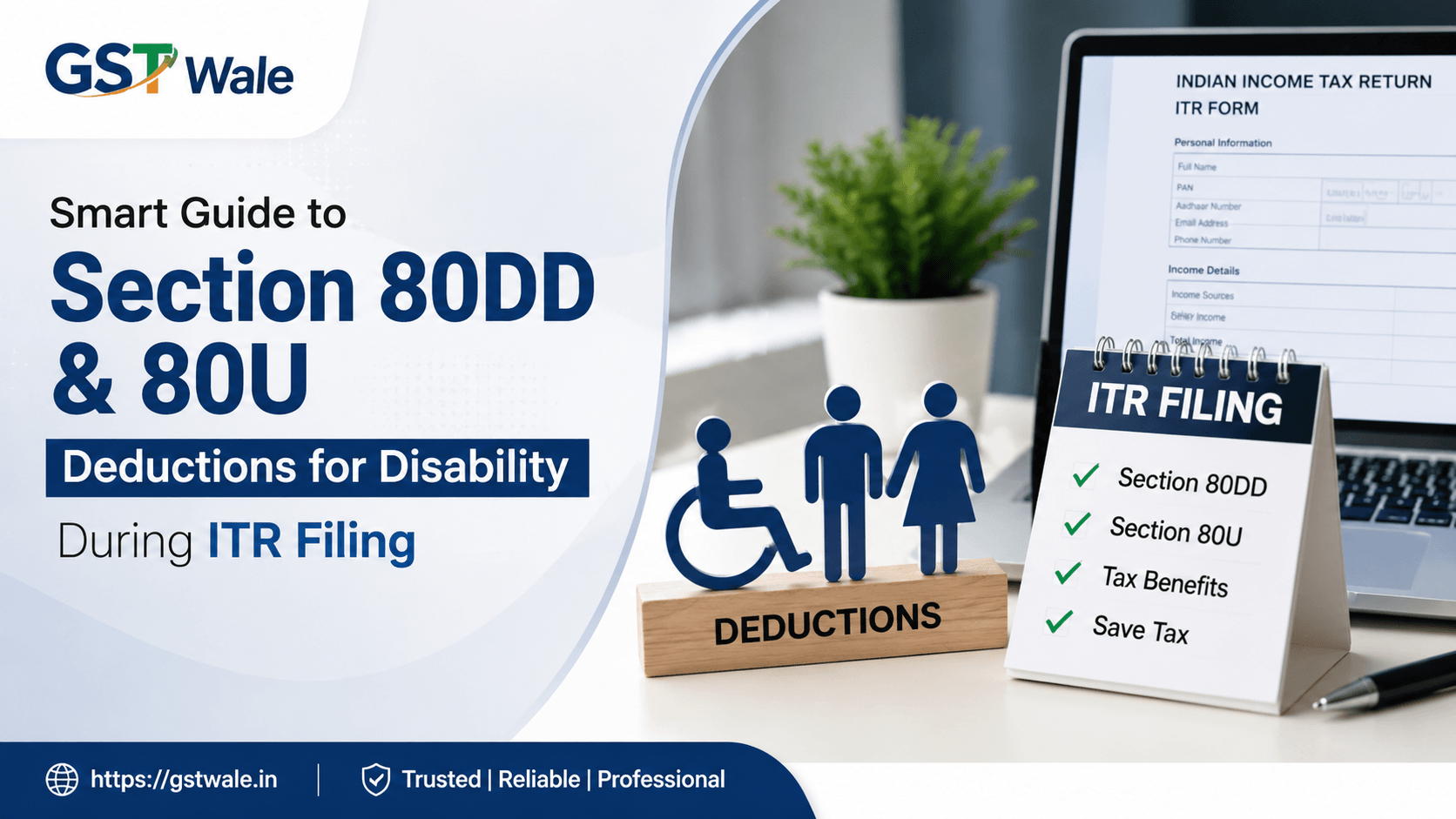
A Smart Guide to Claiming Section 80DD and 80U Deductions for Disability During ITR Filing
A Smart Guide to Claiming Section 80DD and 80U Deductions for Disability During ITR Filing
When it comes to itr filing, many taxpayers miss out on valuable deductions simply because they are unaware of the benefits available under the Income Tax Act. Two important provisions — Section 80DD and Section 80U — provide tax relief for individuals with disabilities and families caring for disabled dependents.
At GST Wale, we regularly help taxpayers maximize legitimate deductions during tax return filing. If you are planning your taxes or preparing documents for ITR Filing, understanding these sections can help you save a significant amount of tax legally and efficiently.
This guide explains everything you need to know about claiming disability-related deductions during itr filing in simple language.
Understanding Section 80DD and 80U in ITR Filing
Both Section 80DD and Section 80U provide tax deductions related to disability, but they apply in different situations.
Section 80DD – For Families Supporting a Disabled Dependent
Section 80DD allows a taxpayer to claim deduction for expenses incurred on the medical treatment, care, training, or rehabilitation of a dependent with disability.
The deduction can also be claimed for contributions made to approved insurance schemes for the disabled dependent.
Who Can Claim Section 80DD?
The following taxpayers are eligible:
- Individual taxpayers
- Hindu Undivided Families (HUFs)
The disabled dependent can be:
- Spouse
- Children
- Parents
- Brothers or sisters
In case of HUF, any dependent member qualifies.
Section 80U – For Individuals with Disability
Section 80U applies when the taxpayer himself or herself is suffering from a disability.
Unlike Section 80DD, this deduction is claimed directly by the disabled individual during itr filing.
Difference Between Section 80DD and Section 80U
| Particulars | Section 80DD | Section 80U |
|---|---|---|
| Who claims deduction? | Family member/HUF | Disabled individual |
| Applicable for | dependent disability | Self disability |
| Need actual expense proof? | Not mandatory | Not mandatory |
| Type of deduction | flat deduction | flat deduction |
One important point to remember is that both deductions cannot be claimed for the same person.
For example:
- If a father claims deduction under Section 80DD for his disabled son, the son cannot separately claim Section 80U for the same disability.
Amount of Deduction Available During ITR Filing
The government provides a fixed deduction amount based on the severity of disability.
For Normal Disability (40% or More)
- Deduction allowed: ₹75,000
For Severe Disability (80% or More)
- Deduction allowed: ₹1,25,000
This is a flat deduction, meaning you can claim the entire amount regardless of actual expenses incurred.
This makes itr filing simpler because taxpayers are not required to calculate every medical bill individually.
What Qualifies as Disability?
The disability must be recognized under the Rights of Persons with Disabilities Act.
Some common disabilities covered include:
- Blindness
- Low vision
- Hearing impairment
- Autism spectrum disorder
- Cerebral palsy
- Mental retardation
- Locomotor disability
- Multiple disabilities
The disability should be certified by an authorized medical authority.
Importance of Disability Certificate During ITR Filing
To claim deductions under Section 80DD or 80U, a valid disability certificate is mandatory.
Documents Required
You should keep:
- Disability certificate from a government hospital
- PAN card
- Aadhaar card
- Medical records if applicable
- Form 10-IA in specified cases
The certificate should clearly mention:
- Nature of disability
- Percentage of disability
- Whether it qualifies as severe disability
When is Form 10-IA Required?
Many taxpayers get confused regarding Form 10-IA during itr filing.
Cases Where Form 10-IA is Necessary
Form 10-IA is generally required for specific disabilities such as:
- Autism
- Cerebral palsy
- Multiple disabilities
The form must be certified by:
- Neurologist
- Civil surgeon
- Chief medical officer
Failing to provide Form 10-IA where applicable may lead to rejection of the deduction claim.
Can You Claim Medical Expenses Separately?
This is one of the most common questions during itr filing.
The answer depends on the section under which you are claiming deduction.
Under Section 80DD
You can claim a medical treatment deduction as part of the overall deduction benefit.
However, the deduction amount remains fixed regardless of actual spending.
For example:
If you spend ₹40,000 or ₹1,00,000 on treatment, the deduction remains:
- ₹75,000 for normal disability
- ₹1,25,000 for severe disability
Step-by-Step Process to Claim 80DD and 80U During ITR Filing
Step 1: Collect Medical Documents
Keep your:
- Disability certificate
- severe disability certificate if applicable
- Form 10-IA
- PAN and Aadhaar details
Step 2: Choose Correct ITR Form
Generally:
- Salaried individuals use ITR-1 or ITR-2
- Business owners may use ITR-3
Selecting the correct form is important for smooth itr filing.
Step 3: Enter Deduction Details
Under Chapter VI-A deductions:
- Select Section 80DD or 80U
- Enter eligible deduction amount
Step 4: Verify Certificate Validity
Ensure the disability certificate is valid on the date of filing.
Expired certificates may create issues during assessment.
Step 5: File and Verify Return
Complete itr filing by:
- E-verification through Aadhaar OTP
- Net banking verification
- Sending signed ITR-V if required
Common Mistakes Taxpayers Should Avoid
At GST Wale, we often notice avoidable errors that lead to notices or rejection of claims.
Claiming Both Sections Together
You cannot claim:
- 80DD and 80U for the same individual simultaneously
Using Expired Certificates
Always renew certificates where validity is limited.
Wrong Disability Percentage
Deduction amount depends on disability percentage.
Incorrect classification may lead to mismatch.
Ignoring Form 10-IA
Certain disabilities specifically require Form 10-IA.
Skipping it can create complications during itr filing.
Real-Life Example for Better Understanding
Let’s understand with a simple example.
Mr. Sharma supports his daughter who has 85% disability. He spends approximately ₹90,000 annually on treatment and rehabilitation.
During itr filing:
- He can claim ₹1,25,000 under Section 80DD
- Actual expense amount does not matter because it is a flat deduction
Now consider another case.
Ms. Neha herself has 50% locomotor disability and works in a private company.
She can directly claim ₹75,000 under Section 80U during itr filing.
Benefits of Proper Tax Planning for Disability Deductions
Correct planning helps taxpayers:
- Reduce tax liability legally
- Avoid notices from Income Tax Department
- Maintain proper documentation
- Improve financial stability for dependent care
Many families underestimate how useful these deductions can be over the long term.
FAQs on Section 80DD and 80U
Can both husband and wife claim Section 80DD for the same dependent?
No. Only one taxpayer can claim deduction for a particular dependent disability.
Is actual medical spending proof mandatory?
No. Both sections provide flat deduction benefits.
Can senior citizens claim these deductions?
Yes, if eligibility conditions are satisfied.
Is Form 10-IA compulsory in all cases?
No. It is required only for specified disabilities.
Can deduction be claimed under the new tax regime?
Currently, Section 80DD and Section 80U deductions are allowed even under the new regime, subject to applicable rules during itr filing.
Understanding Sections 80DD and 80U can make a major difference during itr filing, especially for families managing disability-related expenses and care responsibilities. These provisions are designed to provide financial relief and support taxpayers dealing with long-term medical and rehabilitation needs.
The key is proper documentation, correct deduction selection, and timely filing. Even a small mistake in certificates or forms can delay refunds or trigger unnecessary notices.
At GST Wale, we help individuals, salaried employees, business owners, and families complete accurate itr filing with maximum eligible deductions and full compliance. If you need professional assistance for claiming disability deductions, our experts are here to guide you from start to finish.
 Previous