


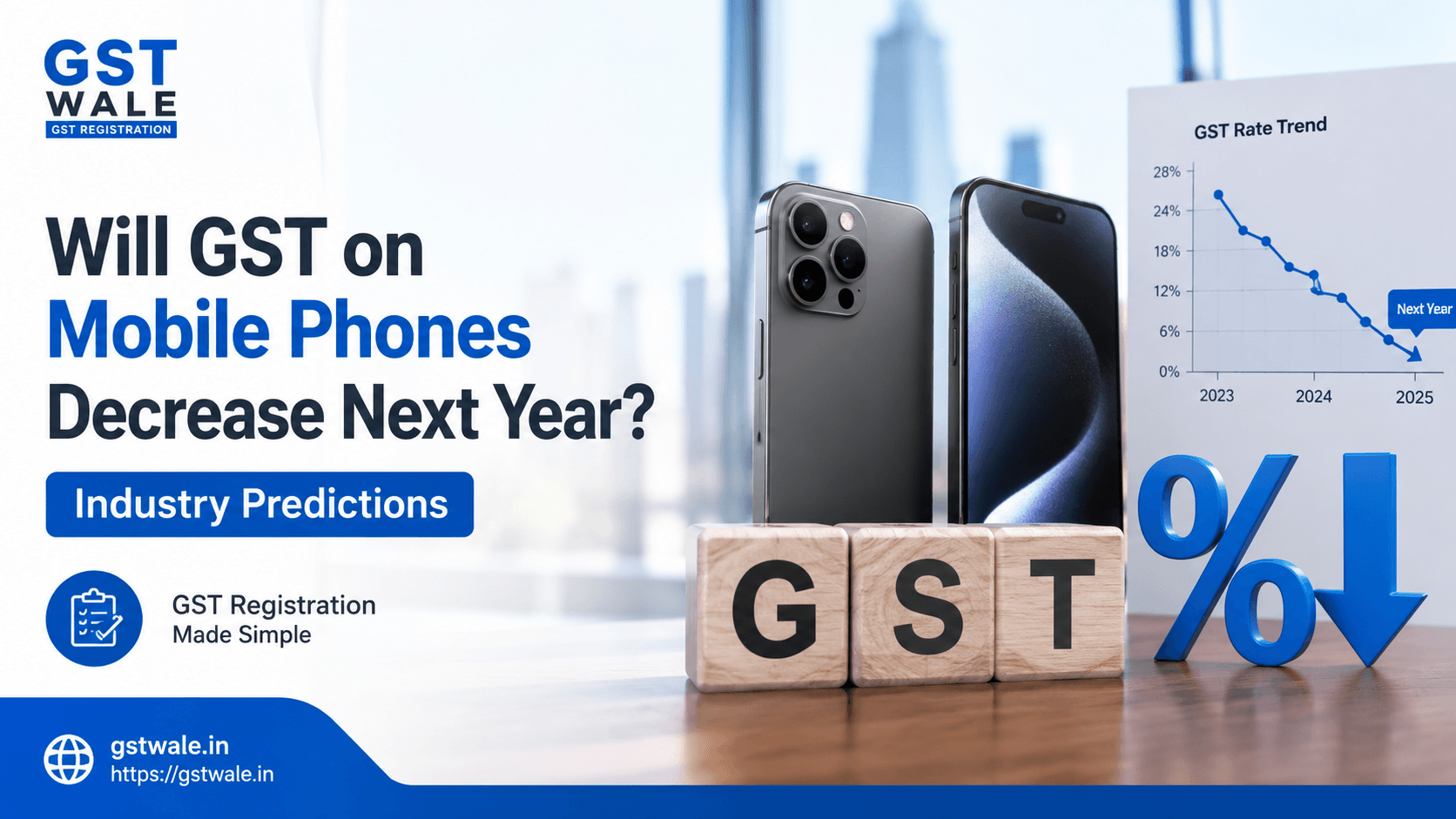
Will GST on Mobile Phones Decrease Next Year? Industry Predictions
Will GST on Mobile Phones Decrease Next Year? Industry Predictions
Every time a major policy discussion hits the news, our desks at GST Wale are flooded with messages from curious retailers, distributors, and everyday smartphone buyers. The burning question lately? "Will the gst on mobile phones decrease next year"
It is a completely valid question. Smartphones are no longer luxury items; they are essential digital infrastructure for everyone from a local kirana shop owner to a corporate professional. If you run a business, staying legally compliant while keeping an eye on these tax shifts is crucial. For instance, when setting up or scaling your business operations, securing a proper GST Registration is the very first step that allows you to legally collect tax and pass on benefits to consumers. Today, we will unpack the current tax structure, look at the latest industry predictions, and decode whether your next smartphone will cost less.
The Current Scenario of GST on Mobile Phones
Right now, the gst on mobile phones stands at a uniform rate of 18% across India. Under the Harmonized System of Nomenclature (HSN) code 8517, this tax rate applies to entry-level feature phones as well as ultra-premium smartphones.
When you purchase a phone locally within your state, this 18% is split evenly as 9% Central GST (CGST) and 9% State GST (SGST). If you are purchasing it online from a seller registered in another state, a single 18% Integrated GST (IGST) is levied on the tax invoice.
Why the Tax Rate Reached 18%
Initially, when the GST regime rolled out, mobile devices were placed under a modest 12% tax bracket. However, during the 39th gst council meet decisions, the government decided to bump the rate up to 18%. The main reason was to correct the "inverted duty structure"—a technical glitch where the tax rate on raw materials and components was higher than the tax rate on the finished product. While this step streamlined tax credits for manufacturing companies, it ultimately made smartphones more expensive for the end consumer.
Will the GST on Mobile Phones Decrease Next Year? Industry Predictions
The Indian cellular market has seen a visible shift over the last few years. According to reports from the Indian Cellular and Electronics Association (ICEA), consumer demand in the entry-level smartphone segment has faced stagnation. As a result, smartphone makers are aggressively pitching for a tax rate revamp.
Here are the key factors driving industry predictions for next year:
1. The Push for a 5% or 12% Special Slab
Industry bodies have formally requested the Ministry of Finance to consider lowering the gst on mobile phones from 18% down to either a midway slab of 12% or an essential slab of 5%. The argument is simple: a lower tax rate will act as a demand stimulus, making digital devices affordable for lower-income groups and reviving the volume of domestic smartphone sales.
2. A Focus on Entry-Level vs. Luxury Segment
One strong rumor circulating in fiscal circles is the possibility of a split rate structure. The GST Council might evaluate keeping premium luxury smartphones (priced above ₹30,000 or ₹50,000) at the 18% slab while reducing the tax on budget phones to 12%. This approach would protect government revenue while providing major relief to mass-market consumers.
3. Deliberations in Upcoming GST Council Meetings
Any final decision regarding a rate cut relies entirely on the gst council meet decisions. While the fitment committee regularly reviews representations from the electronics industry, the government must balance consumer relief against potential revenue losses, which experts estimate could range between $3 billion to $6 billion annually if a flat rate cut is implemented.
Understanding the Interplay: Customs Duty, Incentives, and Budgets
To fully understand smartphone pricing, we cannot look at the gst on mobile phones in isolation. The final price tag on a phone box is shaped by a combination of multiple domestic taxes and import policies.
Custom Duty vs GST
A common point of confusion among business owners is the difference between custom duty vs gst.
Customs Duty: This is an import tax levied when components or fully assembled smartphones enter Indian borders. It is used as a tool to protect domestic manufacturers.
GST: This is a consumption tax levied on the final supply of the good within the country, applied on top of the value including customs duty.
Even if GST remains unchanged at 18%, a reduction in basic customs duty on components instantly brings down the base manufacturing cost, passing on savings to buyers.
Mobile Manufacturing Incentives & Budget Impact
The Indian government has heavily pushed the Product Linked Incentive (PLI) scheme to encourage mobile manufacturing incentives. These schemes offer financial payouts to companies that hit specific production targets within India. Furthermore, positive budget impacts on phones—such as historical duty cuts on camera modules, chargers, and open cells—have successfully helped brands absorb the high 18% GST rate without drastically hiking retail prices.
The Stance of the Mobile Retail Association
Ground-level dealers and traditional brick-and-mortar shop owners are the ones facing the immediate impact of high tax rates. The prominent mobile retail association bodies across India have consistently raised concerns over how the 18% slab impacts their working capital.
When a retailer buys stock, a massive chunk of their capital gets blocked in paying 18% upfront tax to distributors. If the consumer demand slows down, it strains their cash flow. Retail associations strongly advocate for a uniform reduction, arguing that high tax rates inadvertently push low-income buyers toward the unorganized gray market, causing direct losses to honest, tax-paying businesses.
How Businesses Can Offset the Current 18% GST Rate
While we wait to see if the government slashes the tax rates next year, registered businesses do not need to feel the full sting of the 18% rate. You can leverage the Input Tax Credit (ITC) mechanism.
If you purchase a smartphone explicitly for business operations—such as for your sales team, customer support, or official communication—you can claim the full 18% GST paid as credit to offset your outward tax liability.
Essential Checklist to Claim ITC on Mobile Phones:
Ensure the supplier issues a valid Tax Invoice featuring your correct corporate GSTIN and legal name.
The invoice must clearly mention the HSN Code 8517.
The purchase must be reflected in your GSTR-2B statement before you claim the credit in your monthly GSTR-3B filings.
Note: You cannot claim ITC for smartphones purchased for personal or family use.
Frequently Asked Questions (FAQs)
1. What is the current GST rate on mobile phone accessories?
Most essential mobile accessories, including chargers, power banks, lithium-ion batteries, and tempered glass, attract a uniform 18% GST rate.
2. Can I get a refund on GST if I buy a phone during online festive sales?
No, the statutory gst on mobile phones remains fixed at 18% even during sales. However, because e-commerce platforms offer direct discounts on the base price, the actual absolute tax amount you pay naturally goes down.
3. Does the GST rate differ for online and offline phone purchases?
Not at all. The tax rate is identical at 18% nationwide. The only difference is the components shown on the bill: local offline stores charge CGST + SGST, whereas out-of-state online warehouses charge IGST.
4. Will a reduction in GST automatically make iPhones and premium phones cheaper?
If the GST Council introduces a flat rate reduction across all slabs, premium phones will see a sharp price drop. However, if the government decides to reduce rates exclusively for budget smartphones, premium luxury brands may continue to remain at the 18% threshold.
Predicting the exact move of the GST Council is always a calculated guessing game. While the smartphone manufacturing industry is making a powerful case for a rate reduction to kickstart sluggish consumer demand, the central and state governments will likely take a cautious approach to avoid a major dent in monthly tax collections.
Whether the gst on mobile phones drops next year or stays stable at 18%, the best way to safeguard your business profitability is through smart financial compliance. Ensuring your business has clean accounting records, an optimized tax structure, and timely filed returns is the ultimate competitive advantage.
 Previous