


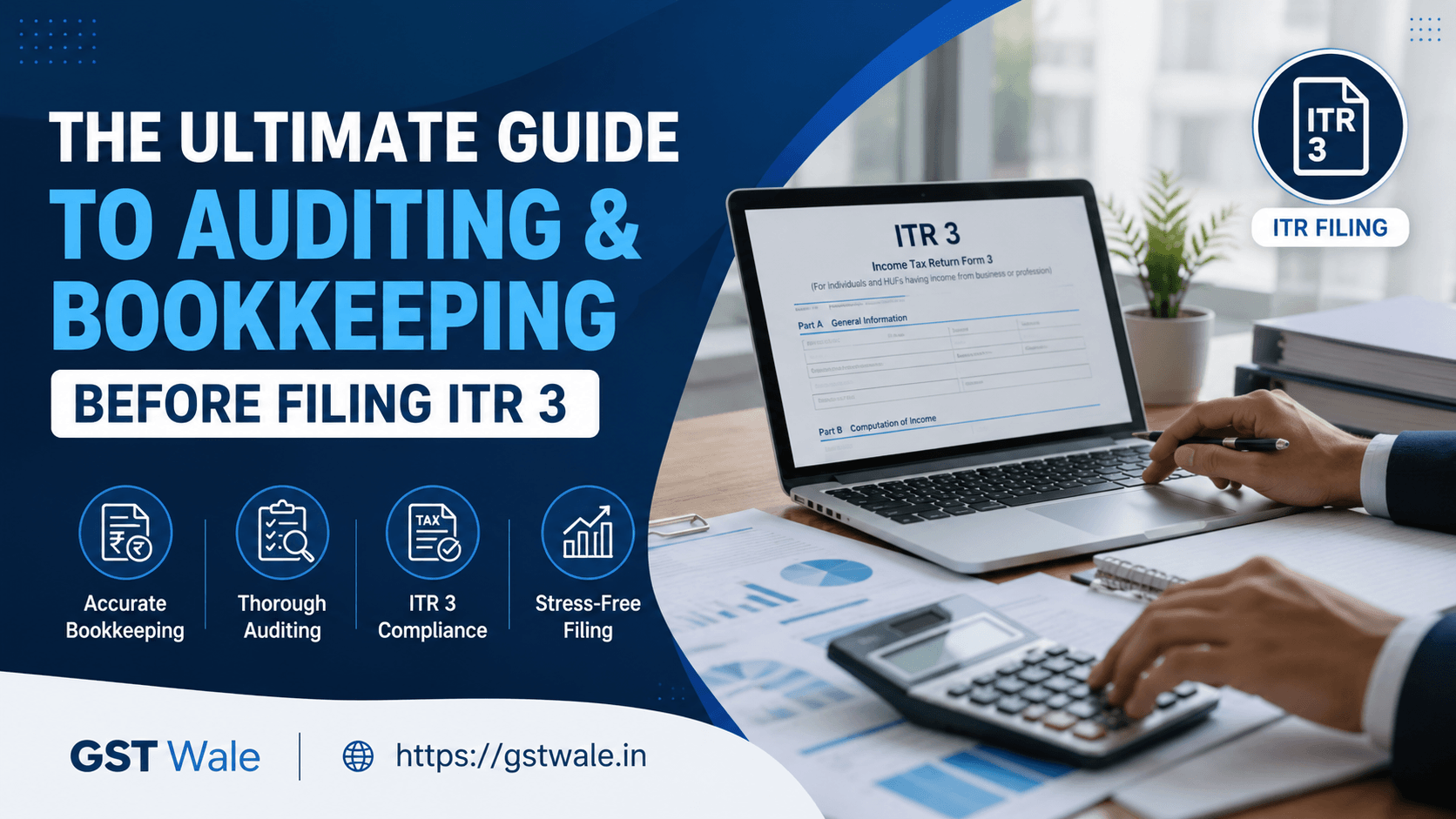
The Ultimate Guide to Auditing and Bookkeeping Before Filing ITR 3
The Ultimate Guide to Auditing and Bookkeeping Before Filing ITR 3
Filing your income tax returns can feel like navigating a maze, especially if you are a business owner, a professional, or a partner in a firm. Among the various tax forms, the itr 3 form is arguably the most comprehensive and detailed. If you have income from a business or profession, this is the form you need to master. However, jumping straight into filing without setting your books in order is a recipe for compliance disasters, steep penalties, and unnecessary income tax notices.
At GST Wale, we interact with hundreds of entrepreneurs who view tax filing as a last-minute scramble. We always tell them the same thing: the secret to a stress-free tax season lies in what you do before you open the e-filing portal. Proper auditing and meticulous bookkeeping are the absolute bedrocks of a successful return. If you want to save yourself from sleepless nights, partnering with experts for professional ITR Filing ensures your accounts are pristine and fully compliant before you submit your details. Let’s break down exactly how you should prepare your books and understand the audit requirements for itr 3.
What is ITR 3 and Who Needs to File It?
The income tax return form known as ITR 3 is tailored specifically for individuals and Hindu Undivided Families (HUFs) who derive income from a proprietary business or profession. Unlike simpler forms like ITR 1 or ITR 4 (which is for presumptive taxation), this itr form leaves no stone unturned.
You must use this specific form if you fall into any of the following categories:
You run a manufacturing, trading, or retail business as a sole proprietor.
You are a practicing professional such as a doctor, lawyer, architect, or chartered accountant.
You are a partner in a partnership firm or an LLP (where you receive salary, bonus, or interest).
You trade in the stock market, specifically dealing in Futures and Options (F&O) or intraday trading, which the Income Tax Department classifies as business income.
You hold directorships in a company or own unlisted equity shares alongside other income sources.
Because it captures balance sheets, profit and loss statements, capital gains, and foreign assets, handling itr 3 requires a much higher level of financial literacy and accounting discipline than ordinary returns.
Clean Bookkeeping: The Foundation of Error-Free Filing
Before you even think about the tax audit thresholds or filling out the schedules of your itr 3 return, you need to look at your ledger. Bookkeeping isn't just about saving invoices in a Google Drive folder; it is about systematic financial tracking.
1. Separate Personal and Business Expenses
This is the most common mistake small business owners make. Paying for a personal family dinner using the business current account complicates your ledger. When you file it returns online, every business deduction claimed must be purely for business purposes. Keep separate bank accounts and credit cards for personal and business use.
2. Reconcile Bank Statements Regularly
Bank Reconciliation Statements (BRS) are your best friend. Ensure that every entry in your bank statement matches your accounting software logs. Unreconciled entries can lead to ghost profits or unexplained cash credits, both of which attract the attention of tax scrutiny officers.
3. Track All Digital and Cash Transactions
With the digital push in India, tracking payments via UPI, net banking, and credit cards has become easier. However, cash transactions still exist. Ensure you maintain a proper cash book with valid vouchers for every cash expense incurred, keeping in mind the statutory limits on cash payments (such as the Rs. 10,000 daily limit per person for business expenses).
Do You Need a Tax Audit Under Section 44AB?
One of the biggest questions we get at GST Wale is, "Do I need a CA to audit my books before I file my itr 3" The answer depends entirely on your turnover or gross receipts. Under Section 44AB of the Income Tax Act, a tax audit is mandatory if:
For Businesses: Your total turnover or gross receipts exceed Rs. 1 Crore in a financial year.
The Digital Boost: This limit is increased to Rs. 10 Crores if your cash receipts and cash payments are both limited to less than 5% of your total transactions.
For Professionals: Your gross professional receipts exceed Rs. 50 Lakhs.
If your business or profession falls under these criteria, a practicing Chartered Accountant must audit your accounts and submit Form 3CD along with Form 3CB (or 3CA) before you proceed with your it filing. Missing the audit deadline carries a penalty of 0.5% of your turnover, up to a maximum of Rs. 1.5 Lakhs.
Step-by-Step Preparation Checklist Before Submitting ITR 3
To ensure a seamless experience when you incometax return online submit your financial data, follow this step-by-step preparation workflow:
Step 1: Finalize the Balance Sheet and Profit & Loss Account
Ensure depreciation on assets is calculated accurately using the Income Tax Act rates, which often differ from the Companies Act rates. Verify that closing stock is valued correctly, as it directly impacts your net profit.
Step 2: Reconcile with Form 26AS, AIS, and TIS
The Income Tax Department knows almost everything about your financial footprint through the Annual Information Statement (AIS) and Taxpayer Information Summary (TIS). Cross-check your recorded TDS (Tax Deducted at Source), TCS, and advance tax payments against Form 26AS. Any mismatch will result in a defective return notice.
Step 3: Classify Share Market Income Properly
If you trade in F&O or intraday, calculate your absolute turnover correctly. F&O trading losses can be carried forward for up to 8 years, but only if you file your itr 3 before the statutory due date.
Step 4: Keep Loan and Interest Certificates Handy
If you have taken business loans, vehicle loans, or home loans, ensure you have the loan interest certificates to claim exact deductions under the appropriate sections.
Frequently Asked Questions (FAQs)
Q1. Can I file ITR 4 instead of ITR 3 to avoid keeping books?
Yes, if your business turnover is under Rs. 2 Crores (or Rs. 3 Crores under specific digital criteria) and you opt for the Presumptive Taxation Scheme under Section 44AD or 44ADA. However, if you want to declare lower profits than the standard 6% or 8% presets, or if you have capital gains and foreign income, you must maintain books and file itr 3.
Q2. What is the deadline for filing ITR 3?
For non-audit cases, the typical deadline is July 31st of the assessment year. For cases where a tax audit is mandatory under Section 44AB, the audit report must be filed by September 30th, and the itr 3 return must be submitted by October 31st.
Q3. What happens if I make an error in my ITR 3 submission?
If you realize you made a mistake after you file it returns online, you can file a Revised Return under Section 139(5) before the end of the relevant assessment year. However, frequent revisions can sometimes act as a red flag for tax systems.
Let GST Wale Handle the Complexity
Preparing your financial statements, reconciling data footprints, choosing the correct tax regime, and executing a flawless itr 3 filing requires dedicated expertise and precision. A single misclassified expense or an overlooked schedule can lead to unnecessary delays or financial penalties.
 Previous