


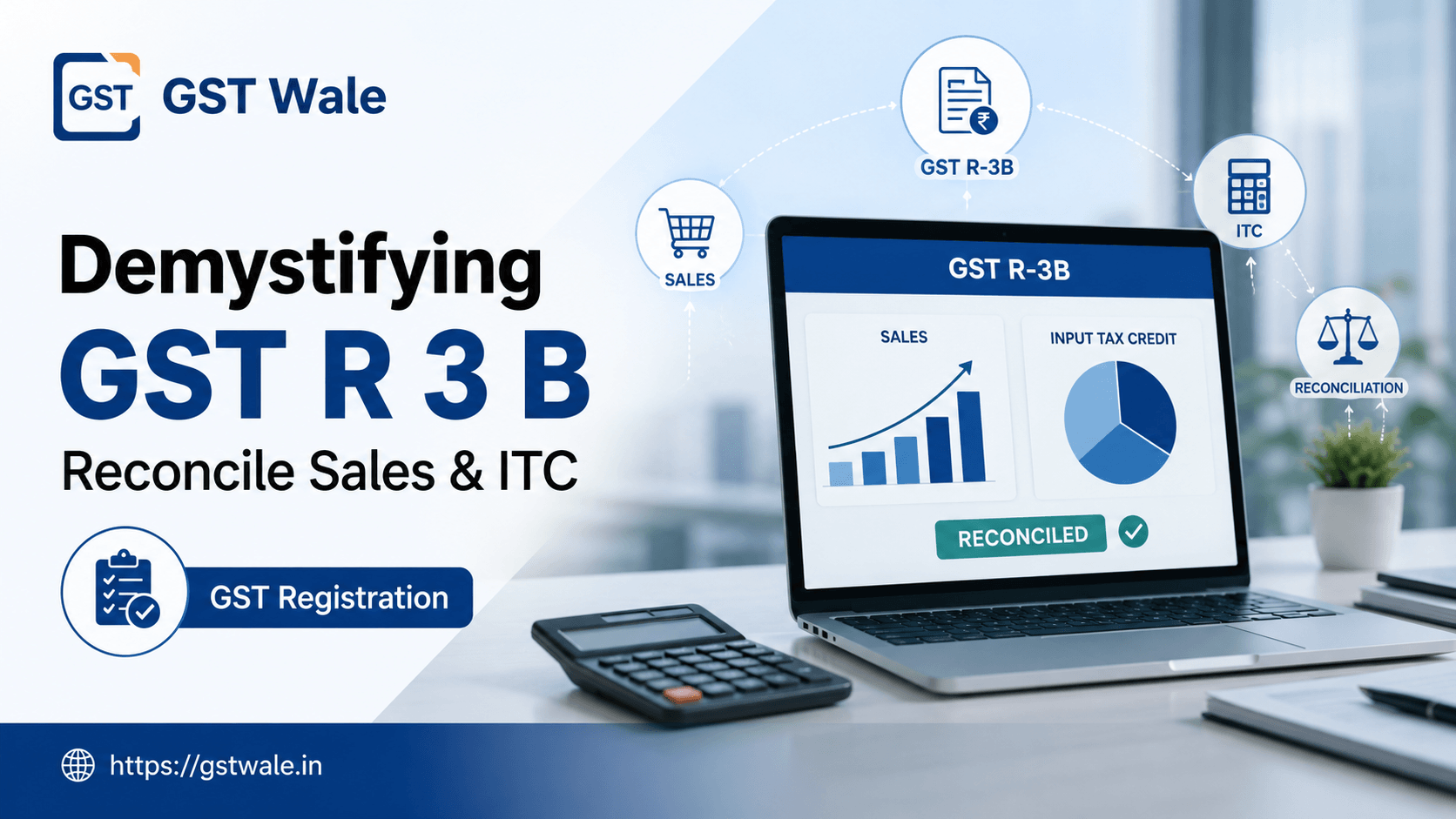
Demystifying GST R 3 B: How to Reconcile Sales and Input Tax Credit
Demystifying GST R 3 B: How to Reconcile Sales and Input Tax Credit
Filing your monthly returns can often feel like walking through a regulatory maze. If you are a business owner in India, one term that probably keeps you up at the end of every month is the gst r 3 b. It is the crucial monthly self-declaration return that every registered taxpayer must file. But let’s be honest: just filing it isn’t enough. The real challenge lies in the background work—specifically, reconciling your sales and Input Tax Credit (ITC).
At GST Wale, we meet countless entrepreneurs who struggle with data mismatches, leading to unnecessary tax notices and penalties. Whether you are a newly established startup that just completed its GST Registration or an established enterprise managing thousands of invoices, getting your monthly return right is non-negotiable. In this comprehensive guide, we will break down the complexities of the return, explain the exact reconciliation process, and help you safeguard your cash flow.
What is the gst r 3 b Return?
Think of the gst r 3 b as a monthly summary of your business's financial health from a tax perspective. Unlike GSTR-1, which is a detailed breakdown of your outward (sales) invoices, this return requires you to report aggregated figures.
You need to declare three main things here:
Your total outward supplies (sales) and the tax collected.
The eligible Input Tax Credit (ITC) you are claiming on your purchases.
The final tax liability to be paid out of pocket after setting off your ITC.
Understanding the standard gstr 3b format is essential. The return is divided into specific tables, such as Table 3.1 for outward supplies, Table 4 for ITC, and Table 5 for exempt or nil-rated supplies. Because it is a summary return, a single wrong entry can skew your numbers, leading to an incorrect ledger balance in gst portal accounts.
The Core Problem: Why Sales and ITC Mismatches Happen
The biggest headache for any taxpayer during the gst r 3 b filing process is a data mismatch. Ideally, your sales books should match your GSTR-1, and your purchase books should match your GSTR-2B. When they don’t, your monthly return becomes a ticking liability bomb.
Mismatches generally happen due to three common reasons:
1. Timing Differences
Your vendor might have made a sale to you in May but forgot to upload the invoice until July. While the purchase sits in your books for May, it won't appear in your GSTR-2B until July, shifting your eligible provisional itc limits and cash flow.
2. Typographical Errors
A minor typo in a GSTIN number or a misplaced decimal point by either you or your supplier can cause the portal to reject or misallocate the tax credit.
3. Missing Reverse Charge Declarations
Failing to identify and report transactions that fall under the reverse charge in 3b (Table 3.1.d) is a very frequent error. If you receive services from an unregistered dealer or specific notified goods, you must pay the tax yourself and then claim it as ITC.
Step-by-Step Guide to Reconcile Sales and ITC for gst r 3 b
Reconciliation isn’t a year-end activity anymore; it is a monthly ritual. Here is the exact, step-by-step workflow we use at GST Wale to ensure error-free filing.
Step 1: Reconcile Outward Supplies (Books vs. GSTR-1 vs. GSTR-3B)
Before you touch the gst r 3 b form, ensure your sales register matches your GSTR-1 perfectly. The portal now auto-populates Table 3.1 of your monthly return based on your filed GSTR-1. If you spot a mistake in the auto-populated data, cross-check your sales register immediately. Never modify the auto-populated figures blindly without finding the source error first.
Step 2: Reconcile Purchase Register with GSTR-2B
GSTR-2B is a static, auto-generated statement that acts as the holy grail for your ITC claims. Compare your internal purchase register against the GSTR-2B line by line.
Matched Invoices: Claim 100% ITC.
Invoices in Books, but missing in GSTR-2B: You cannot claim this ITC yet. Follow up with your vendor to upload their GSTR-1.
Invoices in GSTR-2B, but missing in Books: Verify if it belongs to your business. If yes, record the purchase; if no, mark it as ineligible or reverse it.
Step 3: Compute Your Final Tax Liability
Once your sales and eligible ITC are locked in, check your electronic cash and credit ledger balance in gst portal records. The system will offset your liability using the available credit ledger balance first. If there is a shortfall, you must generate a challan and pay the balance via net banking or over the counter.
Golden Rules for Claiming Input Tax Credit Smoothly
Filing a flawless gst r 3 b requires strict adherence to the dynamic rules set by the government. Over-claiming or under-claiming can both hurt your business.
Abide by Provisional Credit Caps: Gone are the days when you could claim ad-hoc or provisional credit based on your internal books. Tax laws now mandate that you can only claim ITC that strictly reflects in your GSTR-2B. Navigating strict provisional itc limits means any claim beyond what your suppliers have uploaded is illegal.
Track Reverse Charge Efficiently: Always double-check your expenses for legal fees, GTA services, or imports. Failing to declare the reverse charge in 3b means you are underreporting your liability, which attracts immediate department notices.
Check the Vendor's Filing Status: If your supplier files their GSTR-1 but fails to pay their final taxes via their own monthly return, your ITC can be blocked or reversed by the department later.
Expert Advice from GST Wale: Never rely solely on Excel sheets for your monthly reconciliations if your transaction volume exceeds 50 invoices a month. Use robust reconciliation tools or hire professional services to automate the matching process. A single overlooked invoice can lead to an expensive tax dispute.
The Cost of Mistakes: Interest and Penalties
What happens if you file your gst r 3 b late or with errors? The consequences are directly financial.
If you fail to pay your tax liability on time, you are liable to pay interest on delayed payment under Section 50 of the CGST Act. The interest rate is typically 18% per annum on the net tax liability paid through the electronic cash ledger. However, if you wrongly claim and utilize excess ITC, the interest rate can shoot up to 24% per annum.
Furthermore, late filing attracts a daily per-day late fee (up to a maximum capped limit), which accumulates automatically on the portal and must be cleared before your next month's return can be opened.
Frequently Asked Questions (FAQs)
Q1. Can I amend a filed gst r 3 b return?
No, a filed return cannot be revised or amended. Any corrections, omissions, or adjustments must be made in the subsequent month's return by altering the fields or reporting it in the amendment tables of GSTR-1.
Q2. What should I do if my GSTR-2B shows an invoice that doesn't belong to me?
If you see an incorrect invoice in your GSTR-2B, do not claim it in your return. You should mark it as ineligible or reverse the credit in Table 4(B) to maintain a clean ledger balance in gst records.
Q3. Is it mandatory to file a nil return if there are no business transactions?
Yes, filing a nil return is absolutely mandatory even if you had zero sales and zero purchases during the month. Failing to file a nil return will still trigger daily late fees.
Q4. What happens if I forget to declare a reverse charge transaction?
If you miss declaring a reverse charge in 3b, you must declare it in the following tax period. Keep in mind that you will have to pay the tax along with interest on delayed payment for the days delayed, though you can claim the ITC on it in the same return where it is paid.
Let GST Wale Handle the Complexity
Mastering the gst r 3 b return boils down to one fundamental habit: continuous, disciplined reconciliation. Keeping a sharp eye on your vendor behavior, understanding the structure of the gstr 3b format, and monitoring your provisional itc limits will save your business from stressful audits and cash crunches.
However, running a business takes time, and diving deep into tax ledgers every month might not be the best use of your energy. That is where we come in. At GST Wale, our team of experienced tax professionals takes the stress out of compliance. From seamless reconciliation to timely filing, we ensure your business stays 100% compliant, allowing you to focus entirely on growth. Contact GST Wale today, and let the experts handle your tax worries!
 Previous