



GSTR 1 vs GSTR 3B: Key Differences Every Taxpayer Must Understand
GSTR 1 vs GSTR 3B: Key Differences Every Taxpayer Must Understand
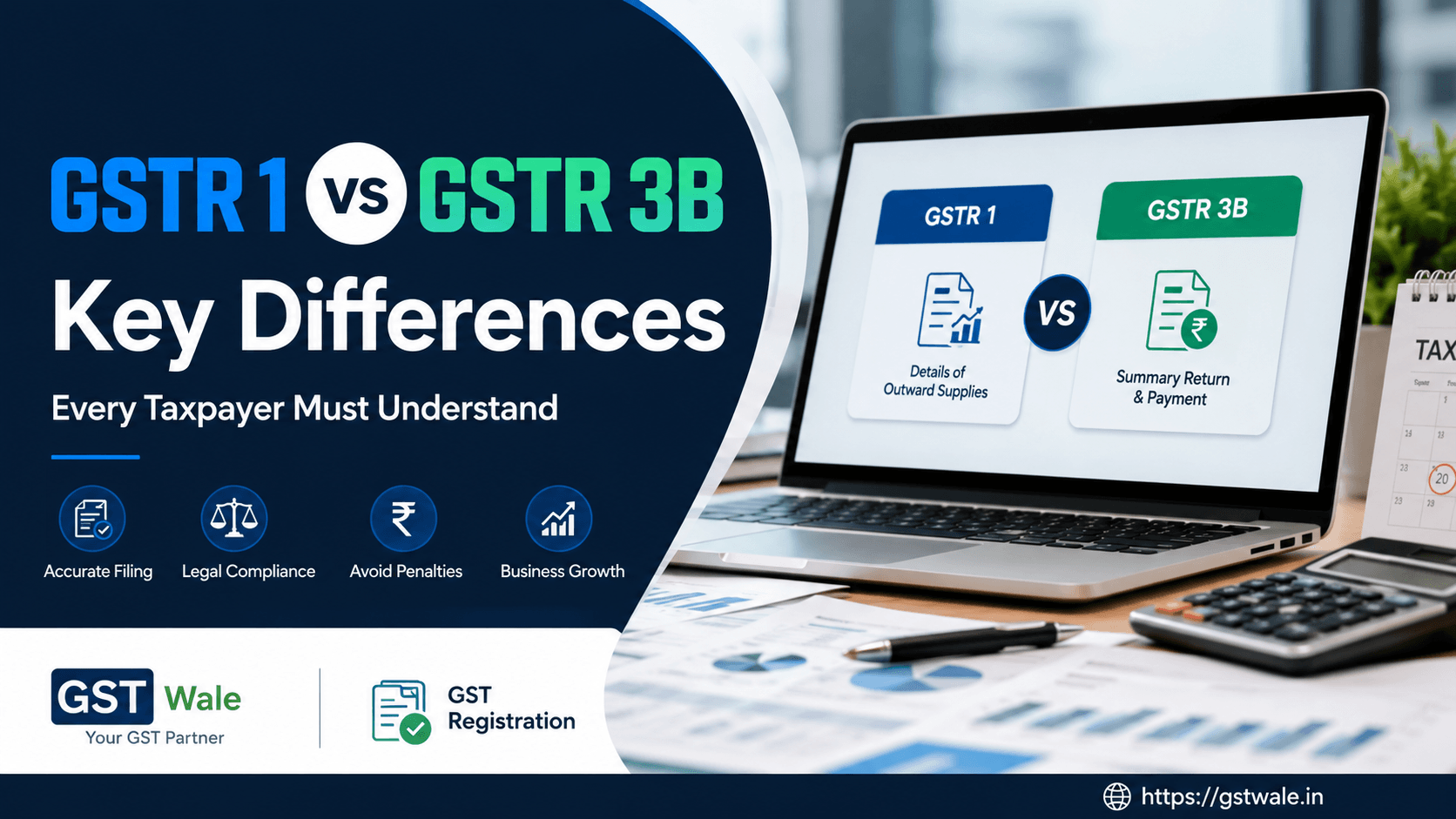
Running a business in India comes with its fair share of exciting milestones, but navigating the compliance landscape can often feel like decoding a complex puzzle. As Chartered Accountants, one of the most frequent points of confusion we encounter among business owners revolves around two fundamental gst return types: GSTR 1 and GSTR 3B. Many taxpayers treat them as interchangeable, or worse, fill them out with different sets of numbers, leading to compliance headaches. If you are just starting out or shifting from the unorganized sector, getting your basic GST Registration sorted is only the first step; understanding how to report your numbers correctly month after month is what keeps your business running smoothly.
At GST Wale, we believe that tax compliance shouldn't feel like a burden. Let’s break down the mechanics of gstr 1 and GSTR 3B so you can stay ahead of the taxman, avoid unnecessary penalties, and keep your cash flow healthy.
What is GSTR 1? The Statement of Outward Supplies
Think of gstr 1 as the detailed blueprint of your sales. It is not a tax payment return; rather, it is a detailed declaration of all your outward supplies (sales) made during a specific tax period (either monthly or quarterly, depending on your turnover and choice of the QRMP scheme).
When you file gstr 1, you are telling the government exactly who you sold goods or services to, the value of those invoices, the rate of tax applied, and the specific GSTINs of your B2B customers.
Key Data Reported in GSTR 1:
B2B Invoices: Sales made to registered businesses (crucial for your buyers to claim input tax credit).
B2C Invoices: Sales made to unregistered individuals or end consumers.
Exports: Goods or services sent outside India.
Credit and Debit Notes: Any adjustments made to previously issued invoices.
The main purpose of gstr 1 is to pass on the Input Tax Credit (ITC) to your business buyers. If you delay filing this return, your buyers won’t see the credit in their GSTR 2B, which can seriously strain your client relationships.
What is GSTR 3B? The Monthly Self-Assessment Summary
If gstr 1 is your detailed sales report, GSTR 3B is your final settlement sheet. GSTR 3B is a monthly self-assessment summary return where you actually calculate your net tax liability and pay it to the government.
Unlike the invoice-level breakdown required in the previous form, GSTR 3B only asks for consolidated, high-level figures.
Key Data Reported in GSTR 3B:
Total taxable value of outward supplies and the corresponding tax liability.
Total Input Tax Credit (ITC) eligible and claimed on inward supplies (purchases).
Net tax payable after offsetting ITC against your output tax liability.
Payment details (paid via cash ledger or credit ledger).
GSTR 1 vs GSTR 3B: The Reconciliation Matrix
To make it incredibly easy to distinguish between the two, the team at GST Wale has put together this simple reconciliation matrix highlighting the core operational differences:
| Feature | GSTR 1 | GSTR 3B |
|---|---|---|
| Core Nature | Detailed statement of outward supplies (sales). | Summary return for tax self-assessment and payment. |
| Level of Detail | Invoice-level breakdown (GSTIN, invoice number, HSN codes). | Consolidated, summary-level figures. |
| Tax Payment | No tax is paid through this return. | Tax must be paid before or during filing. |
| Input Tax Credit | Passes credit to your buyers; does not claim credit for you. | Where you actively claim credit on your purchases. |
| Filing Frequency | Monthly or Quarterly (under QRMP). | Monthly for regular taxpayers (Quarterly for QRMP, though tax payment is monthly). |
| Due Date | Usually the 11th of the next month (for monthly filers). | Usually the 20th of the next month. |
The Pitfall: GSTR 1 and 3B Mismatch
One of the most common triggers for a GST department notice is a gstr 1 and 3b mismatch.
Because gstr 1 records your outward tax obligations and GSTR 3B is where you actually pay them, the total sales tax declared in both forms must match perfectly. If your gstr 1 shows an output tax liability of ₹5,00,000, but your GSTR 3B only shows a payment of ₹4,00,000, the system flags it instantly.
Why do mismatches happen?
Reporting in the wrong month: An invoice generated late in March might accidentally get reported in April's gstr 1 but included in March's GSTR 3B calculations.
Amended invoices: Changing an invoice amount in your sales register but forgetting to update both returns simultaneously.
Clerical errors: Simple data entry mistakes when manually typing figures into the GST portal.
The Consequences of Mismatches & Blocking of GSTR 1
The GST law has become incredibly stringent. Under Rule 59(6) and related provisions, the government has introduced the blocking of gstr 1. If a taxpayer fails to file their GSTR 3B for the preceding month, the portal will automatically block them from filing their subsequent gstr 1.
Furthermore, if there is a massive variance where the output liability in gstr 1 significantly exceeds what was paid in GSTR 3B, authorities can block the generation of your outward return or even suspend your GSTIN. This ensures businesses do not pass on credit via gstr 1 without actually paying the tax via 3B.
Expert Blueprint: How to Avoid Notices
As CAs, our primary advice to clients at GST Wale is to establish a robust monthly routine. Do not wait until the night before the deadline to compile your numbers.
Implement an Internal Reconciliation Matrix: Every single month, map out your total sales register against the auto-populated GSTR 2B (for purchases) and ensure your outward vs inward tax dynamics are perfectly balanced before hitting submit.
Track your E-Way Bills: Ensure that the sales figures reported in your gstr 1 align logically with the E-Way bills generated during the month.
Reconcile Early: Catching an error on the 10th of the month is an easy fix; catching it after the return is submitted means dealing with amendment loops in the subsequent months.
Frequently Asked Questions (FAQs)
Q1: Can I file GSTR 3B without filing my gstr 1?
No. The GST portal enforces a sequential filing rule. You must file your statement of outward supplies (gstr 1) for a given tax period before the system allows you to submit your summary return (GSTR 3B).
Q2: What happens if I make a mistake in my gstr 1?
You cannot revise a filed return under the current GST framework. However, you can rectify the error by filing an amendment in the subsequent month's gstr 1 return under the dedicated amendment tables (like Table 9A/9C).
Q3: Why is my buyer saying they can't claim ITC even though I filed GSTR 3B?
Your buyer's Input Tax Credit is entirely dependent on your gstr 1 filing, not just your GSTR 3B. If you omit their invoice in your gstr 1, or input an incorrect GSTIN, the invoice won't reflect in their GSTR 2B, effectively locking them out of their legitimate tax credit.
Q4: Is there a penalty for late filing?
Yes, late fees apply to both returns. For gstr 1 and GSTR 3B, a daily late fee accumulates up to a maximum capped limit per return, depending on whether you have a tax liability or a 'Nil' return for that tax period. Interest at 18% per annum is also applicable on delayed tax payments via GSTR 3B.
Understanding the distinct roles of your gst return types is the bedrock of strong financial hygiene for your enterprise. gstr 1 is your opportunity to clearly outline your sales narrative to the tax department and ensure your clients get their rightful credits. On the flip side, GSTR 3B is where you balance your outward vs inward tax books and fulfill your financial duty to the nation.
Maintaining a clean sheet without any gstr 1 and 3b mismatch flags requires diligence, time, and precise accounting workflows. If managing these monthly filings, avoiding the dreaded blocking of gstr 1, and keeping up with evolving compliance laws feels like it's taking your focus away from growing your business, let the experts step in. Reach out to GST Wale today, and let our experienced team manage your compliance seamlessly from day one!
 Previous