


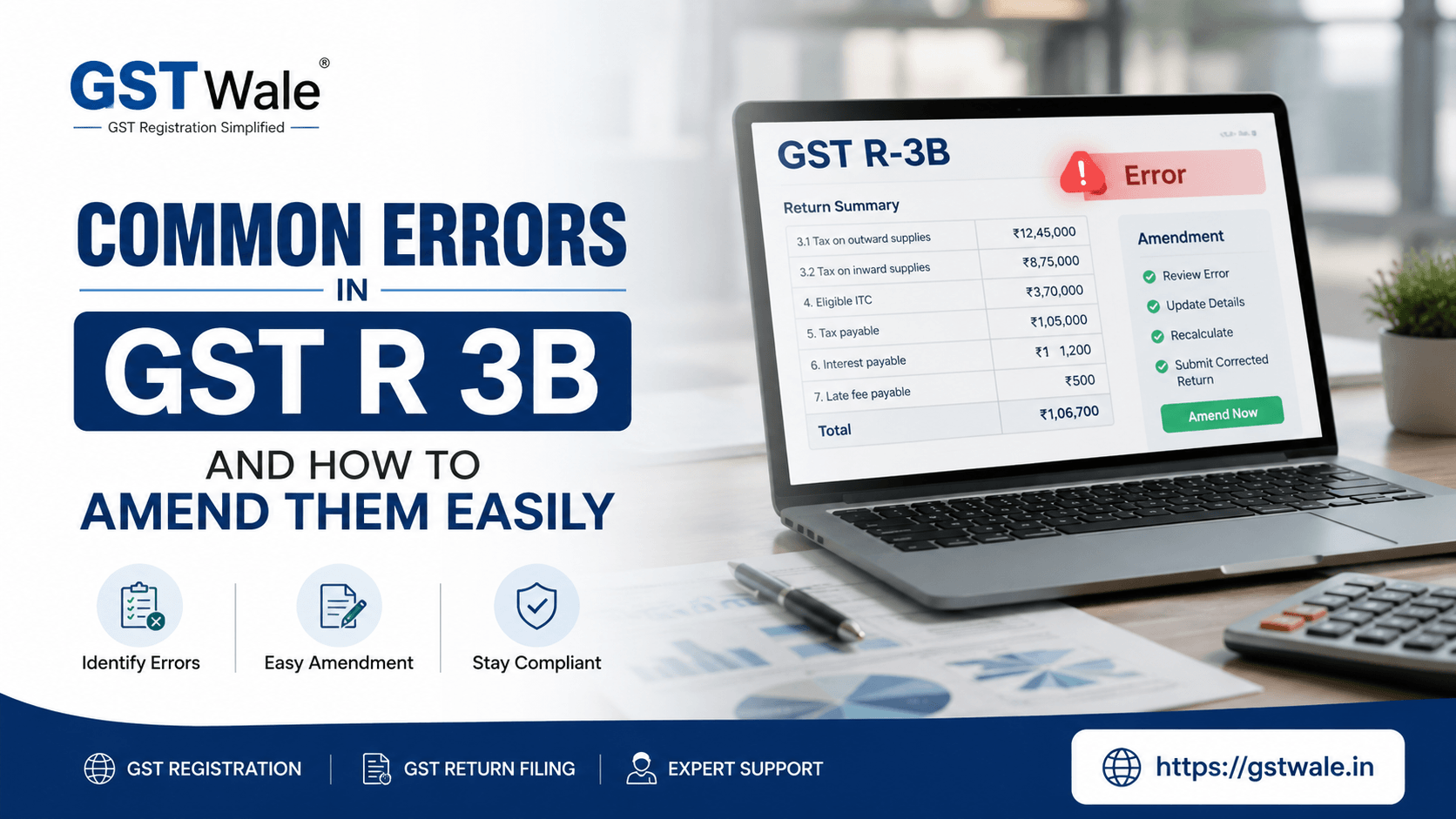
Common Errors in GST R 3b and How to Amend Them Easily
Common Errors in GST R 3b and How to Amend Them Easily
Filing your monthly taxes can sometimes feel like walking a tightrope. Among all the compliance requirements, gst r 3b is undoubtedly the most critical return you file, as it is where you declare your final tax liabilities and claim your Input Tax Credit (ITC). However, even the most meticulous business owners and accountants make mistakes. A single wrong keystroke can lead to an incorrect itc claim or an unexpected tax demand notice from the department.
At GST Wale, we interact with hundreds of entrepreneurs weekly, and we have noticed that a significant number of compliance issues stem from simple, avoidable errors in this monthly summary return. If you are just starting your business journey and have recently obtained your GST Registration, understanding the mechanics of this return is vital to keeping your business fully compliant and stress-free. In this guide, we will break down the most common mistakes made during filing and explain how you can fix them under the current rules.
The Reality of Filing a Monthly Summary Return
Unlike GSTR-1, which is a statement of your outward supplies, the monthly gst r 3b is a self-assessment return where actual cash flows out of your business bank account. Once you hit that submit button, the data freezes, and you cannot simply "delete" or "revise" a filed return for that specific tax period.
Because the GST architecture does not allow a direct revision of a past month's form, handling mistakes requires a strategic approach. You must adjust the figures in the subsequent month's filing. Let's look at the most frequent slip-ups and exactly how to rectify them.
Common Errors Made While Filing gst r 3b
Understanding where things usually go sideways is the first step toward error-free compliance. Here are the most frequent gst portal errors and data mismatches that taxpayers encounter:
1. The Trap of an Incorrect itc claim
This is the single biggest trigger for GST department notices. Taxpayers often claim Input Tax Credit based solely on their purchase invoices without cross-checking Form GSTR-2B. If your supplier fails to upload their invoice or files their returns late, claiming that credit prematurely leads to an incorrect itc claim. Under current regulations, you can only claim ITC that is safely reflecting in your auto-populated GSTR-2B.
2. Mishandling a Credit Note in gstr 3b
When you issue a credit note to a customer due to sales returns or price adjustments, it reduces your overall tax liability. A common mistake is failing to net off this credit note in gstr 3b against the outward supplies of the current month. If your sales returns exceed your current month's sales, entering a negative value can sometimes cause validation errors on the portal if not handled correctly.
3. Inter-State vs. Intra-State Tax Mix-ups
Reporting an inter-state sale (IGST) as an intra-state sale (CGST + SGST), or vice versa, happens more often than you think. While the total tax amount might look identical on paper, the government accounts are completely separate. Paying the wrong head means you still owe tax under the correct head, creating a stressful cash flow mismatch.
4. Overlooking the Reverse Charge Mechanism (RCM)
Many business owners forget that certain services—like goods transport agency (GTA) services or legal services from an advocate—require the recipient to pay tax directly to the government. Failing to declare these liabilities in Table 3.1(d) means you are underreporting your monthly liability.
The gstr 3b amendment rule: How to Fix Mistakes Easily
Since you cannot click a "Revise Return" button, the government introduced a structured mechanism for corrections. The gstr 3b amendment rule essentially allows you to adjust, report, and rectify errors from previous months in your current month's return.
Here is the step-by-step roadmap to fixing your errors seamlessly:
Case A: You Underreported Your Sales Liability
If you forgot to declare an invoice last month, simply add that turnover and the corresponding tax value to Table 3.1 of your current month's gst r 3b.
Expert Note: Keep in mind that you will need to pay interest at 18% per annum on the delayed tax amount, calculated from the original due date until the actual date of payment.
Case B: You Overpaid Your Sales Liability
If you accidentally declared excess sales in a previous month, you can reduce your outward tax liability in the current month's Table 3.1. If the current month's liability isn't enough to absorb the excess, you can carry forward the adjustment to subsequent months or file a refund application.
Case C: You Claimed Excess or Incorrect ITC
If you realize you made an incorrect itc claim in a previous period, you must reverse it in the current month's return under Table 4(B)(2) ("Others"). You will need to pay back the excess credit utilized along with applicable interest to avoid a severe penalty for wrong filing.
Case D: You Missed Claiming Valid ITC
If you forgot to take credit for a valid purchase invoice, you can safely claim it in the current month's Table 4(A)(5) ("All Other ITC"), provided the invoice is visible in your GSTR-2B and falls within the time limit prescribed under Section 16(4) of the CGST Act.
Consequences of Ignoring Errors: Interest and Penalties
Filing an incorrect return and leaving it uncorrected is an open invitation for department scrutiny. The GST portal uses sophisticated data analytics to map your filings, and mismatches quickly flag your account.
Interest on Unpaid Tax: Any short payment or delayed payment of tax attracts interest at 18% per annum.
Interest on Wrongly Utilized ITC: If you make an incorrect ITC claim and actually utilize it to pay off liabilities, you are liable to pay interest at 18% per annum from the date of utilization.
Penalty for Wrong Filing: Under Section 122 of the CGST Act, if a taxpayer suppresses sales or wrongly avails ITC through fraud or willful misstatement, the penalty can go up to 100% of the tax amount involved (subject to a minimum of ₹10,000). For bona fide clerical errors, general minor penalties or late fees may still apply.
Frequently Asked Questions (FAQs)
Q1. Can I revise a filed gst r 3b return directly?
No, a filed return cannot be revised or deleted on the GST portal. Any corrections, additions, or reversals must be done in the return of the subsequent tax month by adjusting the respective tables.
Q2. What is the time limit to rectify errors made in a financial year?
As per the current guidelines, you can rectify errors or claim missed ITC for a particular financial year up to the 30th of November of the following financial year, or the date of filing the Annual Return (GSTR-9), whichever is earlier.
Q3. How should I show a credit note in gstr 3b?
You should reduce the tax liability of the credit note from your total outward taxable supplies in Table 3.1 of the month in which the credit note is issued. Ensure that the corresponding details are also matched in your GSTR-1.
Q4. What happens if my GSTR-1 and gst r 3b data do not match?
If there is a significant variance between the sales reported in GSTR-1 and the tax paid in the summary return, the GST portal will flag it as a mismatch. You may receive an automated system notice (such as Form DRC-01B) asking you to explain the difference or pay the tax deficit.
Let GST Wale Handle Your Compliances
Navigating the gstr 3b amendment rule, calculating precise interest amounts, and constantly matching purchase registers with GSTR-2B can take massive amounts of time away from running your business.
At GST Wale, our team of experienced tax professionals takes the guesswork out of compliance. We ensure that your gst r 3b matches perfectly with your books, helping you avoid an incorrect itc claim and keeping you safe from a steep penalty for wrong filing. Let us handle the portal complexities while you focus on growing your dream business. Reach out to GST Wale today for flawless tax filing and advisory services!
 Previous