


The Essential Guide to Balance Sheet Mapping for ITR 3 Filing
The Essential Guide to Balance Sheet Mapping for ITR 3 Filing
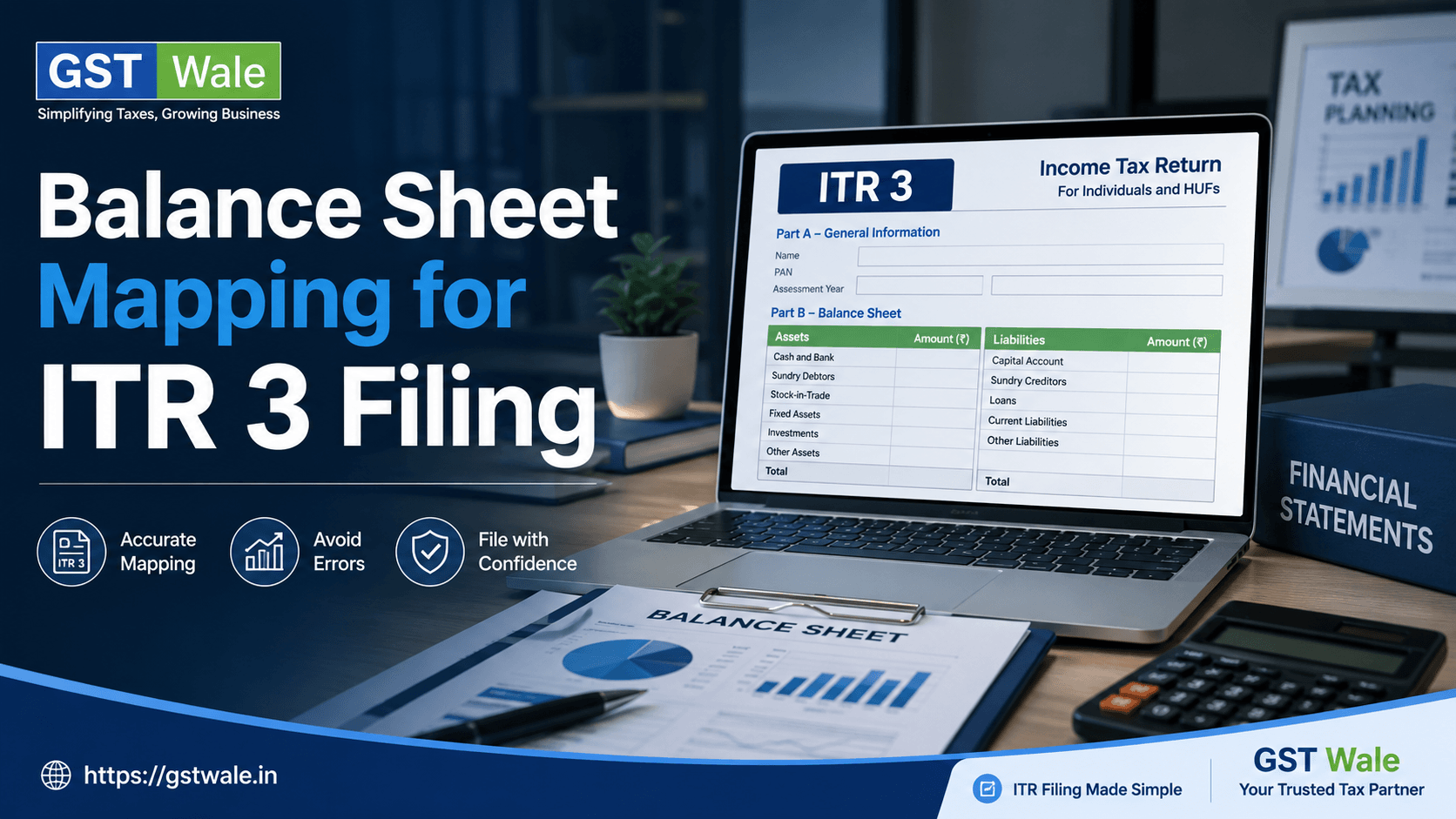
Filing itr 3 can often feel complicated, especially when your return includes business or professional income. One of the most important yet frequently overlooked aspects of the process is balance sheet mapping. Even a small mismatch in financial figures can lead to notices, delays, or unnecessary scrutiny from the Income Tax Department.
At GST Wale, we regularly assist taxpayers, professionals, and business owners in preparing accurate returns. If you are planning your ITR Filing, understanding how your balance sheet should be mapped in itr 3 can save both time and future compliance issues. Whether you are preparing your own income tax return form or working with a tax consultant, this guide will help you understand the essentials in simple language.
What is ITR 3?
itr 3 is an itr form meant for individuals and Hindu Undivided Families (HUFs) who earn income from a proprietary business or profession. It is commonly used by traders, manufacturers, consultants, doctors, lawyers, freelancers, contractors, and other professionals whose income is taxable under the head "Profits and Gains from Business or Profession."
Unlike simpler return forms, itr 3 requires detailed financial information, including:
- Balance Sheet
- Profit and Loss Account
- Business income details
- Depreciation schedules
- Assets and liabilities
- Tax adjustments
This makes accurate financial reporting extremely important.
Why Balance Sheet Mapping Matters in ITR 3
Balance sheet mapping means assigning every financial item to the correct schedule and field in itr 3. The Income Tax Department cross-verifies these figures with your books of accounts and other reported information.
Proper mapping helps you:
- Maintain consistency in financial reporting.
- Reduce the chances of tax notices.
- Avoid validation errors while filing.
- Improve the accuracy of your income tax return form.
- Ensure smoother processing of refunds.
Think of the balance sheet as a financial snapshot of your business. If the snapshot is inaccurate or incomplete, your itr 3 may also become inaccurate.
Key Components of Balance Sheet Mapping in ITR 3
Assets
Every business asset should be correctly classified.
Examples include:
- Cash in hand
- Bank balances
- Sundry debtors
- Stock-in-trade
- Fixed assets
- Investments
- Loans and advances
Each asset must match your books of accounts as on the financial year-end.
Liabilities
Liabilities should also be mapped correctly.
These generally include:
- Capital account
- Secured loans
- Unsecured loans
- Sundry creditors
- Outstanding expenses
- GST liabilities
- Other current liabilities
Incorrect liability reporting often results in inconsistencies during tax assessment.
Capital Account
The capital account deserves special attention in itr 3.
It should accurately reflect:
- Opening capital
- Additional capital introduced
- Business profit
- Drawings
- Closing capital
Any mismatch between the capital account and balance sheet can create unnecessary complications.
How Profit and Loss Connects with the Balance Sheet
One common mistake taxpayers make is treating the Profit and Loss Account separately from the balance sheet.
In reality, both are closely linked.
For example:
- Net profit increases capital.
- Depreciation reduces asset value.
- Outstanding expenses increase liabilities.
- Closing stock affects both trading results and assets.
Before submitting itr 3, always verify that your Profit and Loss Account and balance sheet reconcile perfectly.
Common Balance Sheet Mapping Mistakes
Many taxpayers unknowingly make mistakes while preparing itr 3.
Some common errors include:
- Incorrect opening balances.
- Negative cash balances.
- Wrong classification of loans.
- Missing depreciation adjustments.
- Incorrect stock valuation.
- Capital mismatch.
- Failure to update fixed asset schedules.
- Difference between audited financial statements and tax return.
These errors can easily be avoided through careful review.
Step-by-Step Process for Balance Sheet Mapping in ITR 3
Step 1: Finalise Books of Accounts
Ensure all accounting entries have been completed.
Verify:
- Sales
- Purchases
- Expenses
- Income
- GST adjustments
- Bank reconciliation
Step 2: Prepare Final Financial Statements
Generate:
- Trial Balance
- Profit and Loss Account
- Balance Sheet
Check whether every figure is accurate.
Step 3: Match Every Ledger
Compare ledger balances with the figures entered into itr 3.
This helps eliminate reporting differences.
Step 4: Verify Fixed Assets
Ensure:
- Opening WDV
- Additions
- Sales
- Depreciation
- Closing WDV
are correctly reported.
Step 5: Cross-Check Capital
Verify that:
Opening Capital + Profit + Additional Capital – Drawings = Closing Capital
This simple equation prevents many filing mistakes.
Step 6: Validate Before Submission
Before you file it returns online, use the validation feature available on the Income Tax portal to identify missing or inconsistent information.
Practical Example
Suppose Mr. Raj owns a small trading business.
His books show:
- Cash: ₹1,20,000
- Stock: ₹8,50,000
- Debtors: ₹4,00,000
- Bank Balance: ₹2,30,000
- Creditors: ₹5,00,000
- Capital: ₹12,00,000
- Business Loan: ₹3,00,000
While preparing itr 3, each of these figures must be entered under the correct schedule.
If the capital is mistakenly entered as ₹10,00,000 instead of ₹12,00,000, the entire balance sheet becomes inconsistent. Such errors can trigger validation issues or further queries from the department.
Tips to Avoid Errors While Filing ITR 3
Professional experience shows that careful preparation makes a significant difference.
Keep these tips in mind:
- Maintain updated books throughout the year.
- Reconcile bank accounts regularly.
- Verify GST records before return preparation.
- Review depreciation calculations.
- Preserve supporting documents.
- Match financial statements with tax schedules.
- Double-check balances before submission.
- Keep audit reports consistent with financial statements.
Following these practices makes it filing smoother and more reliable.
Importance of Accurate Financial Records
Businesses often focus only on tax payment while ignoring financial reporting quality.
However, proper bookkeeping offers several advantages:
- Faster loan approvals.
- Better financial planning.
- Easier tax assessments.
- Improved business decision-making.
- Reduced compliance risks.
Accurate records also simplify incometax return online filing and reduce last-minute stress.
When Should You Seek Professional Help?
Although many taxpayers attempt self-filing, professional guidance becomes valuable when:
- Business transactions are complex.
- Multiple income sources exist.
- Capital gains are involved.
- Books require adjustments.
- Audit provisions apply.
- Depreciation calculations are extensive.
- Previous returns need correction.
A tax expert can identify errors before submission and ensure compliance with the latest Income Tax provisions.
FAQs
Who should file ITR 3?
itr 3 is applicable to individuals and HUFs earning income from proprietary business or professional activities along with other eligible sources of income.
Is balance sheet information mandatory in ITR 3?
Yes. Taxpayers maintaining books of accounts are generally required to provide balance sheet and Profit and Loss details in itr 3 as applicable under the Income Tax provisions.
Can incorrect balance sheet mapping result in a notice?
Yes. Incorrect reporting, mismatched figures, or inconsistent financial information may increase the chances of receiving clarification requests or notices from the Income Tax Department.
Can I prepare ITR 3 myself?
Yes, if your accounts are simple and you understand tax reporting requirements. However, businesses with complex transactions often benefit from professional assistance.
Why is reconciliation important before filing?
Reconciliation ensures that your books, bank statements, GST records, and financial statements match the figures reported in your income tax return form, reducing filing errors.
Preparing itr 3 is much more than simply entering financial figures into an online portal. Proper balance sheet mapping ensures that your books of accounts, financial statements, and tax return remain consistent and compliant. Careful verification of assets, liabilities, capital, and business income significantly reduces the chances of filing errors and future tax notices.
At GST Wale, we understand that every business is different. Our experienced tax professionals help individuals, freelancers, and business owners prepare accurate itr 3 returns with complete compliance and peace of mind. If you want a hassle-free filing experience backed by expert guidance, contact GST Wale today and let our professionals help you file your return accurately and on time.
 Previous