


How Independent Directors and Consultants Should Approach Their Annual ITR Filing
How Independent Directors and Consultants Should Approach Their Annual ITR Filing
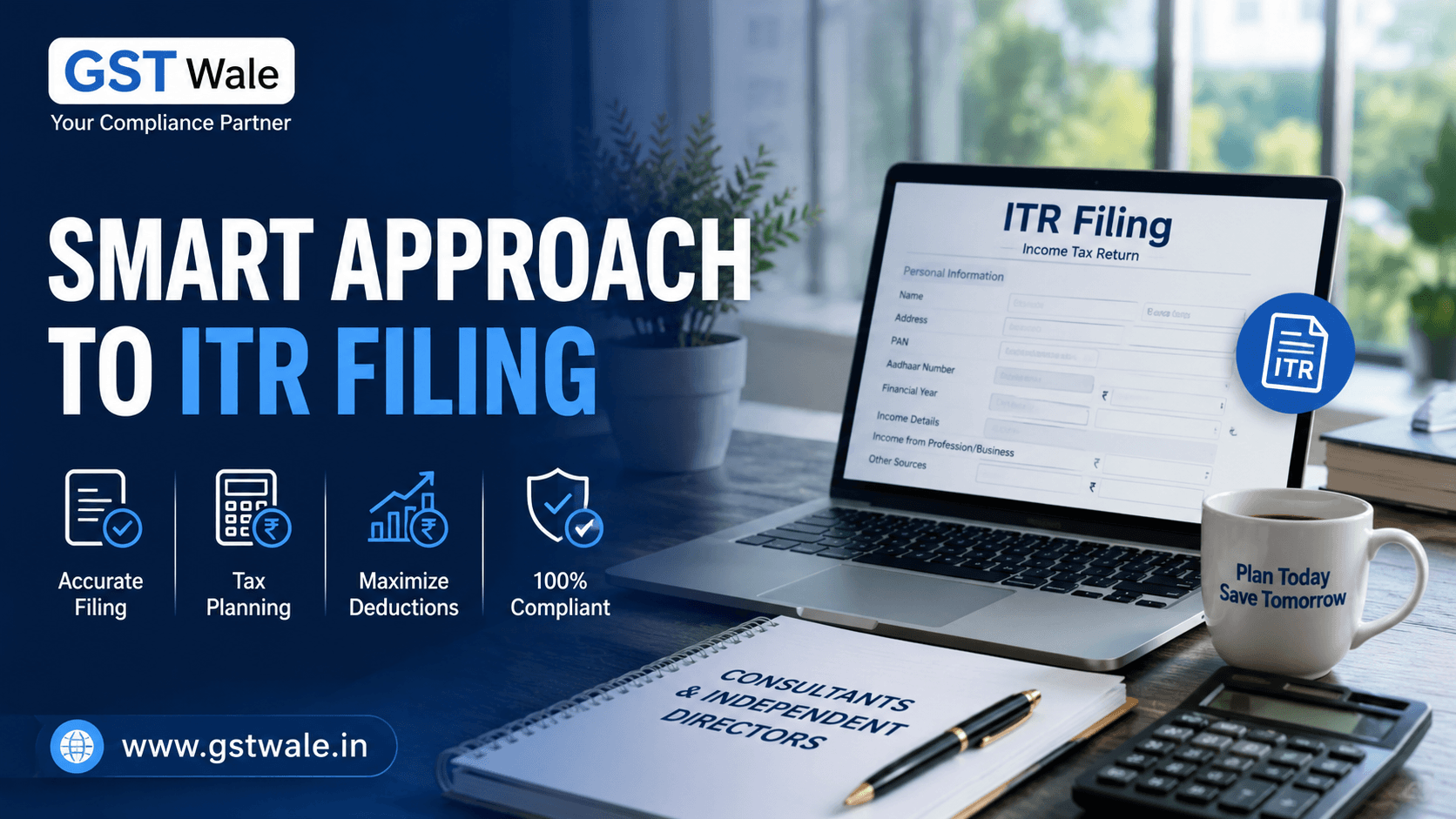
For independent directors and consultants, annual itr filing is not just a compliance activity — it is an important financial responsibility that directly impacts tax savings, credibility, and future financial planning. Many professionals receive income from multiple sources such as consultancy fees, board sitting fees, retainerships, and advisory assignments. Without proper planning, itr filing can become confusing and stressful.
At the same time, the Income Tax Department has increased scrutiny on professional income, GST reporting, and high-value transactions. This makes accurate itr filing more important than ever for independent professionals.
If you are an independent director, management consultant, legal advisor, startup mentor, or freelance expert, understanding the right approach can help you avoid notices, claim eligible deductions, and stay fully compliant. For professional support with ITR Filing, GST Wale helps professionals manage taxation smoothly and efficiently.
Understanding the Nature of Income Before itr filing
One of the biggest mistakes professionals make during itr filing is selecting the wrong income category. Independent directors and consultants generally earn income under:
- Profits and Gains from Business or Profession
- Income from Salary (in specific contractual arrangements)
- Income from Other Sources
In most cases, consultancy income and director remuneration are treated as professional income. Payments received are usually subject to section 194J, where TDS is deducted at 10%.
Before starting itr filing, professionals should carefully reconcile:
- Form 26AS
- AIS (Annual Information Statement)
- Bank statements
- GST returns
- Professional invoices
Mismatch in these records can trigger tax notices or refund delays.
Why Proper Record-Keeping Matters in itr filing
Proper documentation plays a major role in smooth itr filing. Independent professionals often work with multiple clients, making it essential to maintain organized financial records throughout the year.
Important Documents to Maintain
Keep the following records ready:
- Consultancy agreements
- Invoice copies
- TDS certificates
- Bank account statements
- Expense bills
- GST returns
- Investment proofs
When records are incomplete, professionals either pay excess tax or fail to justify deductions during assessments.
Professional Receipts and Their Tax Treatment
Professional receipts include all payments earned for services rendered. These may include:
- Consulting fees
- Advisory retainers
- Director sitting fees
- Project-based payments
- Technical consultancy charges
During itr filing, all professional receipts must match the turnover reflected in GST returns and TDS records.
For example, if a startup consultant raises invoices worth ₹18 lakh and GST returns show the same turnover, the income declared in itr filing should align accordingly. Any mismatch can attract scrutiny.
Role of section 194J in itr filing
Most consultancy payments are covered under section 194J. Clients deduct TDS before making payments to professionals.
Common Issues Professionals Face
Many consultants face these problems:
- TDS deducted but not reflected in Form 26AS
- Incorrect PAN mentioned by clients
- Double reporting of income
- Short deduction of TDS
Before finalizing itr filing, verify every TDS entry carefully. Claiming excess TDS or missing entries can delay refunds significantly.
A practical approach is to maintain a client-wise reconciliation sheet throughout the year instead of waiting till the last minute.
Claiming Business Expenses Deduction Correctly
A major advantage of professional itr filing is the ability to claim legitimate expenses. However, deductions should be reasonable, documented, and connected to professional work.
Commonly Allowed Expenses
Independent directors and consultants can generally claim:
- Office rent
- Internet and mobile bills
- Laptop and software expenses
- Travel expenses
- Professional memberships
- Staff salaries
- Marketing expenses
- Depreciation on assets
A proper business expenses deduction reduces taxable income substantially.
Example of Smart Tax Planning
Suppose a consultant earns ₹25 lakh annually and incurs:
- ₹2 lakh travel expenses
- ₹1 lakh office expenses
- ₹80,000 software costs
- ₹1.2 lakh internet and communication expenses
These eligible deductions can reduce taxable professional income significantly during itr filing.
However, avoid claiming personal expenses as business expenses deduction. This is one of the common reasons for scrutiny notices.
Should You Choose the Presumptive Tax Option?
The presumptive tax option under Section 44ADA is highly beneficial for many consultants and professionals.
What Is the Presumptive Tax Option?
Under this scheme:
- 50% of professional receipts are treated as taxable income
- Remaining 50% is considered deemed expenses
- Detailed expense records may not be required
- Compliance burden reduces significantly
This scheme is available for specified professionals with eligible receipts within prescribed limits.
When the Presumptive Tax Option Works Best
The presumptive tax option is useful when:
- Actual expenses are low
- Compliance simplicity is preferred
- Record maintenance is difficult
- Professional income is consistent
For example, a management consultant earning ₹20 lakh with minimal operational expenses may benefit from the presumptive tax option during itr filing.
When It May Not Be Suitable
Avoid the presumptive tax option if:
- Actual expenses are very high
- You want to show lower profits
- You plan to claim depreciation separately
- You require detailed financial statements for loans or investors
Choosing between regular taxation and presumptive taxation should be based on proper tax analysis.
Importance of GST Integration in itr filing
Today, GST integration has become a critical compliance factor. Income disclosed in GST returns should closely match professional income declared during itr filing.
Common GST Integration Mistakes
Professionals often make these errors:
- Declaring different turnover in GST and ITR
- Missing GST invoices
- Incorrect reporting of export services
- Ignoring reverse charge liabilities
The Income Tax Department increasingly cross-verifies GST integration data with tax returns. Even small inconsistencies can trigger automated notices.
Practical Compliance Tip
Always reconcile:
- GSTR-1 turnover
- GSTR-3B turnover
- Form 26AS receipts
- Professional receipts in books
This single practice can prevent major compliance issues during itr filing.
Advance Tax Responsibilities for Consultants
Unlike salaried employees, consultants and independent directors usually need to pay advance tax.
If tax liability exceeds prescribed limits, advance tax must be paid in installments during the financial year.
Failure to pay advance tax may result in:
- Interest penalties
- Increased tax burden
- Cash flow issues
Professionals should estimate annual income quarterly and plan tax payments proactively.
Common Mistakes to Avoid During itr filing
Many professionals unknowingly make avoidable errors.
Key Mistakes Include
- Selecting the wrong ITR form
- Ignoring foreign income disclosure
- Missing TDS reconciliation
- Claiming unsupported deductions
- Incorrect GST integration reporting
- Delaying itr filing till the deadline
Timely and accurate filing improves financial credibility and reduces compliance stress.
FAQs on itr filing for Independent Directors and Consultants
Which ITR form is generally applicable for consultants?
Most consultants and independent professionals usually file ITR-3 or ITR-4 depending on whether they opt for regular taxation or the presumptive tax option.
Can independent directors claim business expenses deduction?
Yes, legitimate professional expenses related to consultancy or advisory work can be claimed as business expenses deduction during itr filing.
Is GST integration important in income tax returns?
Absolutely. GST integration ensures turnover consistency between GST returns and income tax filings, reducing notice risks.
What happens if section 194J income is missed?
Missing income covered under section 194J can lead to tax notices, mismatch issues, and additional tax liabilities.
Is the presumptive tax option suitable for all consultants?
No. The presumptive tax option works best when actual business expenses are relatively low and simplified compliance is preferred.
For independent directors and consultants, itr filing should never be treated as a last-minute activity. Proper planning, organized records, accurate GST integration, and smart use of deductions can significantly improve tax efficiency and compliance.
With evolving reporting requirements and increased data matching by tax authorities, professional guidance has become more valuable than ever. Whether it is handling section 194J reconciliation, selecting the right presumptive tax option, or maximizing business expenses deduction, expert support can help avoid costly mistakes.
At GST Wale, we help consultants, freelancers, and independent directors manage their itr filing with accuracy, transparency, and practical tax planning. A well-filed return not only ensures compliance but also strengthens your financial profile for future growth.
 Previous