


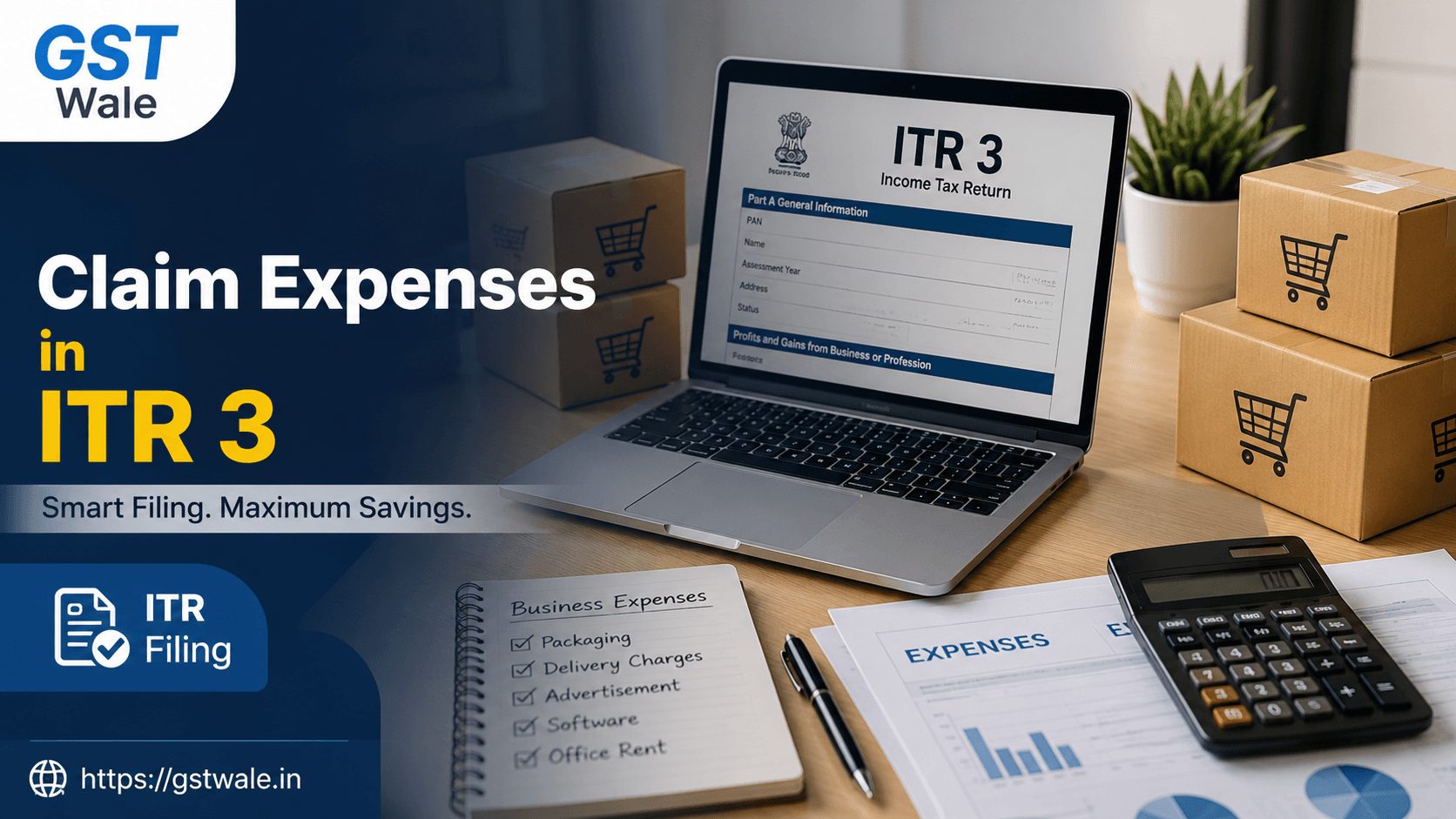
How E-Commerce Sellers Can Correctly Claim Business Expenses in ITR 3
How E-Commerce Sellers Can Correctly Claim Business Expenses in ITR 3
If you run an online business through marketplaces like Amazon, Flipkart, Meesho, Myntra, or your own website, filing your income tax return correctly is just as important as managing sales. Many e-commerce sellers focus only on turnover and profits but overlook legitimate business expenses while filing itr 3. This can result in paying more tax than necessary or facing unnecessary notices from the Income Tax Department.
At GST Wale, we regularly help online sellers prepare accurate tax returns by identifying eligible deductions and maintaining proper documentation. If you are looking for professional assistance with ITR Filing, our experts can help you file the correct income tax return form while ensuring compliance with tax laws.
What is ITR 3 and Who Should File It?
itr 3 is the income tax return form meant for individuals and Hindu Undivided Families (HUFs) earning income from business or profession. Most e-commerce sellers operating as sole proprietors are required to file itr 3 if they maintain regular books of accounts and declare business income under the normal provisions of the Income Tax Act.
If your online business includes buying and selling products, inventory management, digital marketing, logistics, and customer service, chances are that itr 3 is the appropriate itr form for your tax filing.
Why Correctly Claiming Business Expenses Matters in ITR 3
Every genuine business expense reduces your taxable profit. If you miss eligible expenses while preparing itr 3, you may end up paying higher income tax than required.
However, only expenses incurred wholly and exclusively for business purposes should be claimed. Personal expenses should never be included in your business accounts.
Maintaining accurate records also makes future assessments much easier and builds confidence during any tax scrutiny.
Common Business Expenses E-Commerce Sellers Can Claim in ITR 3
1. Marketplace Commission
Marketplaces like Amazon, Flipkart, and Meesho charge commission on every order. These charges are legitimate business expenses and should be properly reflected while preparing itr 3.
2. Shipping and Delivery Charges
If your business bears courier or logistics costs, these expenses are deductible. Preserve courier invoices and payment records for future reference.
3. Packaging Material
Boxes, bubble wrap, tapes, labels, cartons, and protective packaging purchased for customer deliveries qualify as business expenses.
4. Product Purchase Cost
The cost of inventory purchased for resale forms a major component of your business expenditure. Proper inventory records should match your purchases and sales.
5. Warehouse and Storage Rent
If you rent a warehouse or storage facility for inventory management, the rental expense can be claimed in itr 3.
6. Office Rent and Utilities
If you operate from an office, eligible expenses include:
- Office rent
- Electricity bills
- Internet charges
- Water expenses
- Office maintenance
If you work from home, only the business-use portion should generally be considered where appropriate and properly supported.
7. Employee Salaries
Payments made to staff involved in packing, customer support, accounting, inventory management, or administration are allowable business expenses.
8. Digital Marketing Expenses
Most online sellers spend significantly on advertising. Expenses such as:
- Google Ads
- Facebook Ads
- Instagram promotions
- Influencer marketing
- SEO services
can normally be claimed while filing itr 3, provided they are incurred for business promotion.
9. Professional Fees
Payments made to Chartered Accountants, lawyers, consultants, software developers, designers, or compliance professionals for business purposes are deductible.
10. Software and Subscription Charges
Modern e-commerce businesses rely heavily on software. Eligible expenses may include:
- Accounting software
- Inventory management software
- CRM subscriptions
- Email automation tools
- Business productivity software
Expenses That Should Not Be Claimed in ITR 3
One of the most common mistakes during it filing is mixing personal and business expenses.
Avoid claiming:
- Personal shopping
- Family travel
- Personal mobile purchases
- Household groceries
- Personal entertainment expenses
- Personal clothing not related to business
Maintaining a separate business bank account helps keep records clean and accurate.
Maintain Proper Documents Before Filing ITR 3
Good documentation is essential for preparing an accurate itr 3.
Keep the following records safely:
- Purchase invoices
- Sales reports
- Marketplace settlement reports
- GST invoices
- Courier bills
- Salary records
- Rent agreements
- Bank statements
- Digital payment records
- Advertising invoices
Well-maintained records reduce errors in your income tax return form and simplify future compliance.
Step-by-Step Process to Claim Business Expenses in ITR 3
Step 1: Organise Financial Records
Collect all income and expense documents for the financial year.
Step 2: Prepare Profit and Loss Statement
Calculate total sales, deduct allowable business expenses, and determine net profit.
Step 3: Verify TDS and Tax Credits
Cross-check your Form 26AS and Annual Information Statement before preparing your itr form.
Step 4: Match Business Income
Ensure your turnover matches marketplace reports, bank credits, and accounting records.
Step 5: File the Correct Return
Submit itr 3 using accurate figures and complete disclosure. Many taxpayers now prefer to file it returns online through the official portal with proper verification.
Example: How Claiming Expenses Reduces Tax
Suppose Rahul sells electronics through Amazon.
His annual turnover is ₹40 lakh.
During the year, he incurs:
- Marketplace commission – ₹2,00,000
- Advertising – ₹1,20,000
- Packaging – ₹80,000
- Courier charges – ₹1,10,000
- Office rent – ₹1,80,000
- Professional fees – ₹50,000
These genuine business expenses significantly reduce taxable income. Proper reporting in itr 3 ensures Rahul pays tax only on his actual business profit rather than his gross receipts.
Common Mistakes E-Commerce Sellers Make
- Claiming personal expenses as business expenses.
- Ignoring marketplace commission deductions.
- Not preserving invoices.
- Mismatch between GST turnover and income tax records.
- Incorrect selection of income tax return form.
- Skipping reconciliation before incometax return online submission.
- Not reporting all business income.
FAQs
Is ITR 3 mandatory for all e-commerce sellers?
No. It depends on the nature of your business, accounting method, and tax provisions applicable to you. Many sole proprietors maintaining books of accounts use itr 3.
Can I claim mobile and internet expenses?
Yes. If they are used for business purposes, the business-related portion can generally be claimed while preparing itr 3.
Can advertising expenses be deducted?
Yes. Expenses on Google Ads, Meta Ads, influencer promotions, and other genuine business marketing activities are generally allowable if properly documented.
Do I need invoices for every expense?
Maintaining invoices, bills, payment proofs, and bank records is highly recommended as they support the expenses claimed in your income tax return form.
Can I complete incometax return online myself?
Yes. You can complete incometax return online yourself if you understand the tax provisions and maintain proper records. However, professional assistance helps minimise errors and ensures eligible deductions are not missed.
Conclusion
Preparing itr 3 correctly is not just about reporting sales—it is about accurately presenting your business income after claiming all genuine and legally allowable expenses. Proper bookkeeping, supporting documents, and careful reconciliation can reduce your tax liability while keeping your return fully compliant.
Whether you are a new online seller or an experienced e-commerce entrepreneur, GST Wale can help you prepare the correct itr form, complete accurate it filing, and ensure your return is filed without unnecessary errors. Our experienced tax professionals provide practical guidance tailored to your business so you can focus on growing your online venture with confidence.
 Previous