


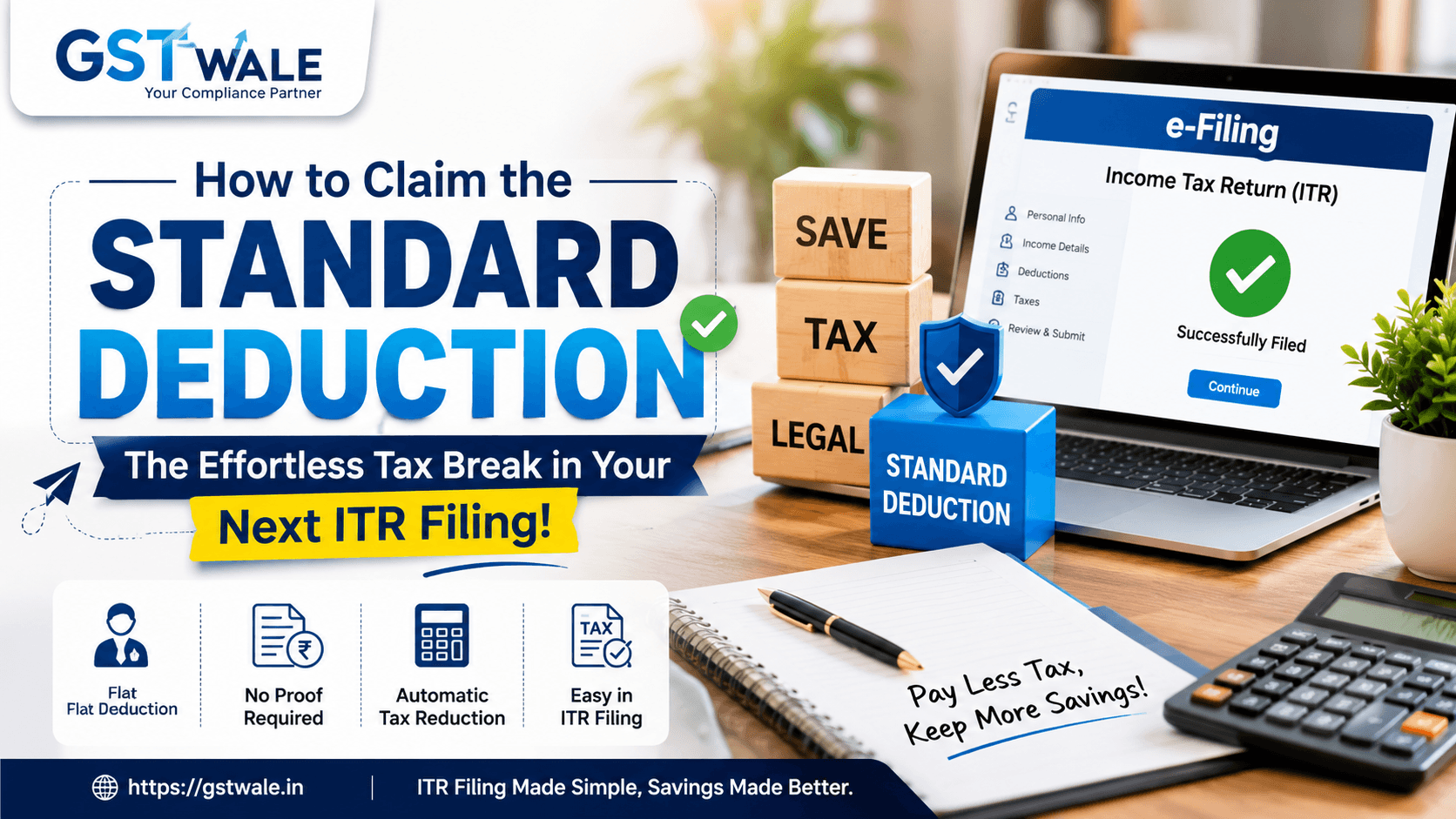
How to Claim the Standard Deduction: The Effortless Tax Break in Your Next ITR Filing
How to Claim the Standard Deduction: The Effortless Tax Break in Your Next ITR Filing
When it comes to itr filing, most taxpayers focus heavily on investments, deductions under Section 80C, or tax-saving insurance plans. However, one of the easiest and most beneficial tax breaks available today is the standard deduction. The best part? You do not need to submit bills, proofs, or lengthy documentation to claim it.
At GST Wale, we regularly guide salaried employees and pension earners who unknowingly miss out on valuable tax reduction opportunities simply because they are unaware of how the standard deduction works. If you are planning your next itr filing, understanding this effortless benefit can help you save money without additional investments.
For individuals looking for professional assistance with ITR Filing, expert guidance can make the process faster, more accurate, and stress-free.
What is Standard Deduction in itr filing?
The standard deduction is a flat deduction allowed by the Income Tax Department to eligible taxpayers. It directly reduces your taxable salary income without requiring any proof of expenses.
In simple words, during itr filing, the government automatically allows a fixed deduction amount from your salary or pension income before calculating tax liability.
Currently, the standard deduction is available to:
- Salaried individuals
- Pension earners
- Family pension recipients (subject to certain conditions)
This deduction was introduced to simplify tax compliance and reduce paperwork for taxpayers.
Current Standard Deduction Limit
Under the latest tax provisions, eligible taxpayers can claim:
- ₹50,000 standard deduction under the old tax regime
- Enhanced benefits under certain revised new regime rules, depending on the applicable financial year announcements
Since tax laws are updated periodically, taxpayers should always verify the latest limits before itr filing.
Why Standard Deduction Matters During itr filing
Many taxpayers wrongly assume that tax saving only comes from investments. In reality, the standard deduction offers an automatic calculation-based benefit that reduces taxable income instantly.
Key Advantages
No Investment Required
Unlike ELSS, PPF, or life insurance deductions, this benefit does not require you to spend money.
No Documentation Hassle
There is no need to keep receipts or submit expense proofs during itr filing.
Automatic Tax Reduction
Your employer often considers this deduction while preparing Form 16, making the process smoother.
Helpful for Pension Earners
Retired individuals receiving pension income can also enjoy this benefit.
Who Can Claim Standard Deduction?
Understanding eligibility is important before itr filing.
Salaried Individuals
Anyone earning salary income from an employer can claim this deduction.
Examples include:
- Private employees
- Government employees
- PSU employees
- Directors receiving salary
Pension Earners
Retired individuals receiving pension from former employers are also eligible because pension is taxable under “Income from Salary.”
Family Pension Cases
Family pension recipients cannot claim the standard deduction available to salaried individuals, but they may qualify for a separate deduction under Income Tax provisions.
How Standard Deduction Works: A Practical Example
Let us understand with a simple example.
Example 1: Salaried Employee
Suppose Rahul earns an annual salary of ₹8,00,000.
During itr filing:
- Gross Salary = ₹8,00,000
- Standard Deduction = ₹50,000
- Taxable Salary = ₹7,50,000
This directly reduces Rahul’s taxable income by ₹50,000 without any extra paperwork.
Example 2: Pension Earner
Mrs. Sharma receives an annual pension of ₹5,40,000.
During itr filing:
- Pension Income = ₹5,40,000
- Standard Deduction = ₹50,000
- Taxable Income = ₹4,90,000
This provides immediate tax reduction for retired taxpayers as well.
Standard Deduction Under Old vs New Regime Rules
One of the biggest areas of confusion during itr filing is choosing between the old and new tax regimes.
Old Tax Regime
Under the old regime:
- Standard deduction is available
- Taxpayers can also claim:
- Section 80C
- Home loan benefits
- Medical insurance deductions
- HRA exemptions
This regime may suit individuals with multiple investments and deductions.
New Tax Regime
The government has gradually made the new regime more attractive.
Under revised regime rules:
- Standard deduction benefits are also available in many applicable cases
- Lower tax slab rates may apply
- Several exemptions and deductions are removed
Which Regime is Better?
There is no universal answer.
During itr filing, taxpayers should compare:
- Total income
- Investments
- Deductions
- Exemptions
- Tax liability under both regimes
At GST Wale, we often advise clients to calculate tax under both systems before final submission.
Common Mistakes People Make During itr filing
Even though the standard deduction seems simple, taxpayers still make avoidable errors.
Ignoring Form 16 Details
Some taxpayers manually alter salary figures incorrectly while filing returns.
Always verify:
- Gross salary
- Standard deduction
- TDS details
Choosing the Wrong Tax Regime
Selecting unsuitable regime rules can increase tax liability unnecessarily.
Assuming Extra Documentation is Needed
Since this is a flat deduction, there is usually no need to upload proofs.
Missing Pension Eligibility
Many pension earners mistakenly believe they cannot claim the benefit.
Step-by-Step Process to Claim Standard Deduction
The good news is that claiming this benefit during itr filing is extremely simple.
Step 1: Collect Salary Documents
Keep these ready:
- Form 16
- Salary slips
- Pension statements (if applicable)
Step 2: Select Correct ITR Form
Choose the correct return form based on your income source.
Step 3: Verify Salary Details
Check whether the standard deduction has already been reflected.
Step 4: Compare Tax Regimes
Evaluate old and new regime rules carefully.
Step 5: File Return Correctly
Ensure salary and deduction details are accurate before submission.
Is Standard Deduction Automatically Applied?
In many cases, yes.
Employers generally include the standard deduction while generating Form 16. Tax filing portals may also use automatic calculation features.
However, taxpayers should still manually verify all entries during itr filing to avoid mistakes.
How GST Wale Helps with itr filing
Tax laws continue to evolve every year. Many individuals struggle with:
- Choosing the correct regime
- Understanding deductions
- Verifying Form 16
- Avoiding filing errors
- Maximising tax reduction legally
At GST Wale, we simplify itr filing for:
- Salaried professionals
- Business owners
- Freelancers
- Pension earners
- NRIs
Our experts ensure accurate return preparation while helping clients claim every eligible deduction without complications.
FAQs on Standard Deduction and itr filing
Can I claim standard deduction without investments?
Yes. The standard deduction is a flat deduction available without making any investments.
Is standard deduction available for pension earners?
Yes, pension earners receiving taxable pension income can generally claim it during itr filing.
Do I need bills or receipts to claim standard deduction?
No. This benefit does not require proof submission.
Can I claim standard deduction under the new tax regime?
Yes, subject to applicable regime rules and financial year provisions.
Is standard deduction automatically added in Form 16?
In most cases, employers include it automatically. Still, verification during itr filing is recommended.
The standard deduction is one of the simplest yet most effective ways to reduce tax liability during itr filing. Since it offers automatic calculation benefits without requiring investments or documentation, every eligible taxpayer should understand how to use it properly.
Whether you are a salaried employee or a pension earner, this flat deduction can significantly improve your tax planning strategy. The key is choosing the right regime rules, reviewing salary details carefully, and filing returns accurately.
At GST Wale, we help taxpayers complete hassle-free itr filing with expert support, proper tax planning, and maximum eligible deductions. If you want accurate filing and professional guidance, connect with GST Wale today and make your next tax return stress-free.
 Previous