


A Complete Guide to Section 80TTB vs Section 80TTA: Savings Interest Claims in Your Income Tax Return
A Complete Guide to Section 80TTB vs Section 80TTA: Savings Interest Claims in Your Income Tax Return
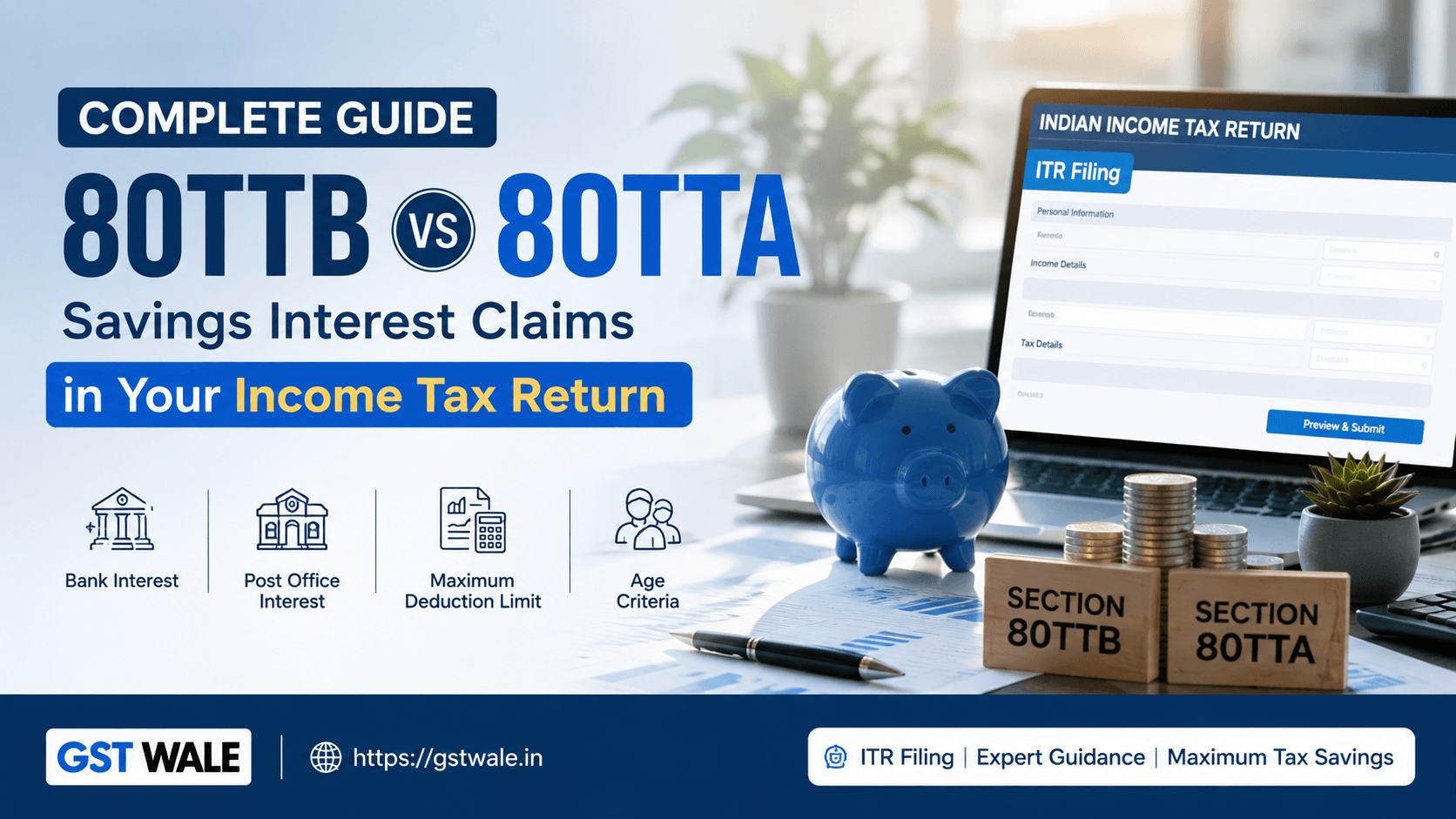
Interest earned from a savings account, fixed deposit, recurring deposit or post office investment is taxable, but the Income Tax Act provides specific deductions in certain cases. The two provisions that often create confusion are Section 80TTA and Section 80TTB. Understanding the difference can help you claim the correct deduction while filing your income tax return and avoid unnecessary tax payments.
If you are preparing your ITR Filing, checking your interest income and selecting the correct deduction should be an important part of the process. At GST Wale, we regularly see taxpayers either miss these deductions or claim the wrong one because they are unsure about the age criteria and the type of interest covered.
For Assessment Year 2026-27, Section 80TTA provides a deduction of up to ₹10,000 for eligible non-senior citizens, while Section 80TTB provides a deduction of up to ₹50,000 to eligible resident senior citizens.
What Is Section 80TTA in an Income Tax Return?
Section 80TTA is designed primarily for individuals who are not senior citizens and Hindu Undivided Families (HUFs). It allows a deduction on interest earned from deposits maintained in eligible savings accounts with a bank, cooperative bank or post office.
The maximum deduction limit under Section 80TTA is ₹10,000 in a financial year. Importantly, this is a deduction from eligible interest income, not a complete exemption from reporting the interest. The interest should first be included in the appropriate income category and the eligible deduction can then be claimed.
For example, suppose Rahul earns ₹7,500 as interest on his savings account during the year. If he satisfies the applicable conditions and uses the old tax regime, he can claim the entire ₹7,500 as a deduction under Section 80TTA.
If his interest on savings accounts is ₹16,000, his deduction is restricted to ₹10,000. The remaining ₹6,000 continues to form part of his taxable income.
What Is Section 80TTB in an Income Tax Return?
Section 80TTB provides a more generous deduction to resident senior citizens. It covers interest received on deposits with banks, cooperative banks and post offices.
The maximum deduction limit under Section 80TTB is ₹50,000. Unlike Section 80TTA, the provision is not restricted only to savings account interest. Eligible deposit interest can include interest from savings deposits as well as fixed deposits, subject to the applicable provisions. The Income Tax Department specifically confirms that both savings and fixed-deposit interest can qualify under Section 80TTB.
This makes Section 80TTB particularly useful for senior citizens who depend on interest income from their accumulated savings.
For instance, assume Mr. Sharma, a resident senior citizen, receives ₹42,000 as savings account interest and ₹30,000 as fixed-deposit interest. His total eligible interest is ₹72,000. Subject to the applicable conditions and tax regime, the deduction under Section 80TTB can be claimed up to ₹50,000.
Section 80TTA vs Section 80TTB: Key Difference
The easiest way to understand these provisions is to compare who can claim them and what type of interest is covered.
Eligibility and age criteria
Section 80TTA generally applies to an individual who is not a senior citizen or to an HUF. Section 80TTB is available to a resident senior citizen.
For tax purposes, a senior citizen generally means a resident individual who has attained the prescribed age of 60 years during the relevant previous year. Therefore, age criteria should be checked carefully before selecting the section.
Type of interest covered
Section 80TTA is restricted to interest earned from eligible savings accounts.
Section 80TTB has a broader scope for resident senior citizens and covers interest from eligible deposits, including savings and fixed deposits with banks, cooperative banks and post offices.
Maximum deduction limit
Under Section 80TTA, the maximum deduction is ₹10,000.
Under Section 80TTB, the maximum deduction is ₹50,000.
The maximum deduction limit does not mean that every taxpayer automatically gets ₹10,000 or ₹50,000. The deduction is restricted to the eligible interest actually earned.
Can You Claim 80TTA or 80TTB Under the New Tax Regime?
This is one of the most important points when preparing an income tax return.
For Assessment Year 2026-27, the Income Tax Department's ITR validation rules specify that deductions under Section 80TTA and Section 80TTB cannot be claimed when the new tax regime is selected. These deductions are available under the old tax regime, subject to their respective conditions.
Therefore, don't simply look at your interest income and claim a deduction. First check which tax regime you are using.
A taxpayer may have ₹8,000 of interest on a savings account but still be unable to claim Section 80TTA if the return is being filed under the new tax regime.
How to Claim the Deduction in Your Income Tax Return
Claiming the deduction becomes easier when your interest records are organised before filing.
Step 1: Collect interest details
Download or obtain interest certificates and statements from your bank, cooperative bank and post office wherever applicable.
Check savings account interest separately from fixed-deposit or other deposit interest.
Step 2: Report the interest income
Do not assume that interest below the deduction limit does not need to be reported. The interest income should be correctly considered while preparing your income tax return.
Step 3: Check your age and residential status
If you are claiming Section 80TTB, verify that you satisfy the resident senior citizen conditions.
Step 4: Select the correct section
Use Section 80TTA for eligible savings account interest of qualifying non-senior citizens/HUFs and Section 80TTB for eligible resident senior citizens.
Step 5: Check your tax regime
Before claiming either deduction, confirm that you are eligible to claim Chapter VI-A deductions under the tax regime selected for the relevant assessment year.
Step 6: Reconcile your figures
Compare the interest reported in your bank statements, Form 26AS, Annual Information Statement (AIS) and Taxpayer Information Summary (TIS), wherever applicable.
This simple reconciliation can help prevent discrepancies while filing an income tax return.
Practical Example: 80TTA
Consider Priya, aged 35, who earns:
- ₹9,000 interest on savings accounts
- ₹35,000 interest from fixed deposits
Section 80TTA does not provide a deduction for her fixed-deposit interest. If she is otherwise eligible and follows the old tax regime, only the eligible savings account interest can be considered for the deduction, subject to the ₹10,000 limit.
Therefore, claiming ₹44,000 under Section 80TTA would be incorrect.
Practical Example: 80TTB
Now consider Mr. Verma, aged 67 and resident in India. During the year, he earns:
- ₹18,000 interest on savings accounts
- ₹45,000 fixed-deposit interest
- ₹12,000 post office interest
His eligible deposit interest totals ₹75,000. However, the Section 80TTB deduction is restricted to ₹50,000.
The remaining interest does not disappear. It remains relevant while calculating taxable income.
Common Mistakes to Avoid
When preparing an income tax return, taxpayers should watch out for these common errors:
- Claiming Section 80TTA on fixed-deposit interest.
- Claiming Section 80TTA despite being eligible for Section 80TTB.
- Claiming Section 80TTB without satisfying the resident senior citizen conditions.
- Treating the ₹50,000 limit as a blanket exemption.
- Ignoring post office interest.
- Forgetting to reconcile interest figures with AIS and bank records.
- Claiming these deductions under the new tax regime.
- Reporting only the net interest after deduction instead of correctly considering the gross eligible interest.
Frequently Asked Questions
Can I claim Section 80TTA on fixed-deposit interest?
No. Section 80TTA is intended for eligible interest from savings accounts with banks, cooperative banks and post offices. Fixed-deposit interest is not covered by Section 80TTA.
Can a senior citizen claim Section 80TTA?
Generally, a resident senior citizen claiming the applicable benefit should use Section 80TTB rather than Section 80TTA. Section 80TTB provides the broader deduction for eligible deposit interest and has a ₹50,000 maximum deduction limit.
Is post office interest eligible under these sections?
Eligible post office savings/deposit interest can be considered under the relevant provision, subject to the conditions of the section. Section 80TTB specifically covers eligible deposits with post offices for resident senior citizens.
What is the maximum deduction under Section 80TTA?
The maximum deduction under Section 80TTA is ₹10,000 for eligible interest from savings accounts.
What is the maximum deduction under Section 80TTB?
The maximum deduction under Section 80TTB is ₹50,000 for eligible resident senior citizens. It can cover eligible interest from savings and other qualifying deposits, subject to the applicable conditions.
Choose the Right Deduction in Your Income Tax Return
Section 80TTA and Section 80TTB can reduce your taxable income, but they apply to different categories of taxpayers and interest income. Section 80TTA is generally relevant for eligible non-senior citizens and HUFs, with a ₹10,000 limit on qualifying savings account interest. Section 80TTB is meant for eligible resident senior citizens and provides a higher ₹50,000 limit on qualifying deposit interest.
The most important thing is to report your interest correctly, check your age criteria, verify the applicable tax regime and claim only the deduction you are legally entitled to receive.
At GST Wale, we believe that a properly prepared income tax return is not just about submitting a form—it is about reporting income accurately and using every legitimate tax benefit available under the law. For professional assistance with your income tax return and tax compliance, connect with GST Wale and make your filing process simpler, accurate and stress-free.
 Previous