


How to Save Tax Under Section 80EEA: A Guide for First-Time Homebuyers E Filing of Income Tax
How to Save Tax Under Section 80EEA: A Guide for First-Time Homebuyers E Filing of Income Tax
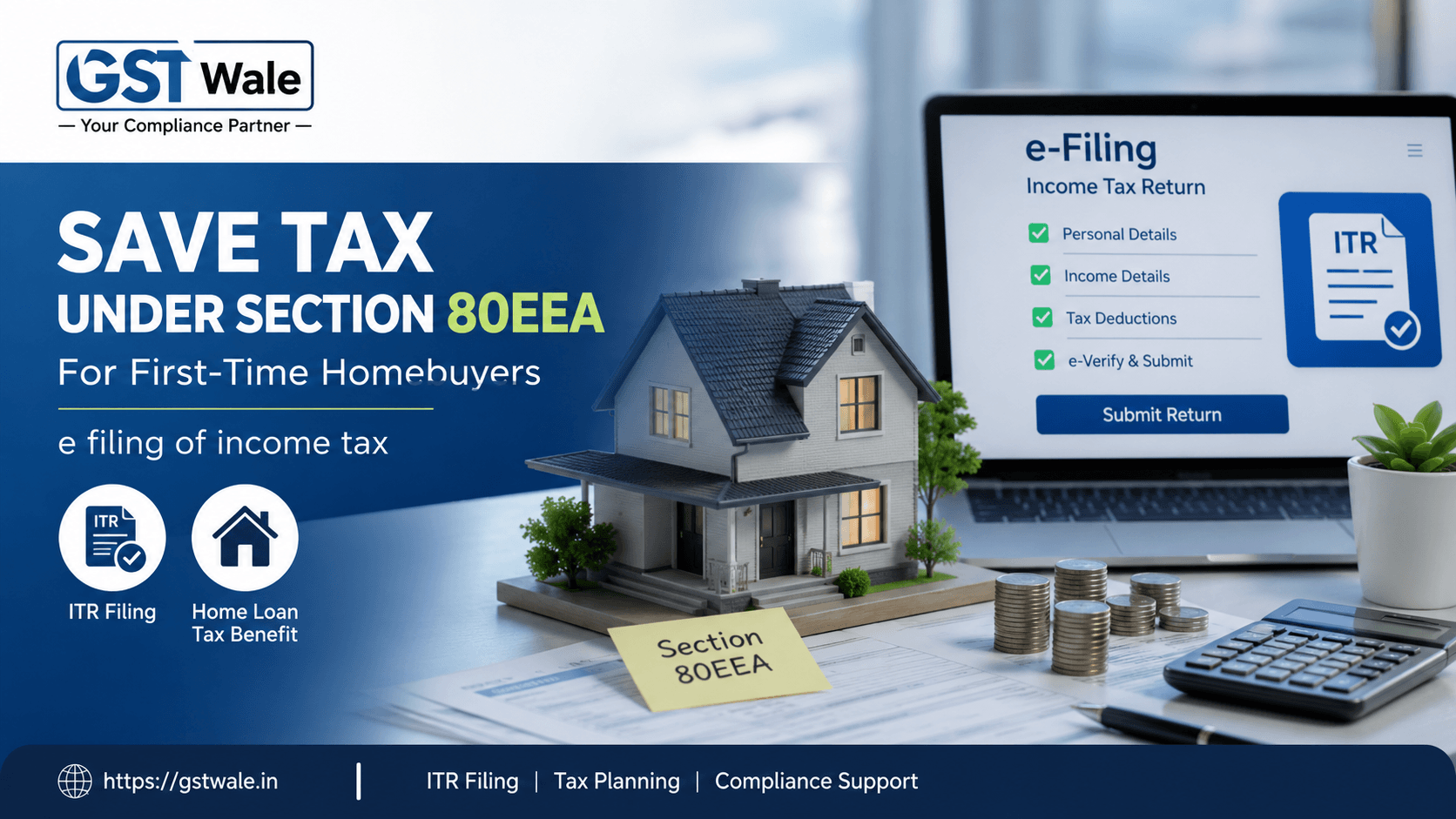
Buying your first home is a major financial milestone, but the cost of a home loan can make the journey challenging. The good news is that eligible first-time homebuyers may get an additional tax benefit on home-loan interest under Section 80EEA. When combined with proper tax planning and accurate e filing of income tax, this deduction can reduce your taxable income significantly. If you are preparing your annual return, professional ITR Filing support can also help you identify eligible deductions and avoid common mistakes.
At GST Wale, we believe tax planning should be practical and easy to understand. Section 80EEA is particularly important because it was introduced to encourage affordable housing. However, there is one important point that many taxpayers miss: the provision applies only to home loans sanctioned during a specific historical period. Therefore, before claiming the benefit during e filing of income tax, you should first confirm whether your loan satisfies the prescribed conditions.
What Is Section 80EEA?
Section 80EEA of the Income-tax Act provides an additional deduction for interest paid on a qualifying housing loan. The maximum deduction available under this section is ₹1.50 lakh in a financial year, subject to the conditions prescribed by law.
The provision was introduced for individuals purchasing certain affordable residential properties. The loan must have been sanctioned between 1 April 2019 and 31 March 2022. Therefore, a person taking a new housing loan today generally cannot become eligible for Section 80EEA merely because the property is affordable.
However, taxpayers who had an eligible loan sanctioned within the specified period may continue to have relevance of this provision in their tax calculations, subject to the applicable conditions and availability of eligible interest. This is why understanding the financial year rules is important before completing e filing of income tax.
Who Can Claim Section 80EEA?
Section 80EEA is meant for individual taxpayers who satisfy its conditions. One of the key requirements is that the taxpayer should not be eligible to claim the deduction under Section 80EE.
The basic eligibility conditions include:
- The taxpayer must be an individual.
- The housing loan must have been sanctioned by a financial institution between 1 April 2019 and 31 March 2022.
- The stamp duty value of the residential property must not exceed ₹45 lakh.
- The taxpayer must not own another residential house property on the date the loan is sanctioned.
- The deduction must relate to interest payable on the qualifying housing loan.
- The same interest cannot be claimed again under another provision of the Income-tax Act.
These conditions should be checked carefully before e filing of income tax because simply being a first-time buyer does not automatically make every home loan eligible.
How Much Additional Interest Deduction Can You Claim?
The maximum additional interest deduction under Section 80EEA is ₹1.50 lakh per financial year.
For example, suppose Rahul purchased his first residential property using an affordable housing loan that was sanctioned in December 2020. During the financial year, he paid ₹2.10 lakh as eligible home-loan interest.
If all Section 80EEA conditions are satisfied, he may potentially claim an additional deduction of ₹1.50 lakh under this section. The remaining interest may be considered under other applicable provisions, subject to the relevant rules and restrictions.
This additional interest deduction can make a meaningful difference for a taxpayer, particularly during the initial years of a housing loan when the interest component is generally higher.
While doing e filing of income tax, taxpayers should therefore reconcile the interest amount appearing in their annual loan statement with the amount actually eligible for deduction.
What Does Affordable Housing Mean Under Section 80EEA?
The term affordable housing is important because Section 80EEA was designed to encourage the purchase of reasonably priced residential property.
The ₹45 lakh stamp duty value limit is one of the most important tests. Importantly, taxpayers should not assume that the price negotiated with the builder or seller is the only relevant figure.
The stamp duty value refers to the value adopted, assessed or assessable by the relevant government authority for stamp-duty purposes. Therefore, checking the property's stamp duty value is essential before claiming the deduction.
The size of the property may also matter in understanding affordable housing provisions and related tax concepts. The concept of carpet area has been used in government housing-related provisions, and buyers should distinguish carpet area from built-up area and super built-up area when reviewing property documents.
For e filing of income tax, it is always better to retain the sale agreement, registration documents and other property records supporting the property's value and eligibility.
Is Section 80EEA Available Under the New Tax Regime?
This is one of the most important questions for taxpayers today.
Section 80EEA is a Chapter VI-A deduction. Under the current new tax regime, Section 80EEA cannot be claimed. The Income Tax Department's current guidance and ITR validation rules specifically exclude Section 80EEA from the deductions available when the new tax regime is selected.
Therefore, an eligible taxpayer needs to consider the tax regime carefully.
For example, assume a taxpayer has ₹1.50 lakh of eligible Section 80EEA interest. Under the old tax regime, that deduction may reduce taxable income if all conditions are fulfilled. Under the new tax regime, the Section 80EEA deduction is not available.
This does not mean the old regime will always result in lower tax. The taxpayer should compare the total tax liability under both regimes after considering all eligible deductions, exemptions and income sources.
During e filing of income tax, selecting the appropriate tax regime can therefore be just as important as identifying the deduction itself.
How to Claim Section 80EEA During E Filing of Income Tax
If you have an eligible loan, claiming the deduction requires accurate information and supporting records.
Step 1: Collect Your Home Loan Statement
Obtain the annual interest certificate or loan statement from your bank or financial institution. It should clearly show the interest payable or paid during the relevant financial year.
Step 2: Verify the Loan Sanction Date
Check your loan sanction letter and confirm that the loan was sanctioned within the period prescribed under Section 80EEA, i.e. from 1 April 2019 to 31 March 2022.
Step 3: Check the Property Value
Review the registration and property documents to establish that the stamp duty value did not exceed ₹45 lakh.
Step 4: Confirm First-Time Buyer Status
You should verify that you did not own another residential house property on the date the qualifying loan was sanctioned.
Step 5: Check the Tax Regime
Before claiming the deduction, confirm that you are using the tax regime under which Section 80EEA is permissible.
Step 6: Enter the Correct Deduction
While completing e filing of income tax, report the eligible interest deduction accurately in the relevant section of the ITR. Do not claim more than the permitted ₹1.50 lakh under Section 80EEA.
Step 7: Keep Supporting Documents
You generally do not attach these documents with the return merely because you are claiming the deduction, but you should retain them safely in case the Income Tax Department asks for clarification or verification.
Common Mistakes First-Time Homebuyers Should Avoid
Many taxpayers lose the benefit of proper tax planning because they focus only on the home loan and ignore the tax conditions.
Some common mistakes include:
- Assuming every first-time homebuyer qualifies for Section 80EEA.
- Ignoring the loan sanction date.
- Checking the purchase price but not the stamp duty value.
- Claiming the same interest twice under different provisions.
- Selecting the new tax regime and still attempting to claim Section 80EEA.
- Entering incorrect interest figures during e filing of income tax.
- Failing to retain the loan certificate and property documents.
- Confusing carpet area with the property's overall saleable area.
- Ignoring the applicable financial year rules.
A tax deduction should always be claimed based on eligibility, not simply because the deduction appears in an online tax calculator.
Practical Example of Section 80EEA Tax Planning
Consider Priya, who purchased her first home using a housing loan sanctioned in 2020. The property's stamp duty value was ₹42 lakh, and she did not own another residential property when the loan was sanctioned.
During a particular financial year, she paid ₹1.35 lakh in eligible interest.
If she satisfies all other conditions and uses the applicable tax regime, her eligible Section 80EEA deduction could be up to ₹1.35 lakh because the deduction cannot exceed the eligible interest actually payable.
Now consider another year in which her eligible interest is ₹1.80 lakh. In that situation, the maximum deduction under Section 80EEA would generally be capped at ₹1.50 lakh.
This simple example shows why maintaining annual loan statements is important for accurate e filing of income tax.
Section 80EEA vs Regular Home Loan Interest Deduction
Section 80EEA should not be viewed in isolation. Homeowners may also have other tax provisions relating to housing-loan interest, depending on the nature and use of the property and the applicable tax regime.
The key point is that Section 80EEA provides an additional interest deduction for qualifying taxpayers, but the same interest cannot be duplicated across provisions. The Income Tax Department specifically states that interest for which deduction is allowed under Section 80EEA cannot be claimed again under another provision for the same or another assessment year.
Therefore, before e filing of income tax, it is sensible to prepare a complete home-loan interest calculation instead of entering individual figures without checking the overall tax treatment.
FAQs About Section 80EEA and E Filing of Income Tax
Can a person taking a home loan in 2026 claim Section 80EEA?
Generally, no. Section 80EEA requires the housing loan to have been sanctioned between 1 April 2019 and 31 March 2022. Therefore, a new loan sanctioned outside this period does not qualify for this specific deduction. Other home-loan tax provisions may still apply depending on the taxpayer's circumstances and tax regime.
What is the maximum Section 80EEA deduction?
The maximum deduction available under Section 80EEA is ₹1.50 lakh for eligible interest. However, the actual deduction cannot exceed the qualifying interest amount and all statutory conditions must be satisfied. The deduction is specifically related to interest on the qualifying residential housing loan.
Is the ₹45 lakh limit based on the stamp duty value?
Yes. One of the statutory conditions is that the stamp duty value of the residential house property should not exceed ₹45 lakh. Taxpayers should therefore check the relevant property and registration documents rather than relying only on the negotiated purchase price.
Can Section 80EEA be claimed under the new tax regime?
No. Section 80EEA is not available under the new tax regime because it is among the Chapter VI-A deductions that cannot be claimed when the applicable new regime is selected.
What documents should I keep for e filing of income tax?
Keep your home-loan sanction letter, annual interest certificate, loan statement, sale agreement, registration documents and relevant property records. These documents help establish the loan date, interest amount, property value and other eligibility conditions if clarification is required later.
Plan Your Home Loan Tax Benefits Carefully
For eligible first-time homebuyers, Section 80EEA can provide a valuable additional interest deduction of up to ₹1.50 lakh. However, the benefit is subject to specific conditions, including the loan sanction period, ₹45 lakh stamp duty value limit, first-time ownership requirement and applicable tax regime.
The most important lesson is not to treat tax deductions as automatic. Check your documents, understand the financial year rules, compare the tax regimes and calculate your eligible interest before completing e filing of income tax.
At GST Wale, our approach is simple: make taxation easier, accurate and practical for individuals and businesses. If you are unsure about your home-loan deduction, tax regime or return preparation, take professional guidance before submitting your return. Proper planning today can help you avoid unnecessary tax and compliance issues tomorrow.
 Previous