


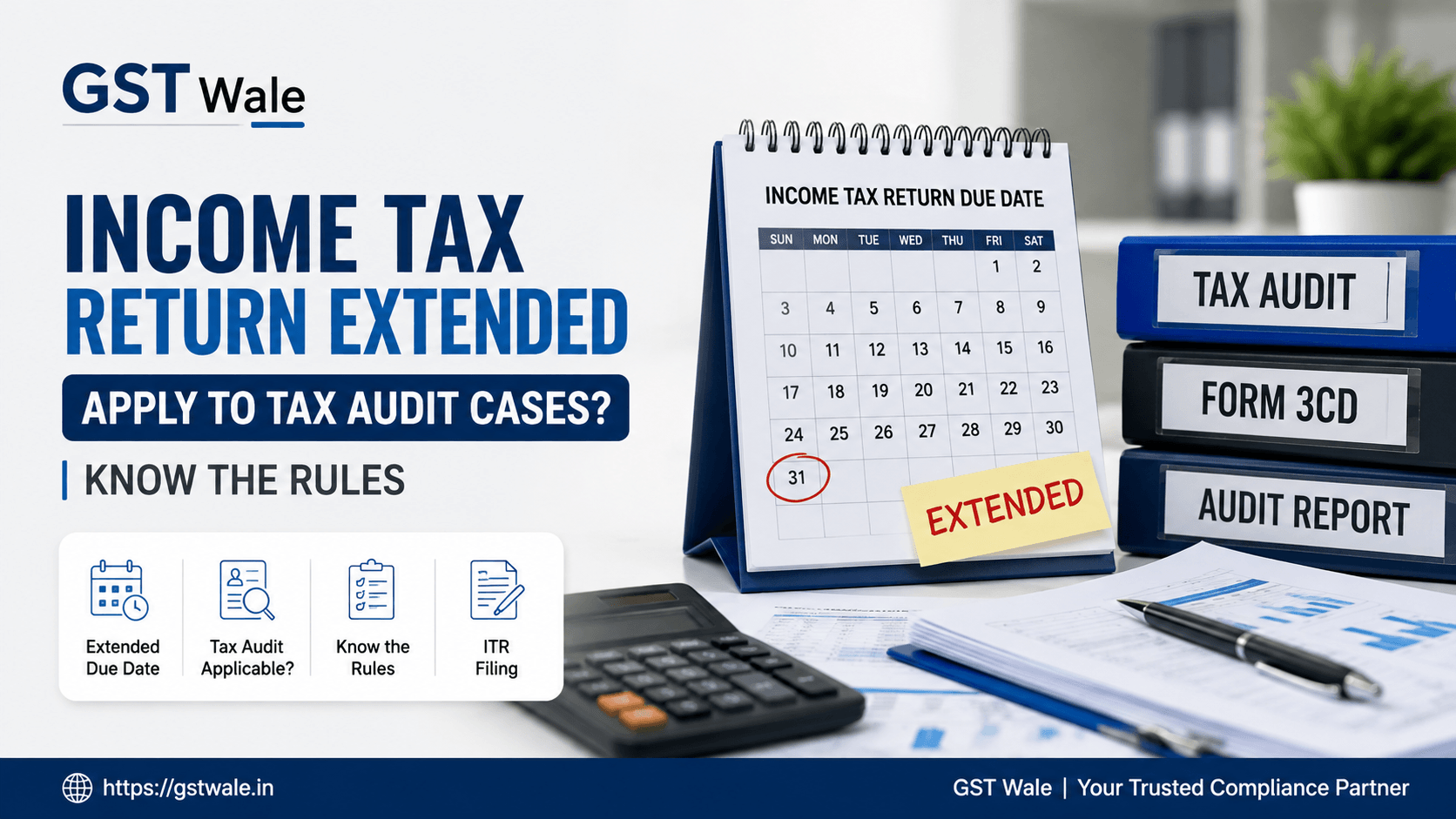
Will the Income Tax Return Extended Date Apply to Tax Audit Cases? Know the Rules
Will the Income Tax Return Extended Date Apply to Tax Audit Cases? Know the Rules
Income Tax Return Extended Date: Does It Cover Tax Audit Cases?
Every year, taxpayers keep a close eye on announcements about the income tax return extended date. An extension can provide welcome relief, especially when businesses are still closing their books, reconciling transactions, or collecting documents. If you are also preparing your ITR Filing, however, there is one important question: does an extension of the income tax return due date automatically apply to taxpayers who are subject to tax audit?
The short answer is not necessarily. Tax audit cases follow a separate compliance framework, and the due date for submitting the tax audit report is linked to the return due date under the Income-tax Act. The Income Tax Department specifically states that Form 3CA-3CD or Form 3CB-3CD is generally required to be furnished one month before the applicable due date for filing the return.
That distinction is important because an income tax return extended announcement does not, by itself, mean every connected compliance deadline has been changed. Taxpayers should always check the actual CBDT notification or order before relying on an extension.
Why Tax Audit Cases Have Different Deadlines
Tax audit provisions primarily arise under Section 44AB of the Income-tax Act. Broadly, certain businesses and professionals crossing the prescribed turnover threshold, or meeting specified conditions, may have to get their accounts audited by a chartered accountant.
The purpose of the audit is not simply to calculate tax. It also requires the auditor to examine the books and report prescribed particulars to the Income Tax Department.
For taxpayers covered by tax audit, the compliance process normally involves:
- Completing the books of accounts and financial statements.
- Getting the accounts audited by a chartered accountant.
- Preparing the applicable audit report.
- Furnishing Form 3CA-3CD or Form 3CB-3CD.
- Filing the applicable income tax return.
- Ensuring tax, interest and other liabilities are properly considered.
The Income Tax Department confirms that Form 3CA-3CD applies where accounts are audited under another law, while Form 3CB-3CD applies where the taxpayer is required to get accounts audited under Section 44AB but is not otherwise required to have the accounts audited under another law.
Does an Income Tax Return Extended Date Automatically Extend Tax Audit?
This is where many taxpayers get confused.
Suppose the government announces an income tax return extended date for a particular category of taxpayers. It would be incorrect to assume that the tax audit report deadline has automatically moved by the same number of days.
The tax audit report has its own statutory relationship with the return filing deadline. In fact, the Income Tax Department's current guidance states that the audit report is to be furnished one month before the due date of the return under Section 139(1).
Therefore, taxpayers should distinguish between:
Extension of ITR filing deadline: This concerns the date by which the income tax return can be filed.
Extension of tax audit report deadline: This concerns the date by which the audit report and prescribed particulars must be furnished.
An extension announcement from CBDT may specifically address one deadline, both deadlines, or a particular category of taxpayers. The wording of the official order matters.
Income Tax Return Extended: What Happens to Form 3CD?
Form 3CD is an important part of tax audit compliance. It contains detailed particulars relating to the taxpayer's business or profession and is furnished along with the applicable audit report.
The Income Tax Department explains that Form 3CD contains prescribed information under Section 44AB and that the CA uploads the applicable audit report electronically. Form 3CD is divided into sections covering basic taxpayer information and detailed particulars required under the law.
This means that a business should not wait until the final ITR deadline to start the audit process.
For example, imagine a business whose accounts require tax audit. Its owner hears that the government has announced an income tax return extended date. The owner assumes there is plenty of additional time and postpones sending the books to the CA.
That can create a serious compliance problem if the tax audit report deadline has not been extended separately.
The practical approach is simple: treat the tax audit report and ITR as connected but separate compliances until an official notification confirms otherwise.
What Is the Tax Audit Limit and Turnover Threshold?
Another common question is whether every business needs a tax audit.
No. Tax audit applicability depends on the provisions of Section 44AB and the facts of the taxpayer. The tax audit limit and applicable conditions can vary depending on the nature of business, profession, cash transactions and other statutory requirements.
For businesses, the turnover threshold is therefore only one part of the analysis. Certain enhanced limits may be relevant where prescribed conditions relating to cash receipts and payments are satisfied.
This is why business owners should not determine audit applicability solely by looking at turnover.
A professional should examine:
- Nature of business or profession.
- Gross turnover or receipts.
- Cash receipts and payments.
- Applicability of presumptive taxation provisions.
- Whether the taxpayer has opted out of a presumptive scheme where applicable.
- Previous-year tax positions.
- Other audit requirements under applicable laws.
A chartered accountant can assess these factors before the return and audit deadlines become urgent.
What Should Businesses Do After an Extension Announcement?
If there is an income tax return extended deadline, businesses should first identify exactly what has been extended.
Step 1: Check the official notification
Do not rely only on social media posts, WhatsApp messages or headlines. Read the CBDT notification, circular or official Income Tax Department communication.
Step 2: Identify the taxpayer category
An extension may apply only to specific taxpayers, assessment years, forms or compliance requirements.
Step 3: Check the tax audit deadline separately
If your business falls under tax audit, confirm whether the tax audit report deadline has also been changed.
Step 4: Complete Form 3CD carefully
Do not treat Form 3CD as a routine formality. The particulars reported by the CA should agree with the books and supporting records.
Step 5: Rework your compliance calendar
Update the compliance calendar with the revised dates instead of simply assuming that every related deadline has moved.
Step 6: File before the last day where possible
An extension is additional time, not an invitation to postpone everything until the final date. Technical issues, missing documents, reconciliations and portal-related problems can take longer than expected.
A Practical Example
Consider a trading business with turnover above the applicable tax audit limit. Its accounts are being audited and the CA is preparing Form 3CD.
Now suppose CBDT announces an income tax return extended date for the relevant category of taxpayers.
The business owner should not immediately assume that the tax audit report can also be filed later.
Instead, the owner should check the notification. If the government has separately extended the audit-report deadline, the revised date will apply according to the terms of that notification. If only the ITR deadline has been extended, the audit report may still have to be completed within its applicable deadline.
This simple distinction can prevent unnecessary interest, late-filing consequences and last-minute compliance pressure.
What If the Tax Audit Report Is Filed Late?
Late compliance can have consequences depending on the facts and applicable provisions. In certain situations, penalty provisions under the Income-tax Act may become relevant, although the law also provides circumstances in which reasonable cause can be considered.
Therefore, taxpayers should not deliberately delay their audit report simply because they expect an income tax return extended date.
If there is a genuine difficulty, discuss it with your CA and maintain proper documentation explaining the circumstances.
Income Tax Return Extended Date: Common Questions
Does an ITR extension automatically extend the tax audit deadline?
No. An ITR extension should not automatically be treated as an extension of the tax audit report deadline. Taxpayers should check the exact CBDT notification to determine which compliance dates have actually been changed.
Is Form 3CD required for tax audit cases?
Yes, prescribed particulars under Section 44AB are reported through Form 3CD along with the applicable audit report. Depending on the circumstances, the taxpayer may have Form 3CA-3CD or Form 3CB-3CD.
Who prepares Form 3CD?
The tax audit report is prepared and furnished by the tax auditor, who must be a registered CA assigned by the taxpayer through the e-Filing portal.
Does crossing the turnover threshold always mean tax audit is mandatory?
Not necessarily. Tax audit applicability depends on the relevant provisions and conditions, not merely on turnover in isolation. Cash transactions, presumptive taxation and other factors can also affect the requirement.
Should I wait for an extension announcement before starting my audit?
No. Businesses should complete their books and start the audit process as early as possible. An extension should be considered additional relief, not the foundation of the compliance plan.
Don't Assume Every Income Tax Return Extended Date Covers Tax Audit
The biggest takeaway is simple: an income tax return extended date does not automatically mean that the tax audit deadline has also been extended. Tax audit cases involve additional compliance, including the audit report and Form 3CD, and these deadlines must be checked separately.
For business owners, the safest approach is to monitor official CBDT announcements, maintain an updated compliance calendar and coordinate with your chartered accountant well before the deadline. If an extension is announced, read its scope carefully rather than relying on assumptions.
At GST Wale, we believe tax compliance should be simple, timely and practical. Whether you are dealing with an audit requirement, tax calculations or an income tax return extended deadline, getting professional assistance early can help you avoid last-minute errors and unnecessary compliance stress.
 Previous