


Is There a Special Income Tax Return Extended Protocol for Flood or Disaster-Struck Areas?
Is There a Special Income Tax Return Extended Protocol for Flood or Disaster-Struck Areas?
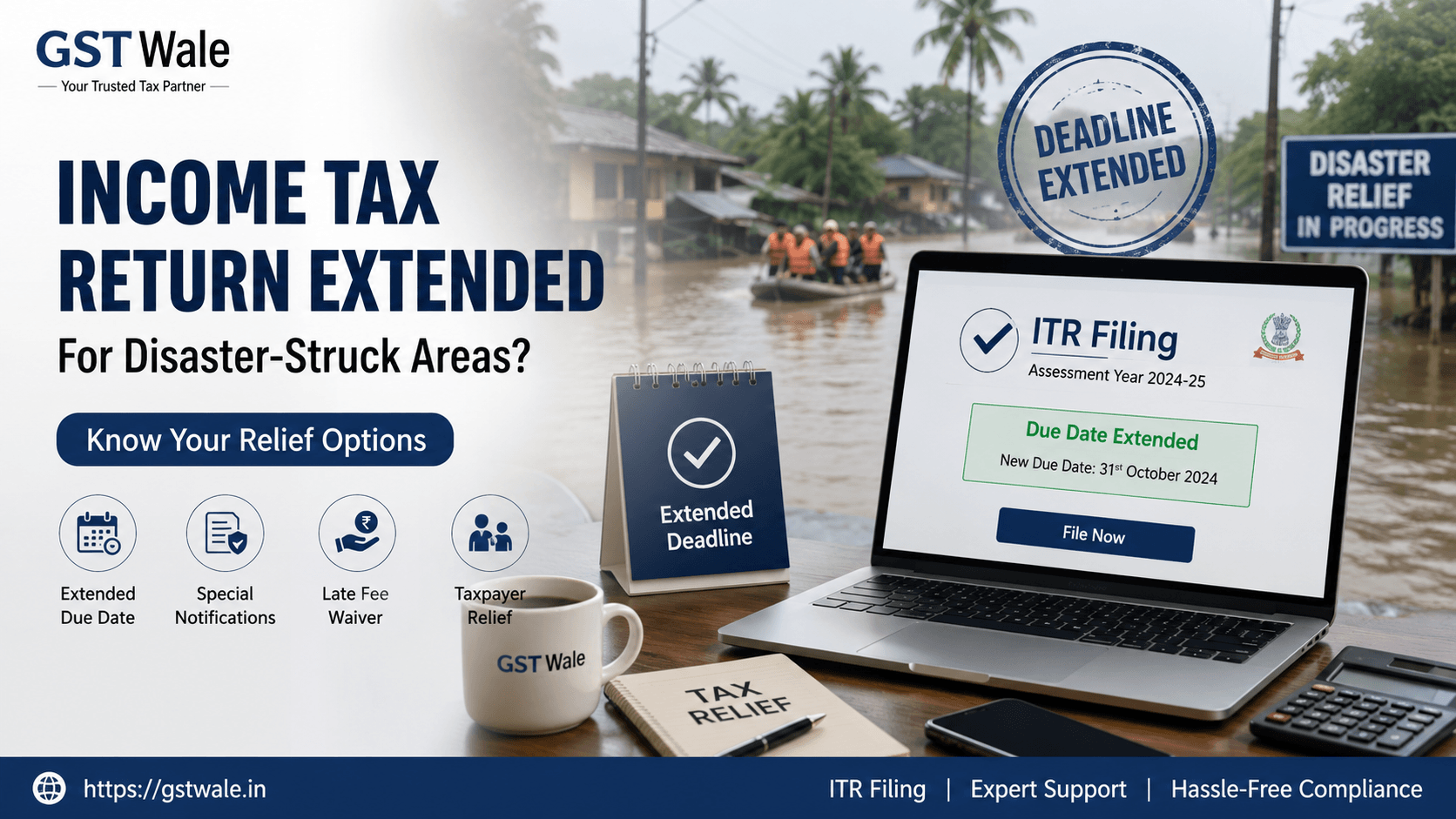
When floods, landslides, cyclones, earthquakes or other major disasters disrupt normal life, filing an income tax return may be the last thing on a taxpayer’s mind. In such situations, many taxpayers naturally ask whether an income tax return extended deadline is automatically available for people living in affected areas.
The short answer is no, not automatically. However, the tax authorities can provide relief through specific orders or special notifications when circumstances justify it. If you need professional help preparing and submitting your return, you can use our ITR Filing service to complete the process correctly and on time.
From a practical tax perspective, disaster-related relief can take different forms. The Central Board of Direct Taxes (CBDT) has powers to relax certain statutory requirements in appropriate circumstances. Therefore, taxpayers should not assume that a flood automatically gives them an extension, but they should also not ignore the possibility of government relief.
Is an Income Tax Return Extended Deadline Automatically Available After a Disaster?
There is no permanent rule under which every taxpayer affected by a flood or natural disaster automatically receives extra time to file an ITR.
The government generally considers the seriousness of the situation, the geographical area affected, the type of taxpayers impacted and the nature of the compliance difficulty before issuing relief.
In other words, an income tax return extended deadline generally requires an official announcement or order. A taxpayer cannot simply decide that the due date does not apply because their business or residence was affected by flooding.
This distinction is extremely important.
For example, suppose a business owner in a flood-affected district loses access to accounting records, computers and supporting documents just before the ITR due date. The person may have a genuine difficulty in filing the return. However, unless an applicable government order extends the deadline or provides another form of relief, the original statutory provisions continue to matter.
How Does a Force Majeure Extension Work for Income Tax?
The expression force majeure extension is often used when an extraordinary event beyond a person’s reasonable control prevents timely compliance.
Natural disasters can potentially create such circumstances. However, taxpayers should understand that force majeure is not, by itself, a magic phrase that automatically extends an income tax deadline.
The relevant tax authority must provide the applicable relaxation.
Under the earlier Income-tax Act, 1961, Section 119 gave CBDT broad powers to issue general or special orders for proper administration of tax laws and, in appropriate cases, provide relief from certain statutory requirements. The provision also allowed relief where genuine hardship was involved.
The tax department has historically used these powers during extraordinary situations. For example, following the severe natural calamity in Uttarakhand in 2013, CBDT extended the return-filing due date for specified taxpayers residing or assessed in the state.
This shows that disaster-related tax relief is possible, but it is generally notification-based rather than automatic.
What Is a Region-Specific Extension?
A region-specific extension means that additional time is granted only to taxpayers connected with a specified affected location.
This is particularly relevant during major floods or other natural disasters because the disruption may be concentrated in certain districts, states or localities.
A notification may define eligibility based on factors such as:
- Place of residence of the taxpayer
- Jurisdiction of the assessing officer
- Place where the taxpayer is assessed
- Specified districts or states
- Particular categories of taxpayers
- Specific compliance dates
Therefore, taxpayers should carefully read the wording of any CBDT order instead of assuming that everyone in the state qualifies.
A person living in one district may qualify while another taxpayer in the same state may not, depending on the exact terms of the notification.
Can CBDT Give Special Relief During Floods or Other Disasters?
Yes. Government authorities have the ability to provide targeted relief where the circumstances justify it.
The tax administration has previously issued extensions for specific situations. For example, CBDT used its statutory powers in 2025 to extend a specified return-filing deadline for certain taxpayers for AY 2025-26.
This is why taxpayers should regularly check official income tax announcements during a serious disaster.
A taxpayer should not rely solely on social media posts, WhatsApp messages or news headlines claiming that an extension has been granted. The actual CBDT notification or order determines:
- Who is covered
- Which return or compliance is covered
- The original due date
- The revised due date
- Whether interest or fees are affected
- Whether any geographical restrictions apply
Does an Extension Mean Late Fee Is Automatically Waived?
Not necessarily.
This is one of the most common misunderstandings about an income tax return extended deadline.
If CBDT officially extends the applicable due date and you file within the revised deadline, the consequences normally depend on the exact terms of the relevant order.
A separate late fee waiver may or may not be expressly provided.
For example, an order might extend the due date for filing a return but have specific provisions concerning interest, late filing fees or other statutory consequences. Therefore, taxpayers should never assume that every consequence disappears merely because the filing deadline has moved.
The notification should always be checked carefully.
What Should You Do If Your Area Is Hit by a Disaster?
If you are genuinely affected by flooding or another disaster, do not wait until the last day to determine what to do.
Step 1: Check the Official Tax Department Website
Look for the latest CBDT circulars, orders and announcements. The Income Tax Department regularly publishes updates through its official portal.
Step 2: Check Whether Your Area Is Specifically Covered
Read the notification carefully. Confirm whether your district, state, jurisdiction or taxpayer category is included.
Do not assume that being located near a disaster-affected area automatically makes you eligible.
Step 3: Identify the Revised Deadline
If an income tax return extended deadline has officially been announced, note the exact revised date.
Keep a copy of the notification for your records.
Step 4: Gather Whatever Records Are Available
If documents have been damaged or lost, start reconstructing them using available sources such as:
- Bank statements
- Form 26AS
- Annual Information Statement
- Taxpayer Information Summary
- Salary certificates
- Invoices and accounting records
- Investment statements
- Loan documents
Step 5: File as Soon as Practically Possible
An extension should provide breathing room, not become a reason for further delay.
Once your records are reconstructed, prepare and verify the return without waiting for the revised deadline.
What If No Special Extension Has Been Announced?
This is where taxpayers need to be particularly careful.
If there is no applicable income tax return extended notification, the normal filing provisions continue to apply.
Where the taxpayer misses the original deadline, the consequences may include late filing implications, interest and other statutory consequences depending on the taxpayer's circumstances and the applicable law.
For certain genuine hardship situations, taxpayers may have remedies under the applicable provisions. Under the earlier Section 119 framework, CBDT could authorise relief in specified cases to address genuine hardship.
However, this should not be interpreted as a blanket permission to file late.
The correct approach is to determine whether a specific relaxation applies to your circumstances and tax year.
Why Taxpayers Should Not Rely on Old Extension News
Tax laws and administrative procedures change.
This is particularly important now because the Income-tax Act, 2025 has introduced the current framework for tax years beginning from 1 April 2026, while earlier assessment years can continue to be governed by the earlier law under the transition provisions. The Income Tax Department has also clarified that payments relating to periods before Tax Year 2026-27 continue to use the earlier Act framework.
Therefore, an extension announced during an earlier flood, pandemic or natural calamity should not automatically be treated as applicable to a current filing.
Always verify the notification applicable to the relevant assessment year or tax year.
Practical Example: Flood-Affected Small Business
Consider a small trader whose shop is severely damaged by flooding a few weeks before the ITR deadline.
The accounting computer is damaged, physical purchase records are destroyed and the owner is temporarily unable to operate the business.
If CBDT issues a notification covering the affected district and extends the relevant filing deadline, the taxpayer can use that additional period to reconstruct records and file the return.
But if no such notification exists, the taxpayer should not simply ignore the statutory deadline. Instead, the taxpayer should immediately discuss the available legal options with a tax professional and file as early as possible.
This is a good example of why income tax return extended relief should always be confirmed through an official notification.
FAQs About Income Tax Return Extended Relief
Is an ITR deadline automatically extended after a flood?
No. A flood or natural disaster does not automatically extend the ITR deadline for every affected taxpayer. An official government order or notification is generally required to provide a specific relaxation.
Can CBDT provide a region-specific extension?
Yes. CBDT has historically issued orders granting extensions to taxpayers in particular states or affected areas. Eligibility depends entirely on the wording and scope of the applicable notification.
Does an extension automatically remove late filing fees?
Not necessarily. The effect on late fees, interest and other consequences depends on the terms of the particular relief order. Taxpayers should read the official notification instead of assuming a complete waiver.
What if my documents were destroyed in a disaster?
Reconstruct your records using bank statements, tax information statements, invoices, accounting backups and other available evidence. If you cannot comply normally, obtain professional tax advice and check whether any special relief is available.
Where can I check whether an extension has been announced?
The Income Tax Department's official e-filing portal and CBDT notifications are the safest sources. Avoid relying only on forwarded messages or unofficial social media claims.
Check Before Assuming an Income Tax Return Extended Deadline
An income tax return extended deadline can provide valuable relief to taxpayers affected by floods, cyclones, earthquakes and other major disasters. However, such relief is generally not automatic. It normally depends on an official CBDT order, notification or other legally applicable relaxation.
If your business or personal records have been affected by a disaster, act quickly. Check whether your location and taxpayer category are covered, understand the revised deadline and determine whether any late fee waiver or other relief is specifically included.
At GST Wale, we believe tax compliance should be practical and easy to understand. Whether you are dealing with a normal filing deadline or an exceptional situation involving disaster-related disruption, getting the return prepared correctly is more important than relying on assumptions.
 Previous