


What to Expect If Your Income Tax Return Extended Request Is Denied by the Authorities
What to Expect If Your Income Tax Return Extended Request Is Denied by the Authorities
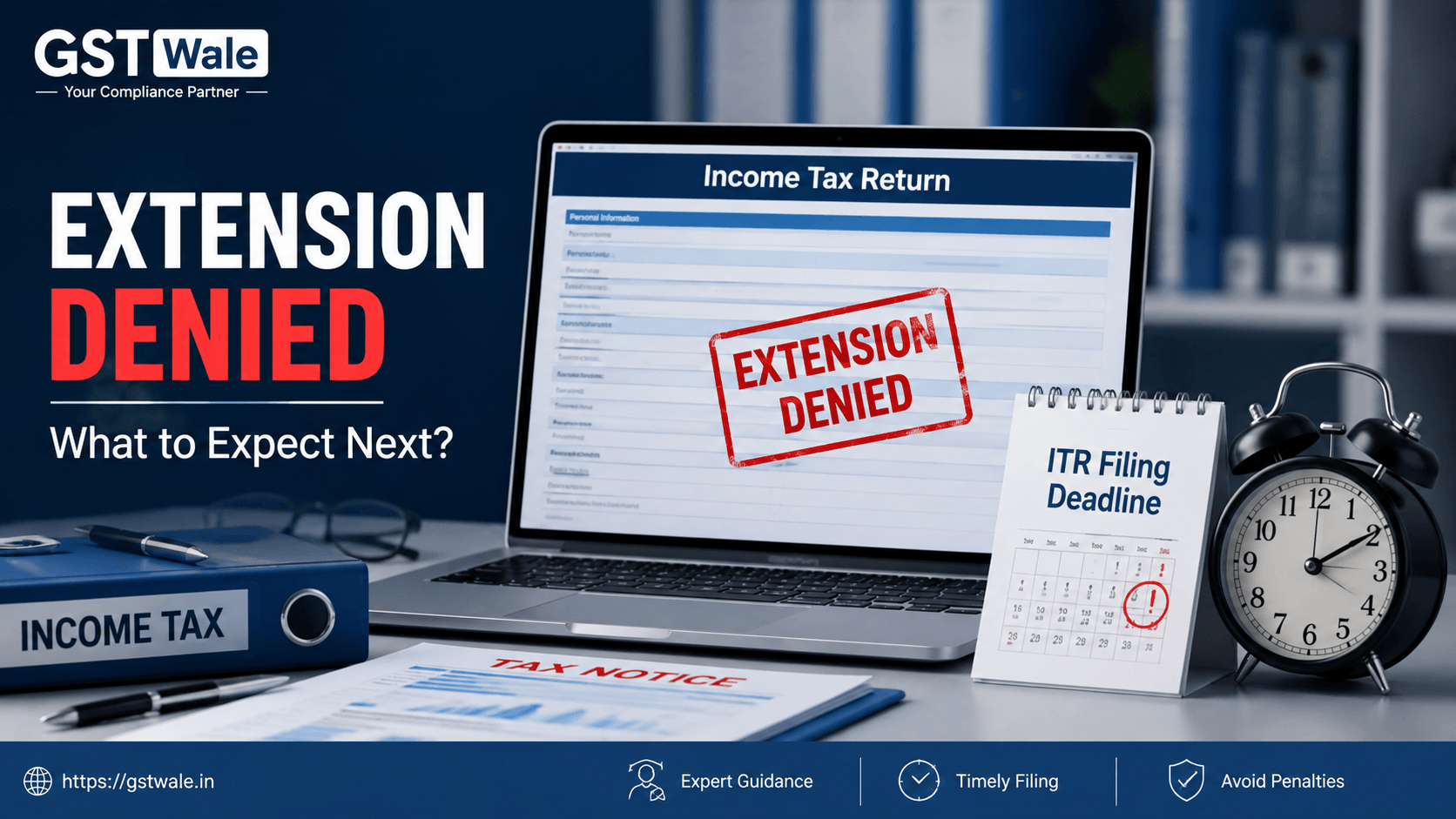
What Happens When Your Income Tax Return Extended Request Is Denied?
Tax deadlines can create genuine pressure, especially when financial records, audit reports, or important documents are still pending. If you requested additional time for filing but your income tax return extended request is denied by the authorities, the situation needs immediate attention. The best approach is not to panic but to understand your obligations and act quickly. If you need professional assistance with filing, GST Wale can help you complete your ITR Filing accurately and within the applicable timeline.
An extension request does not automatically give you additional time unless it has been formally accepted. Therefore, if your income tax return extended request is rejected, you should generally work on the assumption that the original applicable deadline continues to apply. Delaying further can increase your financial and compliance exposure.
Why Can an Income Tax Return Extended Request Be Denied?
An extension is not necessarily a taxpayer's automatic right. Authorities may consider the circumstances, the nature of the request, the applicable tax rules, and whether sufficient justification has been provided.
Some common reasons for denial may include:
- The request was submitted after the relevant deadline.
- The reason for seeking additional time was not considered sufficient.
- Required supporting information was missing.
- The request did not meet the applicable procedural requirements.
- The taxpayer had already received adequate time to comply.
- The circumstances did not justify special consideration.
For this reason, taxpayers should never treat an extension request as a substitute for preparing their return. If there is uncertainty about whether extra time has actually been granted, professional advice should be obtained promptly.
What Happens After an Income Tax Return Extended Request Is Rejected?
The immediate question for most taxpayers is simple: "What should I do now"
The answer depends on the applicable filing deadline and your individual tax position. However, rejection of an income tax return extended request generally means you should focus on completing and submitting the return as soon as possible rather than waiting for another opportunity.
1. The Original Filing Obligation Continues
If the extension has not been approved, the original statutory deadline generally remains relevant. You should review the applicable assessment year, filing category, and deadline before taking further action.
Do not assume that submitting an extension request itself protects you from late-filing consequences.
2. Late-Filing Consequences May Apply
Depending on your circumstances and the applicable provisions, filing after the prescribed due date can result in a late-filing fee or other consequences.
This is why an income tax return extended request should never be viewed as guaranteed relief. Once you know that your request has been denied, every additional day can matter.
3. Interest Accumulation Can Increase
Taxpayers who have unpaid tax may also face interest accumulation for the period of delay, depending on the nature of the liability.
For example, suppose a business owner calculates that ₹80,000 of tax remains payable. If the return and payment are delayed, the total financial liability may increase. The exact interest calculation depends on the relevant provisions and facts.
A professional review can help determine the amount payable before filing.
Is There an Immediate Penalty?
One common misconception is that rejection automatically means an immediate penalty will be imposed.
That is not necessarily how every case works. Different consequences can apply depending on the taxpayer's income, filing obligation, tax payable, nature of the default, and applicable provisions.
A taxpayer should therefore distinguish between:
- Late-filing fees
- Interest on outstanding tax
- Notices or compliance communications
- Additional proceedings where applicable
- Other consequences arising from specific defaults
The safest approach is to calculate the potential exposure instead of assuming that one fixed penalty will apply to everyone.
Income Tax Return Extended: What Should You Do Immediately?
If your request has been rejected, follow a structured approach.
Step 1: Verify the Rejection
Check the communication or status carefully. Confirm whether the request was actually denied, whether any additional information has been requested, and what deadline currently applies.
Keep a copy of the communication for your records.
Step 2: Calculate Your Tax Position
Before filing, determine:
- Total taxable income
- Tax already paid
- TDS/TCS credits
- Advance tax paid
- Self-assessment tax payable
- Applicable interest
- Any applicable late-filing fee
Do not simply upload an incomplete return to meet the deadline. Accuracy remains important.
Step 3: Collect Missing Documents
Bring together Form 16, Form 16A where applicable, bank statements, investment documents, business records, capital-gains information, rental details, and other relevant records.
For business taxpayers, reconciliation of books, sales, expenses, and tax records may also be necessary.
Step 4: Adopt an Urgent Filing Strategy
Once the extension is denied, your urgent filing strategy should focus on reducing further delay without compromising accuracy.
A practical sequence is:
- Verify the applicable deadline.
- Reconcile income and tax credits.
- Identify outstanding tax.
- Pay applicable tax and interest.
- Prepare the return carefully.
- Submit the return through the prescribed process.
- Complete verification within the applicable period.
- Preserve the acknowledgement and payment records.
Can Delay Create a Non-Compliance Flag?
Yes, depending on the circumstances, failure to meet an applicable filing obligation can increase the possibility of compliance-related communication from the tax department.
A non-compliance flag should not automatically be interpreted as a finding of wrongdoing. It can simply mean that a taxpayer's records or filing status require attention.
The important point is to respond properly if a notice or communication is received. Ignoring it can make a manageable issue considerably more complicated.
Could There Be a Summary Assessment Risk?
Taxpayers should also understand that prolonged non-compliance can potentially increase summary assessment risk or other assessment-related consequences, depending on the circumstances and applicable law.
This does not mean that every late return will result in an assessment proceeding. However, taxpayers should avoid creating unnecessary complications by delaying compliance after learning that their extension request has been rejected.
For businesses, this is particularly important because tax information may be cross-checked against reporting from other parties and financial records.
Real-World Example
Consider Rahul, who runs a small trading business. He expected additional time because his financial records were being finalised and submitted an extension request.
The request was denied.
Instead of waiting, Rahul immediately reviewed his books, reconciled his tax credits, calculated his outstanding liability, paid the applicable amount, and filed his return.
Now compare this with another taxpayer who receives the same rejection but waits several weeks hoping that another extension will become available. During that period, interest may continue to accumulate, and the taxpayer may receive compliance-related communication.
The lesson is straightforward: once an income tax return extended request is denied, prompt action is usually better than uncertainty.
What If You Cannot Pay the Entire Tax?
This is where professional advice becomes particularly useful.
If you discover that substantial tax is payable but you cannot arrange the entire amount immediately, do not simply stop the filing process. Understand your filing and payment obligations separately and evaluate the options available under the applicable rules.
A CA can review your computation, verify whether all eligible credits and deductions have been considered, and help you understand the consequences of the outstanding amount.
How GST Wale Can Help
At GST Wale, we believe tax compliance should be handled with clarity rather than last-minute panic. When an income tax return extended request is denied, our focus is on helping taxpayers understand their position and take the right next step.
Professional assistance can be particularly valuable when:
- Your return involves business income.
- You have multiple sources of income.
- Capital gains need to be reported.
- Your tax liability is significant.
- There are discrepancies in tax credits.
- You have received a tax notice.
- Your return has become overdue.
Getting the return filed correctly can help prevent a small delay from becoming a larger compliance problem.
FAQs
What does rejection of an income tax return extended request mean?
It generally means that the requested additional time has not been granted. The taxpayer should check the official communication and applicable deadline and take steps to comply without further unnecessary delay.
Will an extension request rejection automatically result in a penalty?
Not necessarily. The consequences depend on the taxpayer's circumstances and the applicable provisions. Late-filing fees, interest, notices, or other consequences may apply depending on the facts.
Should I file immediately after my extension request is denied?
If you are already beyond the applicable deadline or the deadline is approaching, you should generally prioritise accurate filing and payment of applicable dues rather than waiting for another extension.
Can interest continue to accumulate after the extension request is rejected?
Where tax remains payable, applicable interest may continue to arise according to the relevant provisions. The actual calculation depends on the taxpayer's liability and circumstances.
Can GST Wale help with a delayed income tax return?
Yes. GST Wale can assist with reviewing income and tax information, preparing the return, identifying applicable dues, and guiding you through the filing and compliance process.
Act Quickly After an Income Tax Return Extended Request Is Denied
A rejected income tax return extended request is a signal to act, not a reason to panic. The longer a taxpayer waits, the greater the possibility of additional interest, late-filing consequences, compliance communications, or other complications.
Verify the rejection, determine your actual tax liability, organise your documents, and follow an urgent filing strategy. If the situation involves business income, significant tax liability, missing records, or a tax notice, professional guidance can make the process much smoother.
For reliable, practical and professional tax assistance, connect with GST Wale and get your income tax compliance back on track.
 Previous