


Understanding Section 115BAC: The Backbone of the New Regime in Income Tax E Filing
Understanding Section 115BAC: The Backbone of the New Regime in Income Tax E Filing
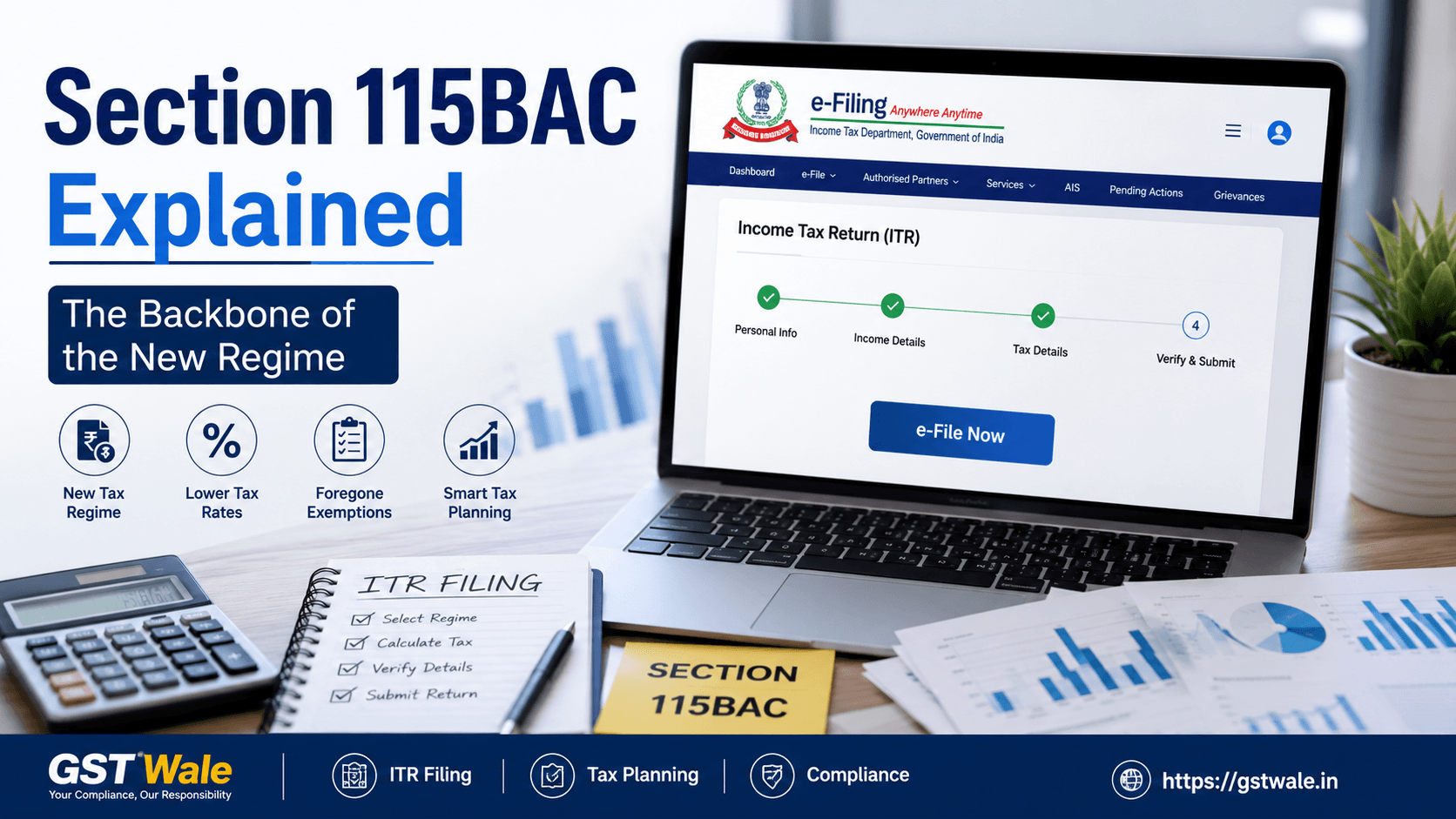
Understanding Section 115BAC in Income Tax E Filing
For many taxpayers, income tax e filing is no longer simply about entering income figures and submitting an ITR. Choosing the right tax regime can directly affect the final tax liability. At the centre of India's new tax regime is Section 115BAC of the Income Tax Act, 1961. If you are preparing your return, understanding this section can make ITR Filing much easier and help you make a more informed tax decision.
Section 115BAC introduced an alternative tax mechanism with comparatively lower tax rates but fewer exemptions and deductions. Over time, the new regime has become the default regime for eligible taxpayers. For AY 2026-27, the revised slabs under Section 115BAC make understanding the provision even more important for anyone involved in income tax e filing.
What Is Section 115BAC?
Section 115BAC provides taxpayers with an alternative method of calculating income tax. Instead of relying heavily on deductions and exemptions, the new regime generally offers lower slab rates and a simpler calculation structure.
The important point is that the new regime is now the default tax regime for eligible individual taxpayers, HUFs and certain other persons. However, eligible taxpayers can still choose the old regime subject to the applicable conditions.
This is why Section 115BAC has become the backbone of modern income tax e filing. A taxpayer cannot simply look at the lowest-looking slab and assume it will always result in lower tax. The complete calculation needs to consider salary, business income, deductions, exemptions, investments and other sources of income.
How Does the New Tax Regime Work?
Under the current provisions applicable for AY 2026-27, the new regime has revised slabs beginning with a nil rate up to ₹4 lakh, followed by 5%, 10%, 15%, 20%, 25% and 30% slabs as taxable income increases.
For example, the structure for an individual taxpayer is broadly:
- Up to ₹4 lakh – Nil
- ₹4 lakh to ₹8 lakh – 5%
- ₹8 lakh to ₹12 lakh – 10%
- ₹12 lakh to ₹16 lakh – 15%
- ₹16 lakh to ₹20 lakh – 20%
- ₹20 lakh to ₹24 lakh – 25%
- Above ₹24 lakh – 30%
These rates are applied progressively, meaning the entire income is not taxed at the rate applicable to the highest slab.
For taxpayers using income tax e filing, this distinction is important. A common misunderstanding is that entering the ₹12 lakh or ₹16 lakh slab means the complete income gets taxed at that rate. In reality, different portions of taxable income are taxed at different slab rates.
Why Foregone Exemptions Matter Under Section 115BAC
One of the biggest differences between the two regimes is the treatment of deductions and exemptions.
Under the old regime, taxpayers may use provisions such as certain deductions under Chapter VI-A, HRA-related exemptions and other eligible benefits to reduce taxable income. The new regime removes or restricts several such benefits in exchange for simpler taxation.
This means foregone exemptions should be considered before making your choice.
For instance, imagine a salaried employee who earns ₹15 lakh annually and has substantial eligible investments and deductions under the old regime. Another employee with the same salary may have very few deductions. Their most tax-efficient regime may not be the same.
This is where professional tax planning becomes valuable. Instead of automatically selecting the default option, compare the actual numbers.
Tax Slab Optimization: What Should Taxpayers Check?
Tax slab optimization does not mean artificially reducing income. It means arranging your legitimate tax information correctly and selecting the regime that produces an appropriate tax outcome.
Before completing income tax e filing, check:
- Total salary or business income
- Income from house property
- Capital gains and other income
- Eligible deductions
- Exempt allowances, where applicable
- Investment-related deductions
- Health insurance deductions, where applicable
- Housing loan-related benefits
- Standard deduction and other benefits available under the selected regime
A salaried taxpayer should also review Form 16, AIS and Form 26AS before finalising the return. Differences between these records and the information entered in the return can create unnecessary notices or reconciliation issues.
New Regime vs Old Regime: Which One Is Better?
There is no universal answer.
The new regime can be attractive for taxpayers who have relatively fewer deductions and want a straightforward calculation. On the other hand, taxpayers with substantial eligible deductions and exemptions may find the old regime competitive.
Consider a simple example.
Suppose Rahul earns ₹18 lakh annually but has limited investments qualifying for deductions. His calculation under the new regime may be comparatively straightforward. Now consider Priya, who earns the same amount but has significant eligible deductions and exemptions under the old framework. Her tax comparison could produce a different result.
Therefore, the right approach is comparison before choice, rather than following what a friend, colleague or family member selected.
Choice Declaration and Income Tax E Filing
For taxpayers without income from business or profession, the regime selection can generally be changed from year to year while filing the return, subject to the applicable rules.
For eligible taxpayers having income from business or profession, opting out of the default regime involves additional compliance, including Form 10-IEA within the prescribed timeline. The rules for switching back to the new regime also have specific conditions.
This makes the choice declaration an important part of tax compliance.
Do not wait until the final submission screen to think about the regime. Compare the tax liability before completing the return. This systematic switch between regimes, where permitted, should be based on your financial position and applicable legal provisions.
A Practical Step-by-Step Approach
Step 1: Collect Your Income Information
Keep Form 16, salary details, bank interest information, rental income details, capital gains statements and other income records ready.
Step 2: Check AIS and Form 26AS
Review the information reported to the Income Tax Department, particularly TDS, interest and other reported transactions.
Step 3: Calculate Under Both Regimes
Where you are eligible to choose, calculate the tax under both options. Include all applicable deductions and exemptions in the old-regime calculation and use the benefits actually available under the new regime.
Step 4: Review the Rebate
The new regime provides a rebate for eligible resident individuals subject to the applicable income limit and conditions. For AY 2026-27, taxpayers should use the current year's rules rather than relying on older tax calculators or previous-year assumptions.
Step 5: Make the Regime Selection Carefully
Once the comparison is complete, select the appropriate regime and ensure the return reflects that choice correctly.
Step 6: Verify the Return
After submission, complete the required verification process within the prescribed timeline. Filing the return is not the final step if verification remains pending.
Common Mistakes During Income Tax E Filing
Taxpayers often make avoidable mistakes while selecting their tax regime.
The most common ones include:
- Assuming the new regime is automatically cheaper for everyone
- Using outdated tax slabs
- Ignoring income other than salary
- Not checking AIS and Form 26AS
- Claiming deductions that are unavailable under the selected regime
- Selecting the wrong regime while preparing the return
- Ignoring the special rules applicable to business or professional income
- Filing without reconciling TDS figures
These mistakes can affect both tax computation and the accuracy of income tax e filing.
Is Section 115BAC Suitable for Business Owners?
Business owners and professionals need to be particularly careful. Their regime selection rules are not identical to those applicable to taxpayers without business or professional income.
If a business owner wants to opt out of the default new regime, the prescribed Form 10-IEA requirements and deadlines must be considered. A later switch back to the new regime can also be subject to specific conditions.
Therefore, business owners should not make the decision based only on the tax slabs. Their deductions, business structure, income pattern and future tax planning should also be evaluated.
Frequently Asked Questions
What is Section 115BAC?
Section 115BAC provides the framework for the new tax regime. It offers revised tax slabs while limiting several exemptions and deductions available under the old regime.
Is the new tax regime the default regime?
Yes. For eligible taxpayers, the new regime is the default regime. However, taxpayers meeting the applicable conditions may opt for the old regime.
Can I choose the old regime while filing my return?
Yes, where you are eligible to opt out of the default regime. The procedure depends on whether you have business or professional income and must be followed within the prescribed timelines.
Should everyone choose the new tax regime?
No. The better option depends on individual circumstances. Compare both regimes after considering legitimate deductions, exemptions, income sources and applicable rebates.
Why is Section 115BAC important for income tax e filing?
Section 115BAC directly influences how taxable income and tax liability are calculated. Understanding it helps taxpayers make the correct regime selection and avoid unnecessary tax-compliance errors.
Make Income Tax E Filing a Planned Decision
Section 115BAC has fundamentally changed the way Indian taxpayers approach income tax e filing. The new regime is designed around simpler calculations and revised slab rates, but that does not mean taxpayers should select it without comparison.
The right approach is to review your income, understand the foregone exemptions, perform proper tax slab optimization, compare both regimes and complete the required choice declaration carefully. For business and professional taxpayers, additional compliance requirements make professional guidance even more valuable.
At GST Wale, our objective is to make taxation easier to understand and compliance easier to manage. Whether you are an individual, salaried professional, freelancer or business owner, take your tax decision based on actual numbers rather than assumptions.
 Previous