


How to Handle Double Taxation and Form 67 Requirements via E Filing of Income Tax
How to Handle Double Taxation and Form 67 Requirements via E Filing of Income Tax
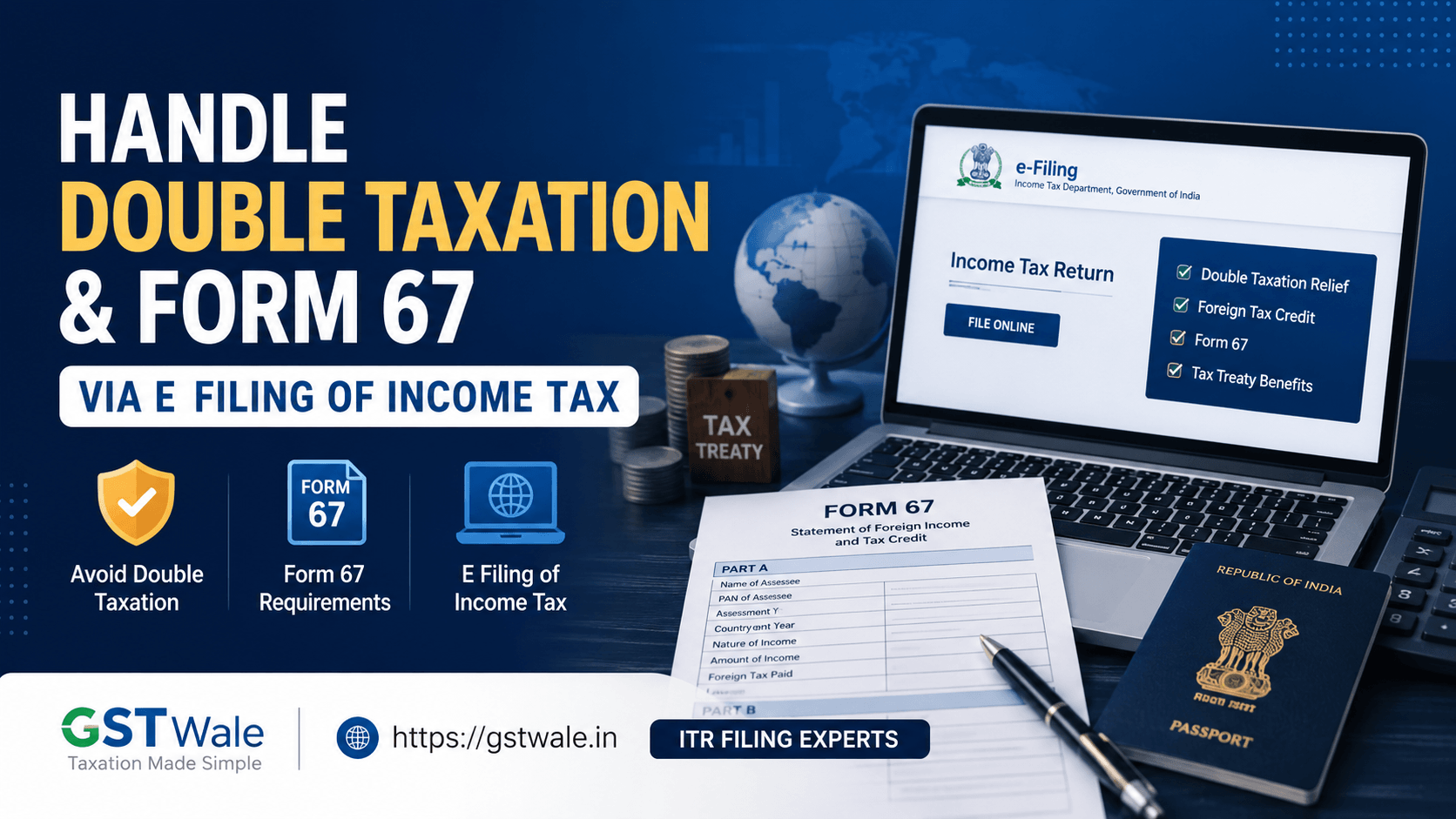
If you earn income from outside India, paying tax in the foreign country and again in India can feel like being taxed twice on the same income. This is where proper e filing of income tax becomes important. Indian residents may be able to claim relief for eligible overseas tax paid, subject to applicable rules and tax treaties. If you are also looking for professional assistance with your return, GST Wale can help you with ITR Filing and related tax compliance.
For many taxpayers, the difficult part is not earning foreign income but correctly reporting it in India and claiming the available foreign tax credit. Form 67 plays an important role in this process. A small mistake in reporting income, selecting the applicable provision, or maintaining documentation can affect the credit you expect to receive.
What Is Double Taxation in Foreign Income?
Double taxation generally occurs when the same income becomes taxable in two countries. For example, suppose an Indian resident works for an overseas company and earns ₹10 lakh from services performed for a foreign client. Tax may be deducted or paid in the foreign country, while the same income may also be taxable in India because the taxpayer is resident in India.
This does not automatically mean that the taxpayer has to bear the full tax burden twice. India provides mechanisms for relief, subject to eligibility and compliance.
The Income Tax Department states that a resident taxpayer can claim credit for eligible foreign tax paid outside India under Rule 128, provided the required conditions and filing requirements are satisfied.
How e filing of income tax Helps Avoid Double Taxation
The purpose of e filing of income tax is not merely to submit an ITR online. For taxpayers with international income, it also provides a structured process for reporting foreign income and claiming eligible tax relief.
Depending on the circumstances, relief may be available under:
- A Double Taxation Avoidance Agreement (DTAA), generally through applicable tax treaty benefits
- Section 90 or 90A where the relevant treaty provisions apply
- Section 91 in certain cases where relief is available under the Income-tax Act
The correct provision depends on the country involved, nature of income, tax paid overseas and the applicable treaty or domestic law. Therefore, taxpayers should not simply enter the overseas tax amount and assume that the entire amount will automatically become a credit.
What Is Form 67 and Why Is It Important?
Form 67 is the statement used for reporting income from a foreign country or specified territory and claiming Foreign Tax Credit. The Income Tax Department currently requires eligible taxpayers to submit Form 67 online through the e-Filing portal.
Form 67 broadly contains:
Part A
Part A captures taxpayer details, foreign income information and the foreign tax credit being claimed.
Part B
Part B deals with specific information relating to foreign tax, including situations involving disputed foreign tax and refund of foreign tax resulting from carry-back of losses.
Verification
The taxpayer confirms the accuracy of the information provided under the applicable rules.
Attachments
The taxpayer is required to provide relevant proof of foreign tax paid or deducted, such as a certificate or statement and proof of payment or deduction.
This is why proper documentation should be collected before starting the e filing of income tax process.
When Should Form 67 Be Filed?
One of the most important compliance points is timing.
As per the current Income Tax Department guidance, Form 67 should be filed on or before the due date specified under Section 139(1) for furnishing the income-tax return.
A common mistake is to first complete the ITR and then think about Form 67 later. Taxpayers dealing with foreign income should plan both filings together.
For example, if you earned interest from a foreign bank and tax was deducted in that country, you should collect the foreign tax certificate, calculate the eligible credit, prepare Form 67 and ensure the relevant foreign income and credit are correctly reflected in the ITR.
Step-by-Step Process for Form 67 Through e filing of income tax
The process is online and can be completed through the Income Tax e-Filing portal.
Step 1: Keep Your Foreign Income Records Ready
Before opening Form 67, collect details such as:
- Foreign income amount
- Country from which the income was received
- Nature of income
- Overseas tax paid or deducted
- Date and proof of payment or deduction
- Foreign tax identification details, wherever applicable
- Relevant tax certificate or statement
Do not rely only on bank statements. A proper tax certificate or equivalent evidence can make the credit claim easier to substantiate.
Step 2: Understand the Income Sourcing Rules
Income sourcing rules determine where particular income is considered to arise and how it should be reported.
For instance, foreign salary, interest, dividend, capital gains and professional income can have different tax implications. The place where services are performed, the location of the asset and the terms of the relevant agreement can matter.
This is an area where professional review can prevent costly mistakes.
Step 3: Log in to the Income Tax Portal
The Income Tax Department's current process is:
e-File → Income Tax Forms → File Income Tax Forms → Form 67
The taxpayer then selects the relevant Assessment Year and starts the form.
Step 4: Enter Foreign Income and Tax Details
Enter the foreign income and foreign tax information carefully. The amount claimed as foreign tax credit should be supported by your documentation.
The credit is not simply a mechanism to claim any amount appearing on a foreign document. Eligibility and the amount of relief depend on the applicable provisions.
Step 5: Upload Supporting Documentation
Attach proof of payment or deduction of foreign tax. The Income Tax Department specifically provides for uploading the relevant certificate or statement and proof of payment/deduction.
Keep the documents readable and consistent with the figures entered in Form 67.
Step 6: Preview and e-Verify
After completing the form, review all information before submission. Form 67 can be e-verified through the permitted verification methods, after which an acknowledgement number is generated.
Keep the acknowledgement safely with your tax records.
Practical Example of Foreign Tax Credit
Consider Rahul, an Indian resident who receives ₹8 lakh in professional income from a US client. Suppose ₹80,000 is withheld as US tax.
Rahul cannot simply assume that ₹80,000 will reduce his Indian tax liability by the same amount.
He needs to:
- Report the foreign professional income in his Indian tax return.
- Determine whether the income is eligible for treaty-based relief or relief under domestic law.
- Check the applicable tax treaty provisions.
- Maintain proof of the overseas tax paid or deducted.
- Complete Form 67 within the prescribed timeline.
- Report the foreign income and credit correctly in the applicable ITR schedules.
The actual credit may be restricted based on the applicable rules and the Indian tax attributable to the relevant foreign income.
Common Mistakes Taxpayers Should Avoid
During e filing of income tax, taxpayers with overseas income should be particularly careful about the following mistakes:
Filing Form 67 Too Late
Missing the prescribed deadline can create complications in claiming the foreign tax credit. Do not treat Form 67 as an optional document to be completed after the return.
Reporting Different Figures
The foreign income, tax paid and credit claimed should be consistent across the relevant documents and ITR schedules.
Ignoring Tax Treaty Benefits
India has tax treaties with several countries. Depending on the income and circumstances, tax treaty benefits may provide an important mechanism for avoiding double taxation.
Poor Documentation
Foreign tax certificates, withholding statements, payment evidence and other relevant records should be preserved. A credit claim without adequate supporting evidence can become difficult to defend.
Assuming All Foreign Tax Is Creditable
Not every foreign levy necessarily qualifies for credit in the same manner. The nature of the foreign tax and the applicable Indian provisions need to be examined.
Why Professional Assistance Can Make a Difference
International income can make an otherwise straightforward ITR more complicated. Taxpayers may need to consider residency, income sourcing rules, treaty provisions, foreign tax credit, disclosure requirements and supporting documentation together.
A professional review is particularly useful when you have income from multiple countries, foreign investments, overseas salary, consulting income, foreign bank interest or complex DTAA-related issues.
At GST Wale, our approach is to look at the complete tax position rather than treating Form 67 as an isolated formality. The objective is to report income correctly, identify eligible relief and maintain the necessary documentation for future reference.
FAQs About e filing of income tax and Form 67
1. Who needs to file Form 67?
A resident taxpayer seeking credit for eligible foreign tax paid or deducted generally needs to furnish Form 67 as prescribed. It is particularly relevant when foreign income has already suffered tax outside India.
2. Can Form 67 be filed offline?
No. The Income Tax Department currently provides Form 67 through the online e-Filing system.
3. Is a CA certificate compulsory for Form 67?
No. The Income Tax Department's FAQ states that obtaining a CA certificate is not mandatory merely for verifying and confirming the foreign tax credit details in Form 67.
4. What documents are needed for claiming foreign tax credit?
Relevant documentation can include a foreign tax certificate or statement and proof of payment or deduction of the foreign tax. The exact documents can depend on the country and nature of income.
5. Can tax treaty benefits help with double taxation?
Yes. Where an applicable DTAA exists, its provisions may provide relief from double taxation. However, the correct treaty article and eligibility should be checked based on the nature and source of income.
Complete e filing of income tax Carefully
Foreign income does not necessarily mean that you have to suffer taxation twice. With the correct use of foreign tax credit provisions, applicable tax treaty benefits, timely Form 67 filing and proper documentation, eligible taxpayers can seek relief from double taxation.
The key is to start early. Collect your overseas tax records, understand the income sourcing rules, calculate the eligible credit and complete Form 67 within the prescribed timeline before finalising your return.
If foreign income or overseas tax is making your e filing of income tax complicated, GST Wale can help you approach the process systematically and compliantly. Get your tax filing reviewed professionally and avoid mistakes that could lead to unnecessary tax demands, delayed credits or compliance issues.
 Previous