


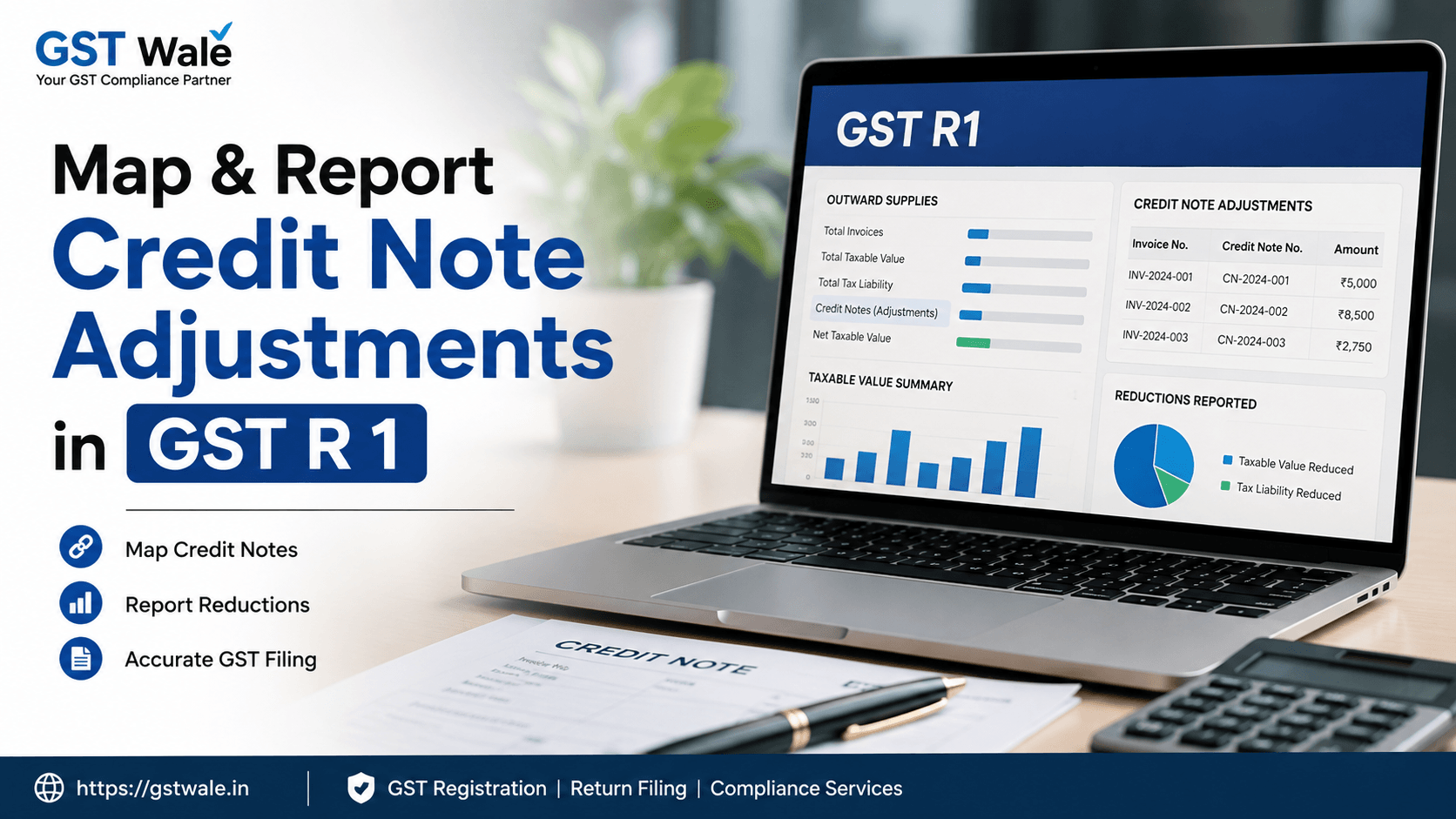
How to Map and Report Credit Note Adjustments and Reductions in GST R 1
How to Map and Report Credit Note Adjustments and Reductions in GST R 1
For many businesses, a sale does not always remain at the original value. A customer may return goods, receive a post-sale discount, or have an invoice corrected because of a pricing or quantity issue. These changes have a direct impact on GST reporting, and understanding how to map them correctly in gst r 1 is important for keeping your returns accurate. If your business is newly starting or regularising its indirect tax compliance, completing your GST Registration correctly is equally important before focusing on return-level adjustments.
Why Credit Note Adjustments Matter in GST R 1
A credit note is not simply an accounting document. When it relates to a taxable supply, it can affect the taxable value and GST originally reported on that transaction. Therefore, the adjustment must be properly reflected in gst r 1 so that your outward supply details remain consistent with your books.
Suppose a business issues an invoice of ₹1,00,000 plus GST. Later, goods worth ₹20,000 are returned by the customer. The supplier may issue a credit note for the eligible reduction. If the credit note is not mapped and reported properly in gst r 1, the books, GST return and customer's records may show different figures.
This is why every credit note should have a clear connection with the original transaction wherever the GST reporting mechanism requires it.
Understanding Credit Notes and Reductions in GST R 1
The first step is to understand why the reduction has occurred. Not every reduction in accounting records should automatically be treated in the same way for GST reporting.
Common situations include:
- Return of goods by the customer
- Post-sale discounts meeting applicable GST conditions
- Cancellation or partial cancellation of a supply
- Excess billing or incorrect pricing
- Quantity differences discovered after invoicing
- Other eligible reductions requiring a credit note
Before reporting the adjustment in gst r 1, check the original invoice number, invoice date, taxable value, GST rate and reason for issuing the credit note.
Post Sales Discounts Documentation
Post sales discounts documentation deserves special attention. A business should maintain agreements, discount schemes, invoices, credit notes and other supporting records that establish why the reduction was provided.
For example, if a distributor receives a volume-based discount after purchasing a specified quantity during a quarter, the documentation should clearly establish the commercial arrangement and its connection with the supplies.
Poor documentation can make a legitimate adjustment difficult to defend during reconciliation or departmental scrutiny.
How to Map a Credit Note to the Original Invoice
Correct mapping is one of the most important practical steps when reporting adjustments in gst r 1.
Start by identifying the original invoice against which the credit note is being issued. Match the following details:
- Original invoice number
- Original invoice date
- Customer GSTIN, where applicable
- Taxable value
- Applicable GST rate
- CGST, SGST/UTGST or IGST amount
- Reason for the adjustment
- Credit note number and date
The credit note should then be recorded in the appropriate section of gst r 1 based on the nature of the transaction and applicable reporting requirements.
A common mistake is to reduce the sales figure directly in accounting software without creating the corresponding GST document. This may make the books look correct but can create a reconciliation difference in gst r 1.
Why Invoice Mapping Is Important
Proper invoice mapping creates an audit trail. If the original supply was ₹50,000 and an eligible credit note reduces it by ₹5,000, the records should make it possible to understand how the final taxable value was arrived at.
This becomes particularly important when a business has hundreds or thousands of invoices. Without proper mapping, return reconciliation can become unnecessarily complicated.
Financial Credit Notes vs Tax Notes
Businesses should understand the difference between financial credit notes vs tax notes before making any reduction.
A commercial or financial credit note may be issued for accounting or commercial purposes without necessarily reducing the taxable value and GST of the original supply. On the other hand, a credit note having GST implications must be handled according to the applicable provisions and reported appropriately.
For example, imagine a supplier gives a customer a ₹10,000 commercial benefit that does not qualify for reduction of the taxable value under the applicable GST conditions. Simply reducing the taxable turnover in gst r 1 may be incorrect.
The accounting treatment and GST treatment should therefore be considered separately.
Reporting Return Value Corrections in GST R 1
Return value corrections are another area where businesses need to be careful.
Suppose an invoice was originally reported with a taxable value of ₹80,000, but the actual transaction should have been ₹75,000. The business should determine whether the difference requires amendment of the original invoice, issuance of a credit note, or another correction based on the facts and applicable GST rules.
Do not use a credit note merely as a shortcut to correct every accounting error.
Before making a correction in gst r 1, compare the return data with:
- Sales register
- Tax invoices
- Credit and debit notes
- E-invoice records, where applicable
- E-way bill information, where relevant
- Customer reconciliation
- General ledger
This process helps identify whether the reduction is genuine or simply the result of an entry error.
How Taxable Turnover Drops Affect GST Reporting
A sudden reduction in taxable turnover should always be investigated.
Taxable turnover drops can happen because of genuine business reasons, such as increased sales returns, cancelled orders, year-end discounts or corrections. However, a significant reduction without supporting documentation can create questions during reconciliation.
For instance, if monthly sales were consistently around ₹50 lakh but suddenly fall to ₹25 lakh because of large credit notes, management should be able to explain the reason and produce the underlying documents.
GST Wale recommends maintaining a simple credit note register containing the credit note number, date, customer, original invoice, taxable amount, GST amount and reason.
Customer Refund Vouchers and Credit Note Adjustments
Customer refund vouchers can also create confusion when businesses deal with returned goods or cancelled transactions.
A refund made to a customer and a GST credit note are related to the underlying commercial transaction, but they should not automatically be treated as identical accounting or GST documents.
For example, if a customer returns goods and the supplier refunds the amount, the business should ensure that the sales return, credit note, refund entry and GST reporting are properly aligned.
This avoids situations where the bank statement shows a refund but the GST records continue to show the original taxable supply without the appropriate adjustment.
A Practical Reconciliation Method
A useful monthly process is to prepare a credit note reconciliation before filing gst r 1.
Compare:
Books → Credit Note Register → GST Return Data → Customer Records
Any difference should be investigated before final submission.
If a credit note exists in the books but is missing from gst r 1, determine whether it needs to be reported or amended. Similarly, if a credit note appears in gst r 1 but is absent from the accounting records, investigate the source before proceeding.
Common Mistakes Businesses Should Avoid
Several recurring mistakes can make GST reconciliation difficult:
- Issuing credit notes without identifying the original transaction
- Treating every commercial discount as a GST reduction
- Failing to maintain supporting documentation
- Entering incorrect GST rates
- Reporting a reduction in the books but not reconciling it with gst r 1
- Using credit notes to hide accounting errors
- Ignoring customer-side reconciliation
- Waiting until the end of the financial year to investigate differences
A disciplined monthly review is much easier than trying to reconstruct several months of transactions at once.
Step-by-Step GST R 1 Credit Note Checklist
Before filing gst r 1, GST Wale recommends following this basic process:
Step 1: Download or prepare the month's sales and credit note register.
Step 2: Match every credit note with its original invoice wherever applicable.
Step 3: Verify customer GSTIN and transaction details.
Step 4: Check taxable value and GST calculations.
Step 5: Review the reason for the reduction and supporting documents.
Step 6: Separate GST-impacting credit notes from purely financial adjustments.
Step 7: Report eligible credit notes in the appropriate gst r 1 section.
Step 8: Reconcile the final return figures with the accounting books.
Step 9: Investigate unusual taxable turnover drops.
Step 10: Preserve invoices, credit notes, agreements and other supporting records.
FAQs About GST R 1 Credit Note Adjustments
Can every credit note reduce GST liability?
No. The GST impact depends on the nature of the credit note and whether the applicable legal conditions for reducing the taxable value and tax have been satisfied. A commercial reduction recorded only for accounting purposes should not automatically be treated as a reduction of GST liability.
Should a credit note always be linked to the original invoice?
Where the reporting mechanism requires invoice-level linkage, the original invoice details should be correctly mapped. Maintaining this connection also creates a clear audit trail and makes reconciliation substantially easier.
Can post-sale discounts affect GST reporting?
They can, but the treatment depends on the nature of the discount and applicable GST conditions. Businesses should maintain proper post sales discounts documentation before claiming any reduction in taxable value.
What should I do if gst r 1 does not match my books?
First, compare the sales register, credit note register, tax invoices and return data. Identify whether the difference is caused by a missing credit note, incorrect value, timing issue or accounting error. Correct the underlying issue rather than making an unsupported adjustment.
Why should businesses reconcile credit notes every month?
Monthly reconciliation helps identify errors while the transaction details are still easily available. It also reduces the risk of incorrect tax reporting, customer mismatches and last-minute corrections.
Report GST R 1 Adjustments With Confidence
Credit note adjustments require more than simply reducing a sales figure. Businesses need to understand the reason for the adjustment, maintain proper documentation, map the transaction correctly and ensure that the accounting records agree with gst r 1.
Whether the issue involves post-sale discounts, returned goods, customer refunds, financial credit notes or return value corrections, a structured reconciliation process can prevent avoidable GST complications.
At GST Wale, our approach is simple: understand the transaction first, apply the correct GST treatment and maintain a clear documentary trail. If you need professional assistance with GST compliance, registration, return preparation or reconciliation, connect with GST Wale and keep your gst r 1 reporting accurate, organised and compliant.
 Previous