


The Tax Consultant's Checklist for Filing a Final GST R 3 B Before Business Closure
The Tax Consultant's Checklist for Filing a Final GST R 3 B Before Business Closure
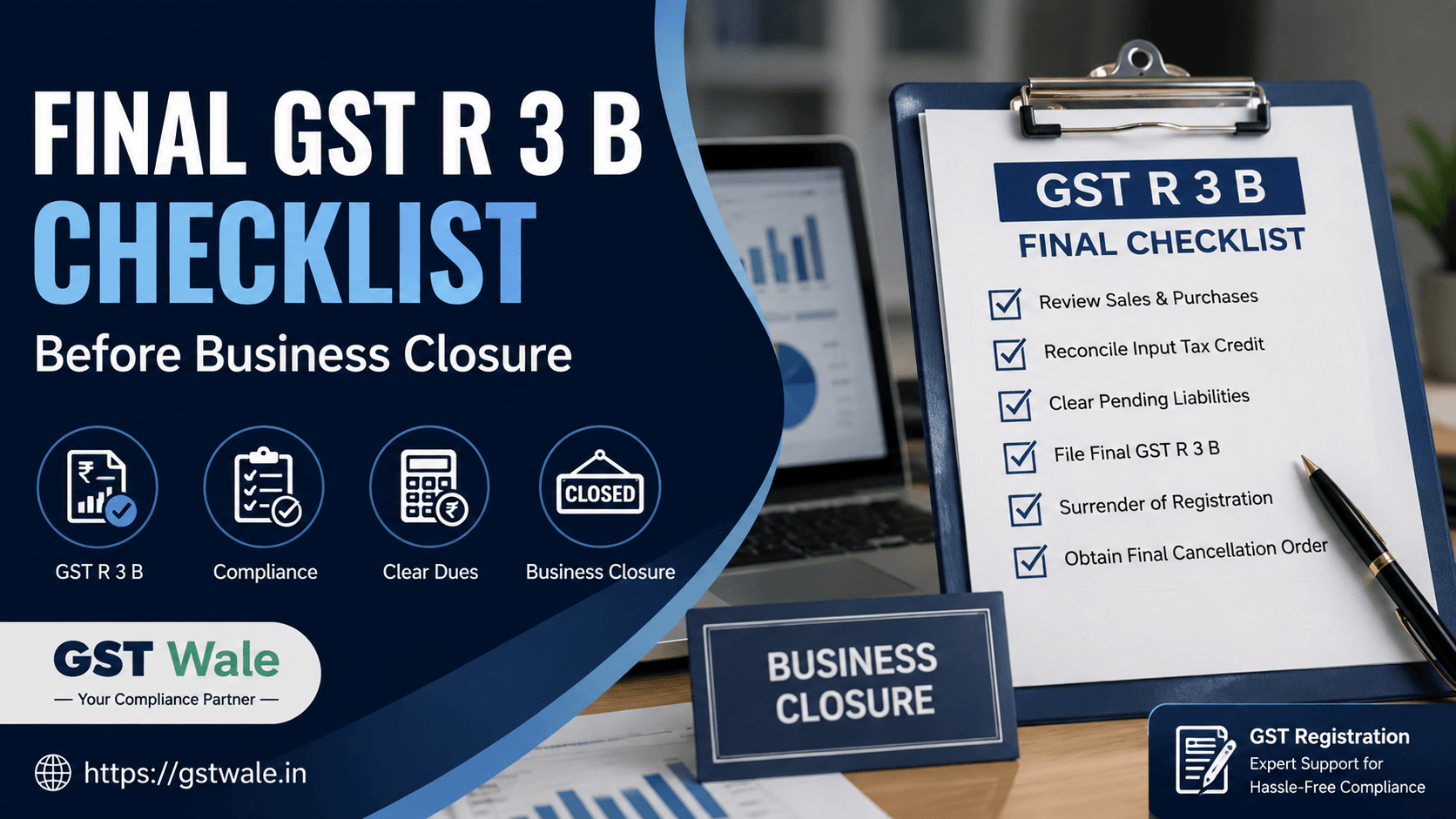
Closing a Business? Do Not Rush the Final GST Filing
Business closure involves much more than shutting the office, settling employees, and closing a bank account. If the business is registered under GST, one of the most important compliance tasks is completing the final gst r 3 b correctly and ensuring that no tax liability remains outstanding.
For a business owner, the process can feel confusing because cancellation of GST registration does not automatically erase pending compliance. If you need professional assistance with the registration and cancellation process, GST Registration support can help you understand the applicable requirements before you proceed.
At GST Wale, we recommend treating the final GST compliance as a proper closure exercise rather than simply filing one last return. A tax consultant should check sales, purchases, input tax credit, stock, tax payments, notices, and other outstanding matters before the business is finally closed.
Why the Final GST R 3 B Matters Before Closure
The gst r 3 b is a summary return in which a registered taxpayer reports outward supplies, eligible input tax credit and GST liability. Even when a business has stopped trading, the return may still need to be filed for the applicable tax period.
A common mistake is assuming that a business with no sales has nothing to report. Depending on the circumstances, there may still be transactions, reverse-charge liabilities, input tax credit adjustments, stock-related tax implications, or previous-period liabilities that need attention.
Therefore, the final gst r 3 b should be considered part of the overall closure process.
GST R 3 B Checklist Before Business Closure
A tax consultant should ideally work through a structured checklist before submitting the last return.
1. Check All Previous GST Returns
Before preparing the final gst r 3 b, verify that all earlier GST returns have been filed.
Check:
- GSTR-1 filing status
- Previous GSTR-3B filing status
- Tax payment history
- Input tax credit claimed
- Any late fees or interest
- Outstanding demands or notices
- Differences between books and GST returns
If an earlier return is pending, filing the final gst r 3 b without resolving it may leave the business with an incomplete compliance record.
2. Reconcile Sales With Books
The closing period should be reconciled with the accounting records. Compare taxable sales, exempt supplies, nil-rated supplies, credit notes, debit notes and advances wherever applicable.
The figures reported in the final gst r 3 b should be supported by the books of accounts and relevant GST records.
For example, suppose a trading business stopped operations on 20 June but issued a credit note in July relating to an earlier invoice. The consultant should consider the appropriate reporting treatment instead of simply filing a nil return.
3. Review Input Tax Credit
Input tax credit requires particular attention at the time of closure.
The consultant should review:
- ITC already claimed
- Any ineligible credit
- Credit requiring reversal
- Credit relating to outstanding invoices
- Capital goods and stock-related credit
- ITC differences between books and GST records
The objective is to ensure that the final gst r 3 b does not carry an incorrect credit balance.
Closure Return Protocols and Stock Treatment
One of the most overlooked areas during business closure is leftover stock.
Selling Leftover Inventory Tax
If inventory remains when a business is being closed, the tax treatment should be examined carefully. Selling the stock before closure may create an outward supply and corresponding GST liability.
The phrase selling leftover inventory tax should not be treated as a simple additional formality. The applicable rate, transaction value, documentation and reporting treatment should all be reviewed.
For example, if a retailer has ₹5 lakh worth of taxable goods remaining, selling those goods before cancellation can result in GST liability that must be properly reported and paid.
Depending on the circumstances, disposal or transfer of stock may also have GST implications. A consultant should review the specific facts before recommending a course of action.
Follow Closure Return Protocols
Proper closure return protocols help ensure that the final compliance cycle is complete.
The consultant should establish:
- The effective date of business closure.
- The relevant GST return period.
- The status of all previous returns.
- Outstanding tax, interest and late fees.
- Stock and capital asset position.
- ITC reversal requirements, wherever applicable.
- Final outward and inward supply figures.
- Whether any GST notices remain unresolved.
Once these points are reviewed, the final gst r 3 b can be prepared with much greater confidence.
Clearing Pending Liabilities Before Cancellation
Identify Every Outstanding Amount
Closing a business does not necessarily mean that its GST liabilities disappear. Any outstanding tax, interest, late fee or demand should be identified and addressed.
Clearing pending liabilities is therefore an essential part of GST closure planning.
Check the electronic cash ledger, electronic credit ledger and liability records. Also review GST notices, orders and demands that may have been issued before the closure application.
If a liability relates to an earlier tax period, it may continue to require attention even after the registration is cancelled.
Do Not Assume Cancellation Ends Compliance
GST cancellation means the registration is cancelled from the applicable effective date. It does not necessarily prevent the department from examining earlier transactions or raising a demand for a previous period.
This is why the final gst r 3 b should be treated as one component of the broader compliance closure rather than the last action by itself.
Surrender of Registration Steps
Once the tax position is reviewed, the taxpayer can proceed with the appropriate surrender of registration steps.
The consultant should generally verify the following:
Step 1: Determine the Correct Closure Date
The actual date on which business activities stopped matters. The consultant should establish the appropriate date based on the business records and circumstances.
Step 2: Complete Pending Returns
Ensure that applicable returns up to the relevant period have been filed. The final gst r 3 b should be checked against the books before submission.
Step 3: Settle Outstanding GST
Any tax, interest or applicable late fee should be considered and paid as required.
Step 4: Apply for Cancellation
The GST cancellation application should contain accurate information regarding the reason and effective date of cancellation.
Step 5: Respond to Departmental Queries
If the GST officer requests clarification or supporting documents, respond within the prescribed timeline.
Step 6: Preserve Records
Keep invoices, ledgers, returns, reconciliation statements, payment records and other GST documents safely after closure. Cancellation does not mean that historical records can immediately be discarded.
What About the Final Cancellation Order?
A taxpayer should not consider the GST closure process fully complete merely because a cancellation application has been submitted.
The final cancellation order and related GST records should be reviewed once issued. Check the effective date, cancellation status and any conditions or observations mentioned in the order.
If there is a mismatch between the requested cancellation date and the date reflected in the order, professional advice should be obtained before taking further action.
Common Mistakes Taxpayers Make
Filing a Nil Return Without Checking Everything
A business may have stopped sales but still have other transactions or liabilities. Filing a nil gst r 3 b without proper reconciliation can create problems later.
Ignoring Old GST Notices
Old notices do not automatically disappear because the business is closing. They should be reviewed and addressed appropriately.
Forgetting Stock
Remaining inventory can have tax implications. The stock position should be documented and evaluated before cancellation.
Claiming Excess ITC
A final review of input tax credit is essential. Incorrect credit can result in additional liability, interest and possible proceedings.
Treating Cancellation as Immediate Closure
GST cancellation is a compliance process. The business owner should complete the required return filing, payment and documentation rather than assuming that submitting the cancellation application ends everything.
GST R 3 B FAQs
Is the final GST R 3 B required if the business has stopped operations?
Depending on the taxpayer's registration status and applicable filing obligations, returns may still be required for the relevant tax period. Stopping business activity does not automatically mean that all GST compliance ends. The taxpayer should check the applicable period and complete pending obligations before cancellation.
Can I close my GST registration without clearing outstanding dues?
Outstanding GST liabilities should not simply be ignored. Tax, interest, late fees or other demands may continue to remain payable. Before completing the closure process, the taxpayer should reconcile the liability position and take appropriate steps for clearing pending liabilities.
What happens to leftover stock when GST registration is cancelled?
The treatment depends on the nature of the stock, how it is disposed of or transferred, applicable GST provisions and the taxpayer's circumstances. Selling leftover goods can create GST implications, so inventory should be reviewed before cancellation rather than being treated as an ordinary business closure expense.
Should previous GST returns be checked before filing the final return?
Yes. A proper review of previous returns helps identify unpaid tax, incorrect ITC, mismatches, notices and other compliance issues. The final gst r 3 b should be prepared only after reconciling the closing-period figures with the books and available GST records.
Does GST cancellation remove previous tax liabilities?
No. Cancellation of registration does not necessarily eliminate liabilities relating to earlier periods. Tax authorities can continue to examine previous transactions and raise appropriate demands where applicable. Businesses should therefore maintain their records and resolve outstanding matters even after receiving the cancellation confirmation.
Final GST R 3 B Checklist: Close the Business Properly
A business closure should be planned as a complete tax-compliance exercise. The final gst r 3 b, reconciliation of sales and ITC, stock review, payment of outstanding liabilities, closure return protocols and surrender of registration steps all deserve careful attention.
The biggest mistake is treating GST cancellation as merely an online application. A clean closure requires accurate records and a final review of the taxpayer's entire GST position.
At GST Wale, our approach is simple: review the numbers, identify the pending issues, complete the required filings and help the taxpayer move toward a properly documented closure. If you are planning to shut your business and are unsure about your final GST compliance, connect with GST Wale for professional guidance and a smoother closure process.
 Previous