


Why Your Self-Assessment Computations Might Differ from Portal Auto-Populated GST R 3b
Why Your Self-Assessment Computations Might Differ from Portal Auto-Populated GST R 3b
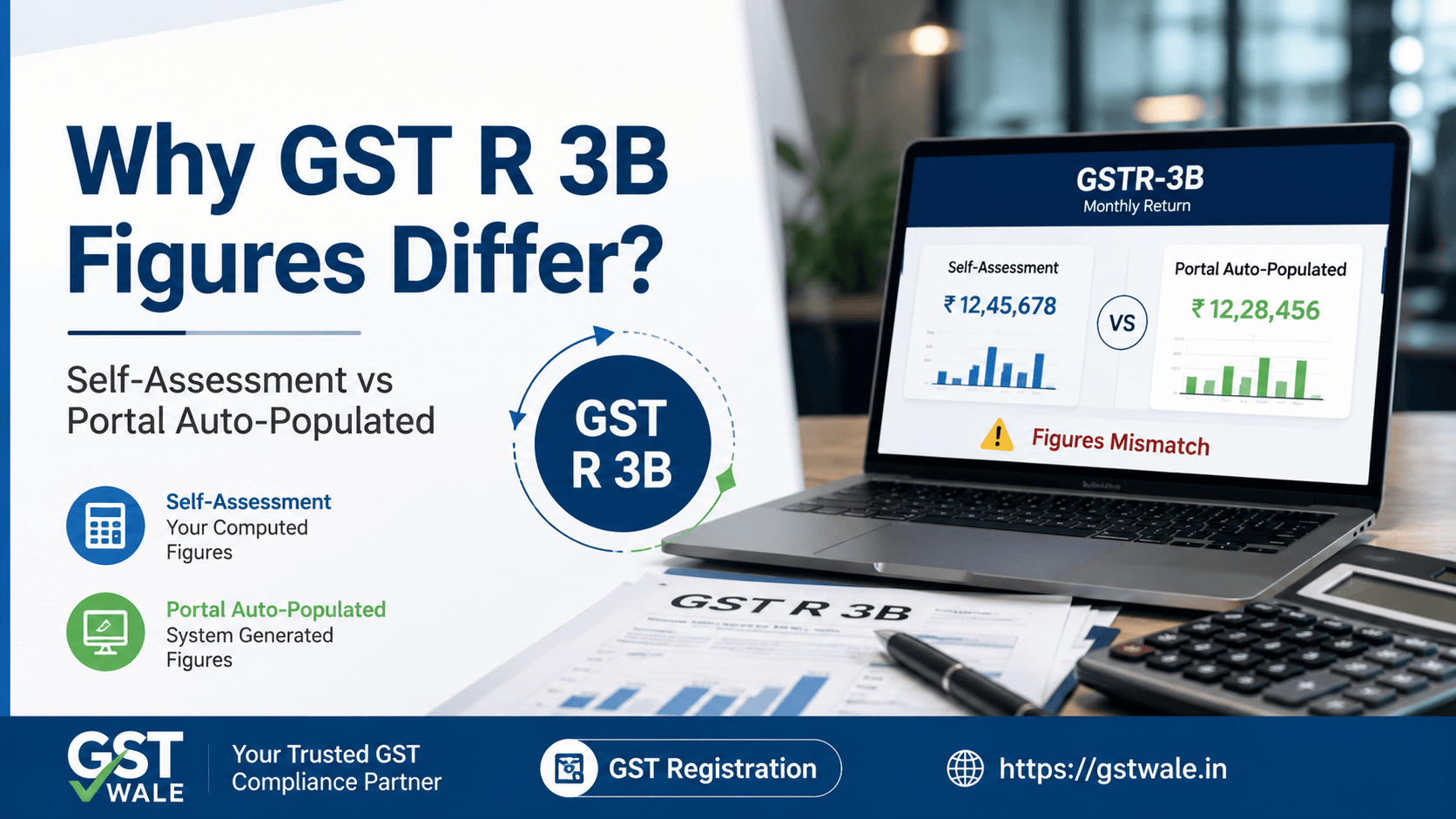
If the figures you calculated for gst r 3b do not match the numbers auto-populated on the GST portal, do not assume that either figure is automatically wrong. In practice, differences can arise because your books, accounting software, source documents and the GST portal may follow different data timelines and calculation logic. This is especially important when businesses handle multiple invoices, amendments, credit notes, or changes in registration details. If you are setting up a new business or correcting registration-related information, professional support with GST Registration can also help establish the right compliance process from the beginning.
A self-assessment is based on the taxpayer's records and applicable GST rules, while portal auto-population depends on information available in returns and statements such as GSTR-1 and other system-generated data. Therefore, a mismatch in gst r 3b does not necessarily indicate an error. It is a signal that the underlying data needs to be checked carefully.
Why GST R 3B Figures Can Differ
The basic purpose of gst r 3b is to report the taxpayer's summary liability and claim eligible input tax credit for the relevant tax period. However, the figures shown or suggested by the portal may not always represent the exact position reflected in your accounting records at that moment.
Different Data Cut-Off Dates
One of the most common reasons for a mismatch is timing.
Suppose a supplier uploads an invoice after you have completed your books and prepared your gst r 3b working. That invoice may appear in the relevant auto-populated data later. Similarly, an invoice you expected to appear may not yet be reflected because the supplier has not filed or uploaded the required information.
This is where late uploaded source files become important. Businesses should not change their tax position blindly merely because a figure appears or disappears from the portal.
Manual System Overrides
Businesses sometimes make legitimate adjustments to figures generated by their accounting system or the GST portal. These manual system overrides can arise because a particular transaction requires professional judgment or because an earlier return needs correction.
For example, an accountant may identify that an invoice was wrongly classified as an eligible ITC item. The portal may continue displaying the underlying transaction, but the taxpayer may correctly decide not to claim the credit.
Therefore, portal data should be treated as an important reconciliation source rather than an unconditional instruction.
GST R 3B and Accounting Software May Use Different Logic
Another major source of differences is software vs portal logic.
Your accounting software may calculate GST invoice by invoice, while the GST portal works with information reported through specific return tables and system processes. Both systems can therefore produce slightly different totals.
For instance, your software might calculate tax separately for every line item and then add the results. The portal may receive a consolidated figure from the supplier's filing. Depending on how values were originally entered, the totals can vary by a small amount.
Rounding Discrepancies
Rounding discrepancies are particularly common when there are hundreds or thousands of transactions.
Consider an invoice where GST calculated on individual line items results in fractions of a rupee. Your accounting software may round each line before calculating the invoice total. Another system may calculate the complete taxable value first and then apply the tax rate.
Individually, the difference may be insignificant. Across hundreds of invoices, however, it can become noticeable in your gst r 3b reconciliation.
Small rounding differences should be investigated, documented and handled consistently rather than repeatedly changing figures without understanding their source.
Timing Issues Can Affect GST R 3B
Late Uploaded Source Files
A supplier may upload or amend invoice information after you have already completed your monthly reconciliation. This can change the information available for your input tax credit review.
For example, assume your purchase register contains ₹5 lakh of eligible purchases, but the relevant supplier documents reflected on the portal cover only ₹4.7 lakh at the time of reconciliation. Your initial gst r 3b working may therefore differ from the portal data.
Later, when the remaining invoices are uploaded, the figures may move closer to your books.
This is why reconciliation should be performed periodically rather than only when a return is about to be filed.
Point of Supply Conflicts Can Create Differences
Point of supply conflicts can also cause discrepancies, particularly in transactions involving interstate supplies, services, exports, or transactions where the place of supply requires careful examination.
Your internal system may classify a transaction based on information entered by your team, whereas the reporting treatment may depend on the applicable GST provisions and the facts of the transaction.
Before changing a gst r 3b figure, check:
- Whether the transaction is intra-state or inter-state.
- Whether the correct place of supply has been determined.
- Whether the GST rate is correct.
- Whether the invoice belongs to the relevant tax period.
- Whether any amendment has been reported subsequently.
A classification issue can sometimes look like a simple numerical mismatch when the actual problem is the underlying tax treatment.
How to Reconcile GST R 3B Correctly
A structured reconciliation process is much safer than comparing only the final numbers.
Step 1: Start With Your Books
Begin with your sales and purchase registers for the relevant period. Make sure invoices, debit notes, credit notes and amendments have been recorded correctly.
Step 2: Compare Portal Data
Download or review the relevant information available on the GST portal. Do not compare only the grand total. Break the difference into categories such as taxable value, IGST, CGST and SGST.
Step 3: Identify Timing Differences
Check whether any supplier has uploaded documents late or whether an amendment was made after your books were closed. Late uploaded source files should be separately tracked.
Step 4: Review Manual Adjustments
Check for manual system overrides made by your accountant or tax team. Every material adjustment should have a reason and supporting documentation.
Step 5: Investigate Software vs Portal Logic
If the difference remains, examine the calculation method used by your accounting software. This software vs portal logic review is particularly useful when the difference is small but recurring.
Step 6: Document the Difference
Do not simply force the books and portal figures to match. Maintain a reconciliation statement explaining why the numbers differ and what action was taken.
A Practical Example
Imagine ABC Traders has calculated ₹1,20,000 as its eligible ITC based on its purchase records. The portal data initially indicates ₹1,17,850.
After investigation, the accountant discovers:
₹1,000 relates to a supplier invoice uploaded late.
₹750 is due to rounding discrepancies.
₹400 relates to an invoice requiring further eligibility review.
The remaining difference comes from an amendment that was reported in a different period.
The original gst r 3b calculation was not necessarily wrong. The difference simply required reconciliation and supporting evidence.
This is the approach a professional tax team should take: understand the difference first, and adjust only when the underlying facts and GST provisions justify doing so.
Common Mistakes to Avoid in GST R 3B
Businesses should avoid these common practices:
- Treating portal auto-population as automatically correct.
- Ignoring differences because the amount appears small.
- Claiming ITC solely because an invoice appears in system data.
- Changing books just to make portal figures match.
- Ignoring late amendments.
- Failing to maintain reconciliation records.
- Making repeated manual adjustments without documentation.
- Assuming every difference is caused by a technical portal issue.
A proper gst r 3b reconciliation should connect your books, source documents, portal information and GST rules.
When Should You Take Professional Help?
If the difference is recurring, material, or connected with complex transactions, professional review is advisable. This is particularly true for businesses with multiple GST registrations, large purchase volumes, interstate transactions, credit notes, exports, or frequent amendments.
A CA or experienced GST professional can review the reconciliation, identify whether the issue is timing-related or tax-related, and help establish a repeatable monthly process.
FAQs About GST R 3B Differences
Why does my GST R 3B calculation differ from portal data?
The difference may arise from timing, supplier uploads, amendments, rounding, classification issues, or different calculation methods. Portal information may also change when new source documents are reported.
Should I always follow the auto-populated figure?
No. Auto-populated information should be reviewed against your books and applicable GST provisions. A taxpayer remains responsible for reporting the correct figures in the return.
Can late invoice uploads change my GST R 3B reconciliation?
Yes. A supplier uploading or amending invoice information later can change the data available for reconciliation. Maintain a record of such timing differences.
What are rounding discrepancies in GST?
Rounding discrepancies occur when tax is calculated or rounded at different stages. Even small differences on individual invoices can accumulate across a large transaction volume.
How can I prevent repeated GST R 3B mismatches?
Perform monthly reconciliation, maintain proper purchase and sales registers, track amendments and late uploads, review ITC eligibility, and document manual adjustments.
Make GST R 3B Reconciliation a Routine
Differences between your self-assessed figures and portal auto-population are not unusual. What matters is understanding why the difference exists and whether the final gst r 3b figures accurately reflect your actual GST liability and eligible input tax credit.
From manual system overrides and rounding discrepancies to late uploaded source files, point of supply conflicts, and software vs portal logic, several factors can create differences. The safest approach is to reconcile systematically rather than simply matching numbers.
At GST Wale, we believe GST compliance should be practical, transparent and properly documented. If your gst r 3b figures are repeatedly different from portal data, professional review can help you identify the real reason and build a smoother compliance process. Get the right guidance, maintain proper reconciliations, and file your GST returns with confidence.
 Previous