


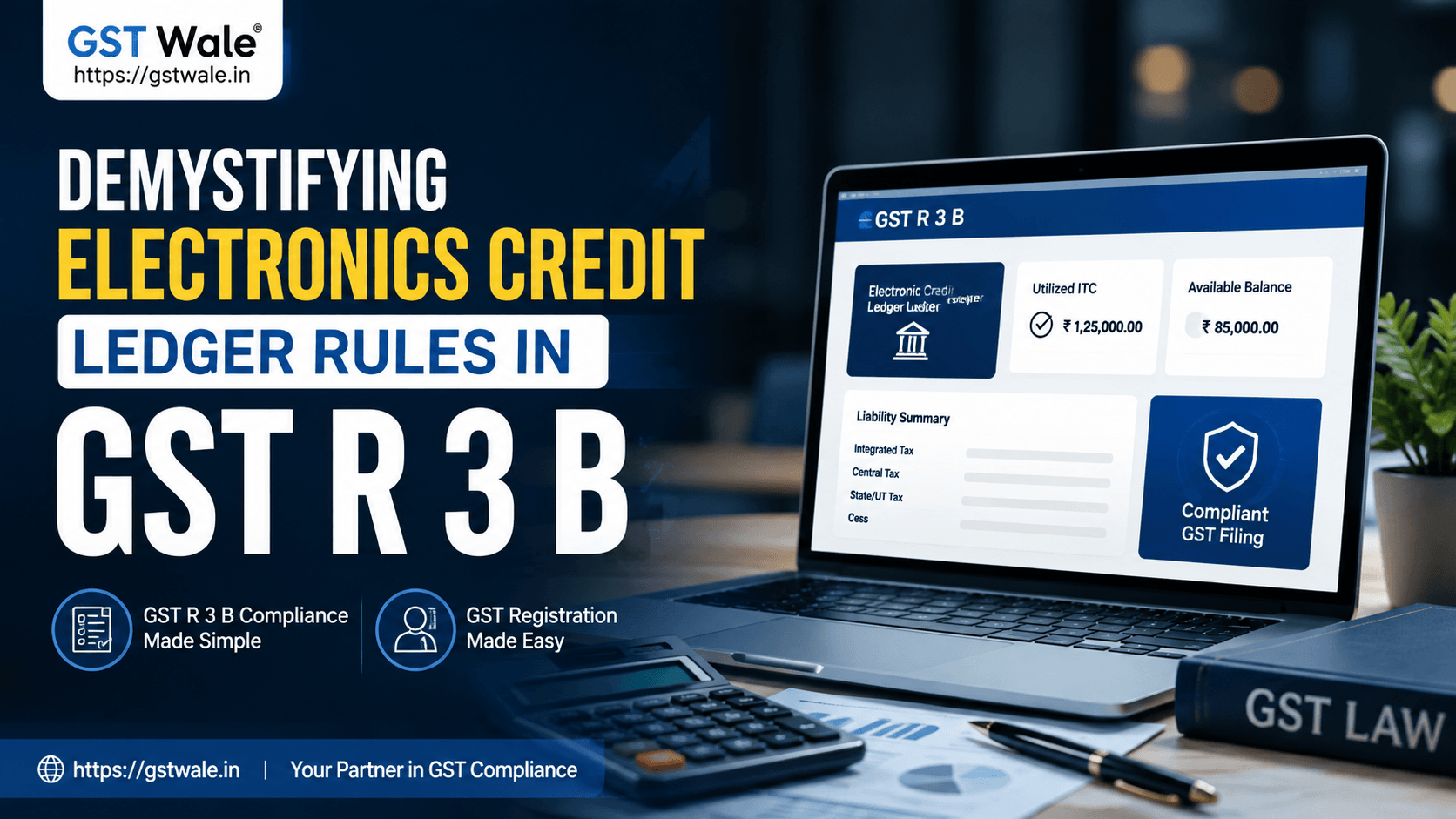
Demystifying the Electronics Credit Ledger Rules in GST R 3 B
Demystifying the Electronics Credit Ledger Rules in GST R 3 B
If you regularly file gst r 3 b, you may have heard about the Electronic Credit Ledger and Rule 86B but still find the rules confusing. Many businesses assume that as long as they have sufficient Input Tax Credit (ITC), they can discharge their entire GST liability through credit. However, the law has introduced certain restrictions that every taxpayer should understand. If you are planning a new business or expanding your operations, completing your GST Registration correctly is the first step toward smooth GST compliance and hassle-free return filing.
The Electronic Credit Ledger plays a significant role in gst r 3 b filing because it records the ITC available to a taxpayer. While ITC helps reduce the tax burden, Rule 86B places certain conditions on how much credit can actually be used. As experienced GST professionals at GST Wale, we often help businesses understand these provisions so they can avoid unnecessary notices, penalties, and cash flow issues.
Understanding the Electronic Credit Ledger in gst r 3 b
The Electronic Credit Ledger is an online ledger maintained on the GST portal where eligible Input Tax Credit is credited after purchases are reported by suppliers. During gst r 3 b filing, taxpayers utilize this credit to pay their GST liability.
Simply put, whenever you purchase goods or services for business purposes and meet the eligibility conditions, the GST paid becomes available as Input Tax Credit. This credit accumulates in your Electronic Credit Ledger and can be used against future GST liabilities.
However, this utilization is no longer unlimited because of Rule 86B.
What is Rule 86B in gst r 3 b?
Rule 86B restrictions were introduced by the Government to curb fake invoicing and fraudulent ITC claims. The objective is to ensure that businesses having substantial turnover contribute at least a minimum amount of GST through cash instead of relying entirely on Input Tax Credit.
This rule became effective from 1 January 2021 and impacts eligible taxpayers while filing gst r 3 b.
The 1 Percent Cash Payment Rule
The most discussed aspect of Rule 86B is the 1 percent cash payment rule.
If Rule 86B applies to your business, you cannot utilize 100% of your available ITC. Instead, at least 1% of your output tax liability must be paid using the Electronic Cash Ledger.
This effectively creates a maximum itc utilisation cap, ensuring that some portion of GST is always paid in cash.
When Does Rule 86B Apply?
Rule 86B applies only if specific conditions are satisfied. The most important condition relates to taxable turnover.
The restriction generally applies when:
- The taxable value of supplies exceeds ₹50 lakh in a month.
- The taxpayer intends to discharge almost the entire GST liability using ITC.
- No exemption under Rule 86B is available.
This means that small businesses generally remain outside its scope.
Who Comes Under the Exempt Taxpayers List?
Fortunately, not every taxpayer is covered under Rule 86B. The Government has specified an exempt taxpayers list to reduce unnecessary hardship for genuine businesses.
Taxpayers Who May Be Exempt
- Income tax paid exceeds the prescribed limit in recent financial years.
- The registered person has received a substantial GST refund due to exports or inverted duty structure.
- Government departments, public sector undertakings, local authorities, and statutory bodies.
- Businesses that satisfy other notified exemption conditions under GST law.
Understanding whether your business qualifies under the exempt taxpayers list is important before applying Rule 86B during gst r 3 b filing.
How Does Rule 86B Affect gst r 3 b Filing?
Many taxpayers have sufficient Input Tax Credit accumulated over several months. Earlier, they could use almost the entire balance to pay GST liability.
Now, if Rule 86B applies, the taxpayer must:
- Calculate total GST liability.
- Determine available Input Tax Credit.
- Pay at least 1% through Electronic Cash Ledger.
- Utilize the remaining eligible ITC from the Electronic Credit Ledger.
This makes accurate planning essential while preparing gst r 3 b.
Practical Example of gst r 3 b Under Rule 86B
Suppose ABC Traders has:
- Monthly GST liability: ₹10,00,000
- Available ITC: ₹12,00,000
Without Rule 86B, the entire ₹10,00,000 could have been adjusted through ITC.
However, if Rule 86B applies:
- Minimum cash payment = ₹10,000 (1%)
- Remaining liability through ITC = ₹9,90,000
This simple calculation demonstrates the impact of the 1 percent cash payment rule while filing gst r 3 b.
Importance of Liquidity Management
One major consequence of Rule 86B is its effect on liquidity management.
Businesses that previously depended entirely on ITC now need sufficient cash every month to meet mandatory GST payments.
Good liquidity management helps businesses:
- Avoid last-minute cash shortages.
- Prevent delayed GST payments.
- Reduce interest and penalty exposure.
- Maintain smooth compliance.
- Improve financial planning.
Businesses should forecast monthly GST liabilities well in advance rather than arranging funds at the last moment.
Tips for Smooth gst r 3 b Compliance
Verify ITC Every Month
Always reconcile purchase records with GSTR-2B before filing gst r 3 b.
Monitor Turnover Regularly
Track monthly taxable turnover to determine whether Rule 86B could become applicable.
Maintain Cash Availability
Plan funds in advance to comply with the mandatory cash payment requirement.
Review Eligibility for Exemption
Check whether your business falls under the exempt taxpayers list before assuming Rule 86B applies.
Consult GST Experts
Professional review helps prevent filing errors and ensures compliance with changing GST provisions.
Common Mistakes Businesses Make
- Ignoring Rule 86B applicability.
- Using excessive ITC beyond permissible limits.
- Failing to maintain sufficient cash balance.
- Not reviewing exemption eligibility.
- Poor documentation supporting ITC claims.
- Late reconciliation before filing gst r 3 b.
Frequently Asked Questions
1. What is the Electronic Credit Ledger in gst r 3 b?
The Electronic Credit Ledger records eligible Input Tax Credit available to a registered taxpayer. This credit can be used to pay GST liability during gst r 3 b filing, subject to applicable rules such as Rule 86B.
2. What are Rule 86B restrictions?
Rule 86B restrictions limit the utilization of Input Tax Credit for certain taxpayers. Eligible businesses must pay at least 1% of their GST liability through the Electronic Cash Ledger if the rule applies.
3. What is the 1 percent cash payment rule?
The 1 percent cash payment rule requires specified taxpayers to discharge at least 1% of their output GST liability using cash instead of utilizing the entire liability through ITC.
4. Does Rule 86B apply to every taxpayer?
No. Rule 86B applies only to taxpayers meeting prescribed turnover conditions and who are not covered under the exempt taxpayers list specified under GST law.
5. How can businesses manage Rule 86B effectively?
Businesses should regularly reconcile ITC, review turnover, maintain sufficient working capital, improve liquidity management, and seek professional guidance before filing gst r 3 b.
Understanding the Electronic Credit Ledger and Rule 86B is essential for accurate gst r 3 b filing. While Input Tax Credit remains one of the biggest advantages under GST, businesses must also comply with the prescribed restrictions on credit utilization. Proper planning, timely reconciliation, awareness of the exempt taxpayers list, and effective liquidity management can help avoid compliance issues and unnecessary financial stress.
At GST Wale, we help businesses stay compliant with evolving GST regulations through expert guidance, accurate return filing, registration support, and practical tax advice. Whether you are a startup, trader, manufacturer, or service provider, our experienced professionals ensure your GST compliance remains simple, accurate, and worry-free. Get in touch with GST Wale today for reliable GST solutions tailored to your business needs.
 Previous