


How to Reconcile E-Way Bills Directly with Your Monthly GSTR 1 Data
How to Reconcile E-Way Bills Directly with Your Monthly GSTR 1 Data
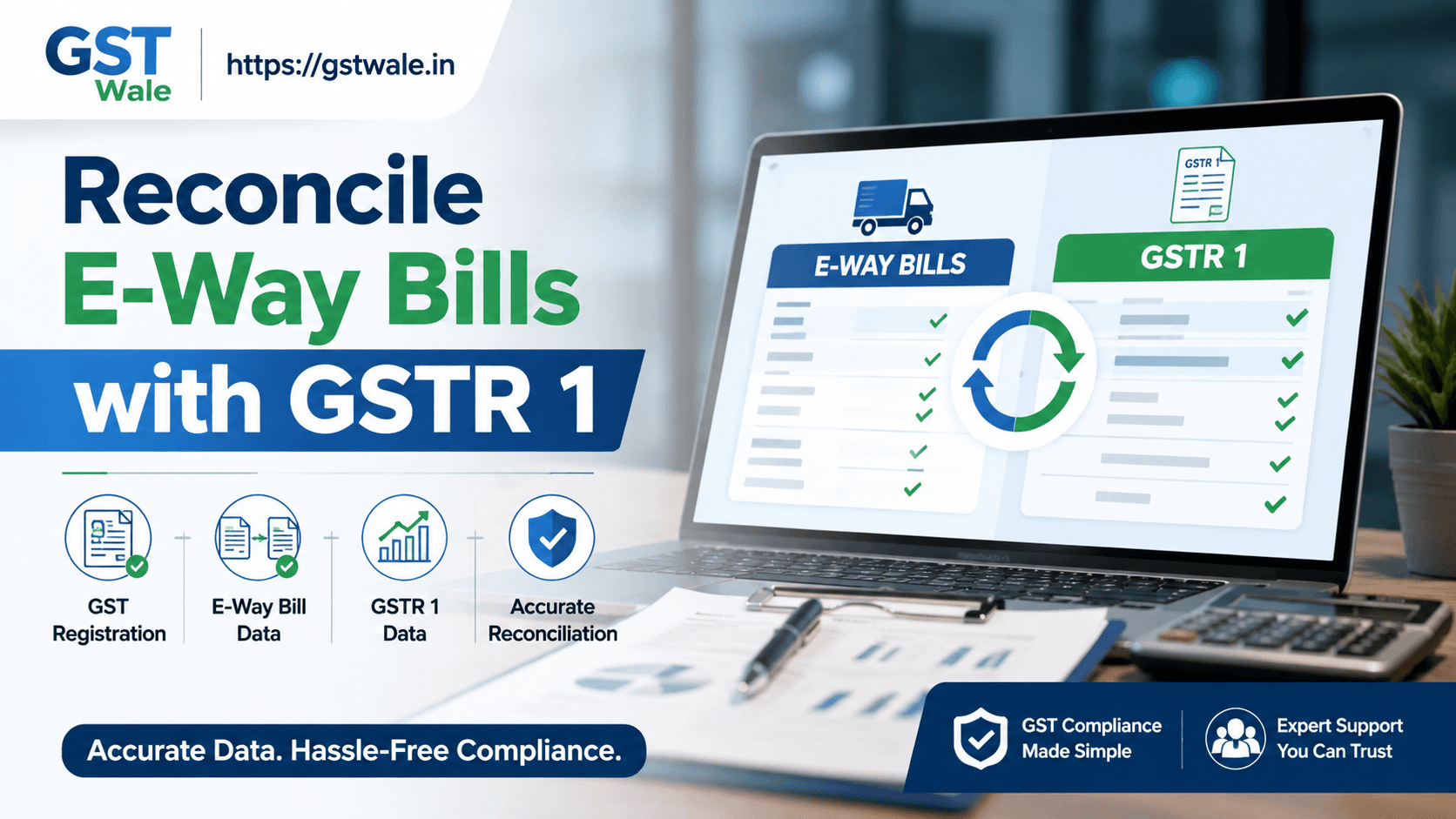
Every GST-registered business that supplies goods knows the importance of filing gstr 1 accurately. However, many taxpayers still face notices, reconciliation issues, and delays because the information reported in their E-Way Bills does not match the data declared in gstr 1. Even small differences can trigger compliance risks, making reconciliation an essential monthly activity rather than an optional task.
If you are a new business or planning to expand your operations, completing your GST Registration correctly is the first step toward smooth GST compliance. Once registered, maintaining accurate records between your invoices, E-Way Bills, and gstr 1 becomes much easier and helps avoid unnecessary departmental queries.
At GST Wale, we regularly help businesses identify mismatches before filing returns. In this guide, we explain how to reconcile E-Way Bills directly with your monthly gstr 1 data using practical methods that save time and improve compliance.
Why Reconciling E-Way Bills with GSTR 1 Is Important
The E-Way Bill system records the movement of goods, while gstr 1 captures details of outward supplies made during a tax period. Ideally, both should reflect the same transaction details wherever applicable.
When businesses ignore reconciliation, they may encounter:
- Missing invoices in gstr 1
- Duplicate invoice reporting
- Incorrect taxable value
- Wrong GSTIN of recipients
- Invoice date inconsistencies
- Increased chances of GST notices
Reconciling every month ensures that your outward supplies reported in gstr 1 are supported by transportation records generated through the E-Way Bill portal.
Understanding the Relationship Between E-Way Bills and GSTR 1
Although the E-Way Bill portal and GST portal are separate systems, both are connected through invoice-level transaction data.
Information Commonly Available in Both Systems
- Invoice Number
- Invoice Date
- Supplier GSTIN
- Recipient GSTIN
- Taxable Value
- Place of Supply
- Product Description
- Document Type
When these details match correctly, filing gstr 1 becomes significantly more accurate.
Common Reasons Behind E Way Bill System Mismatch
Businesses frequently experience an e way bill system mismatch because of operational errors rather than tax calculation issues.
Some common reasons include:
- Invoice created but E-Way Bill not generated
- E-Way Bill generated using incorrect invoice number
- Wrong GSTIN entered while creating E-Way Bill
- Cancelled invoices still appearing in records
- Credit notes not adjusted properly
- Manual data entry mistakes
- Delayed invoice accounting
Identifying these issues before filing gstr 1 reduces the risk of future scrutiny.
Step-by-Step Process to Reconcile GSTR 1 with E-Way Bills
Step 1: Download Monthly E-Way Bill Data
Begin by downloading all E-Way Bills generated during the relevant tax period.
Ensure the report includes:
- Invoice Number
- Invoice Date
- EWB Number
- GSTIN
- Taxable Amount
- Vehicle Details
Export the data into Excel for easy comparison.
Step 2: Download Outward Supply Data from Your Accounting Software
Next, generate the sales register that will be used for preparing gstr 1.
The report should include:
- Invoice Number
- Customer GSTIN
- Invoice Date
- Taxable Value
- GST Amount
- Place of Supply
Using the same reporting period avoids comparison errors.
Step 3: Match Invoice Numbers
Invoice number matching is the first and simplest reconciliation step.
Look for:
- Missing invoices
- Duplicate invoice numbers
- Incorrect invoice formats
- Manual numbering mistakes
Many businesses discover that invoice numbering inconsistencies are the primary reason behind reconciliation failures.
Step 4: Compare Taxable Values
Once invoice numbers match, compare taxable values between:
- Sales Register
- E-Way Bill Records
- gstr 1
Any difference should be investigated before filing the return.
Step 5: Verify GSTIN Details
Incorrect recipient GSTIN is another common issue.
Check whether:
- Customer GSTIN matches exactly
- State code is correct
- B2B transactions are properly classified
Incorrect GSTIN entries can affect recipient tax credit as well.
Step 6: Review Cancelled Documents
Cancelled invoices and cancelled E-Way Bills should not remain in reconciliation reports.
Review:
- Cancelled invoices
- Cancelled EWBs
- Revised invoices
- Credit Notes
- Debit Notes
Cleaning these records helps prepare accurate gstr 1 data.
Using Transport Data Reconciliation for Better Accuracy
Proper transport data reconciliation is becoming increasingly important for businesses with multiple dispatch locations.
Useful checks include:
- Vehicle numbers
- Transporter IDs
- Dispatch dates
- Delivery dates
- Distance covered
- Consignee details
These records help confirm that every physical movement of goods has a corresponding invoice reported in gstr 1.
Build an Outward Supply Matching Tracker
A simple outward supply matching tracker can significantly reduce reconciliation time.
A practical tracker should include:
- Invoice Number
- Invoice Date
- Customer GSTIN
- Taxable Value
- EWB Number
- EWB Status
- GSTR 1 Status
- Remarks
Businesses using such trackers can identify missing transactions before return filing rather than after receiving notices.
Inventory Flow Compliance Matters
Many businesses overlook inventory flow compliance, focusing only on invoice reporting.
However, proper reconciliation also ensures:
- Goods issued from warehouse match invoices
- Stock movement aligns with transport records
- Dispatch quantity matches billed quantity
- Inventory reduction reflects actual sales
Maintaining inventory flow compliance strengthens both GST compliance and internal financial controls.
Watch Out for the EWB Block List
Businesses should also monitor the ewb block list regularly.
A taxpayer may face restrictions on E-Way Bill generation due to non-compliance under GST provisions.
If your GSTIN appears on the ewb block list:
- Goods movement may be affected.
- Business operations can slow down.
- Customer deliveries may get delayed.
- Compliance costs may increase.
Regular filing of returns and timely reconciliation help reduce the chances of such issues.
Practical Example
Suppose ABC Traders generated 250 E-Way Bills during April.
While preparing gstr 1, the accountant found only 243 invoices in the sales register.
After reconciliation:
- Four invoices were accidentally excluded.
- Two invoices had incorrect GSTINs.
- One cancelled invoice was still included.
These corrections ensured accurate filing of gstr 1, prevented customer disputes, and reduced the possibility of receiving GST notices.
Best Practices for Monthly GSTR 1 Reconciliation
To improve accuracy every month:
- Reconcile data before filing gstr 1.
- Avoid manual invoice editing after E-Way Bill generation.
- Standardise invoice numbering.
- Download monthly reconciliation reports.
- Verify customer GSTIN before invoice generation.
- Maintain supporting transport documents.
- Review cancelled invoices separately.
- Perform reconciliation every month instead of quarterly.
- Keep accounting software updated.
- Maintain proper documentation for future audits.
Frequently Asked Questions
Does every E-Way Bill need to appear in GSTR 1?
Where an E-Way Bill is generated for a taxable outward supply, the corresponding invoice should generally be reported in gstr 1. Any omission should be reviewed carefully before filing.
Can mismatches lead to GST notices?
Yes. Significant differences between E-Way Bill data and gstr 1 may attract departmental scrutiny, especially if the mismatch affects taxable turnover or tax liability.
How often should reconciliation be performed?
Ideally, businesses should reconcile E-Way Bills with gstr 1 every month before filing returns. Regular reconciliation helps detect errors early and simplifies compliance.
What documents are required for reconciliation?
Typically, you should compare your sales register, invoice records, E-Way Bill reports, transporter details, and accounting data to ensure consistency before filing gstr 1.
Is reconciliation useful for small businesses?
Absolutely. Even businesses with a limited number of invoices can benefit from monthly reconciliation, as it reduces filing errors and improves overall GST compliance.
Accurate reconciliation between E-Way Bills and gstr 1 is one of the most effective ways to strengthen GST compliance. By matching invoice details, transport records, taxable values, GSTIN information, and inventory movement every month, businesses can minimise errors, avoid unnecessary notices, and ensure smooth return filing. A disciplined reconciliation process not only improves reporting accuracy but also builds confidence during audits and departmental verification.
If you want expert assistance with gstr 1, GST reconciliation, return filing, registrations, or ongoing GST compliance, GST Wale is here to help. Our experienced professionals provide practical guidance, timely support, and reliable GST solutions so your business stays compliant while you focus on growth.
 Previous