



No More Manual Edits: Navigating the Non-Editable GSTR-3B Rules
No More Manual Edits: Navigating the Non-Editable GSTR-3B Rules
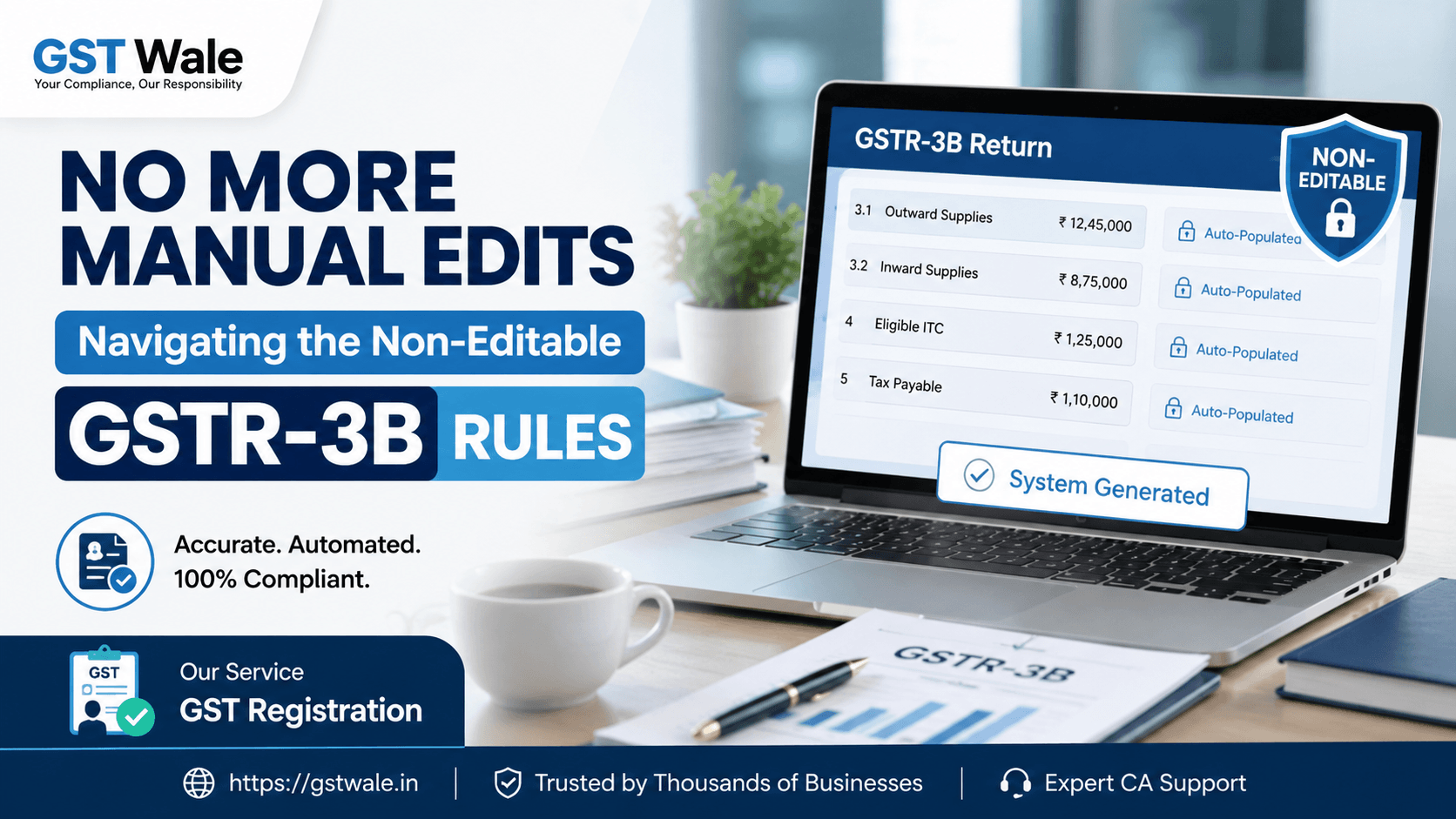
Understanding the New gstr 3 b Filing Environment
For years, businesses have treated gstr 3 b as the final checkpoint where figures could be reviewed, adjusted and filed. But the GST system is steadily becoming more automated. Certain figures are now generated from information already reported through other GST forms, and some system-generated values cannot be reduced manually. For business owners, this means the old habit of simply changing a number in gstr 3 b is no longer always available.
This makes accurate reporting from the beginning even more important. If you are starting a business or getting your tax structure in place, proper GST Registration is only the first step. Your invoices, GSTR-1, GSTR-1A, books of accounts and gstr 3 b should all tell the same story.
At GST Wale, we see this as a positive change when businesses understand how the system works. Automation can reduce repetitive work, but it also makes reconciliation more important.
Why Is gstr 3 b Becoming Less Editable?
The basic idea behind the new approach is straightforward: GST returns are becoming interconnected.
Information reported in GSTR-1 and information available through GSTR-2B can be used to auto-populate relevant portions of gstr 3 b. GSTN's earlier guidance explains that liability figures in specified tables are linked to outward supplies reported in GSTR-1, while eligible ITC information is linked to GSTR-2B.
The system is therefore moving from:
Enter → Edit → File
towards:
Report correctly → Reconcile → Verify → File
This is an important change in mindset for taxpayers.
If your outward supplies are reported incorrectly in the source return, waiting until gstr 3 b may not be the best way to fix the problem.
What Does a Non-Editable Field in gstr 3 b Mean?
A non-editable field is a value generated or controlled by the GST system that cannot simply be overwritten by the taxpayer.
However, taxpayers should not assume that every number appearing in gstr 3 b is automatically non-editable. Different tables and functionalities have different rules.
The practical question should always be:
Where did this figure come from, and can the underlying information be corrected?
For example, suppose a business has actual taxable sales of ₹12 lakh, but its system-generated liability reflects ₹11 lakh because an invoice was not correctly reported. The answer is not to ignore the difference.
Instead, the taxpayer should:
- Identify the missing or incorrect invoice.
- Check the relevant GSTR-1 data.
- Determine whether GSTR-1A or another permitted correction mechanism is applicable.
- Reconcile the corrected figures.
- Review the resulting gstr 3 b liability before filing.
This source-first approach is much safer than trying to force the final return to match your books.
How GSTR-1A Affects gstr 3 b
GSTR-1A has become an important part of the GST reporting cycle because it can allow eligible corrections or additions relating to outward supplies before the corresponding gstr 3 b filing.
For a business owner, the important lesson is timing.
Do not wait until the last moment to discover that your sales figures do not match.
A Better Monthly Workflow
A practical GST return process can follow these steps:
- Finalise sales invoices and accounting records.
- Reconcile outward supplies with GSTR-1.
- Review whether any eligible correction is required through GSTR-1A.
- Check the system-generated figures.
- Reconcile ITC with GSTR-2B.
- Review gstr 3 b liability and tax payment.
- Check the Electronic Cash Ledger and Electronic Credit Ledger.
- File only after the final reconciliation.
This workflow may take a little more discipline, but it can prevent costly mistakes later.
What Are Auto-Populated Returns?
Auto-populated returns are designed to reduce manual data entry and improve consistency between GST forms.
GSTN has explained that system-generated information in gstr 3 b is derived from sources such as GSTR-1 and GSTR-2B. The portal also provides a system-generated summary so taxpayers can understand how certain figures have been calculated.
But there is an important point that every business owner should remember:
Auto-populated does not mean automatically verified.
Your responsibility for the correctness of the GST return remains.
If your accounting software shows ₹20 lakh in taxable sales but the GST portal shows ₹18 lakh, do not simply file because the portal has generated the figure. Investigate the ₹2 lakh difference.
What Should You Reconcile?
Before filing gstr 3 b, compare:
- Sales register with GSTR-1
- GSTR-1 with system-generated liability
- Purchase records with GSTR-2B
- Eligible ITC with the amount claimed
- Tax payable with your accounting records
- Cash balance with the automated tax ledger and electronic ledgers
- Previous-period adjustments with current-period liabilities
These checks are particularly important for businesses with a large number of invoices.
New Interest Rules for gstr 3 b
One of the significant recent developments relates to interest calculation.
GSTN's advisory states that from the January 2026 tax period, the interest calculation in Table 5.1 was enhanced to consider the minimum cash balance available in the Electronic Cash Ledger during the relevant period, in line with the applicable CGST Rules.
The system-generated interest is treated as a minimum amount. The taxpayer cannot reduce the auto-populated amount, but if the taxpayer's actual interest liability is higher, the amount can be increased after self-assessment.
This is an important distinction.
Non-editable downward does not mean that the taxpayer can ignore a higher legal liability.
A business should always calculate its actual interest obligation rather than assuming the portal's figure is the final answer in every situation.
Tax Liability Breakup in gstr 3 b
Another useful change applies to the tax liability breakup table.
For gstr 3 b filings from the January 2026 tax period, GSTN states that the portal can auto-populate the tax liability breakup for supplies belonging to previous tax periods when those supplies are reported in the current period through GSTR-1, GSTR-1A or IFF.
Consider a simple example.
A service provider issued an invoice in December but reported the relevant transaction in January. If the liability is discharged in the January gstr 3 b, the system can identify the transaction as relating to an earlier tax period based on the document information.
This provides greater visibility into why a current return may contain liability connected with an earlier period.
What Should You Do When gstr 3 b Shows an Unexpected Figure?
Don't panic and don't immediately assume that the portal is wrong.
Step 1: Identify the Table
Find the exact table where the unexpected amount appears.
Step 2: Trace the Source
Determine whether the figure has come from GSTR-1, GSTR-1A, IFF, GSTR-2B or another system-generated source.
Step 3: Check Your Books
Compare the GST figure with invoices, sales records, purchase records and accounting entries.
Step 4: Find the Difference
Classify the mismatch. It may be due to a missed invoice, wrong GSTIN, incorrect tax rate, timing difference, amendment or previous-period transaction.
Step 5: Correct the Right Return
If the error originates from an earlier reporting document, use the applicable GST correction mechanism rather than attempting to manipulate a locked or system-controlled field.
Step 6: Reconcile Again
Once the correction is reflected, review gstr 3 b again before filing.
Common Mistakes to Avoid
The increasing use of automation makes certain traditional mistakes even more risky.
Avoid these common errors:
- Treating auto-populated figures as automatically correct.
- Waiting until gstr 3 b filing day to reconcile sales.
- Ignoring differences between books and GSTR-1.
- Failing to review GSTR-1A where applicable.
- Claiming ITC without properly reconciling GSTR-2B.
- Ignoring system-generated interest.
- Not checking the Electronic Cash Ledger before payment.
- Filing a return simply because the portal permits filing.
- Keeping no working papers for your monthly reconciliation.
Good gst compliance is not about filing quickly. It is about filing correctly.
A Practical gstr 3 b Checklist for Businesses
Before pressing the final filing button, ask yourself:
- Have all sales invoices been recorded?
- Do outward supplies in the books agree with GSTR-1?
- Have eligible corrections been considered through GSTR-1A?
- Does the system-generated liability make sense?
- Does ITC agree with the relevant reconciliation?
- Have previous-period liabilities been identified?
- Has interest been reviewed independently?
- Is sufficient tax payment balance available?
- Have unusual differences been investigated?
- Have supporting reconciliation records been saved?
If the answer to all ten is yes, your monthly GST process is in a much stronger position.
FAQs About gstr 3 b Non-Editable Rules
Can all fields in gstr 3 b be edited?
No. Some figures are system-generated and specific fields can be non-editable. The treatment depends on the particular table and functionality. Taxpayers should check the source of the value before deciding how to address a difference.
What if the auto-populated gstr 3 b amount is incorrect?
First identify where the amount originated. Compare it with GSTR-1, GSTR-1A, GSTR-2B, invoices and your books. If the source data needs correction, use the applicable GST mechanism instead of attempting to change a non-editable field.
Why is GSTR-1A important?
GSTR-1A can be relevant for eligible corrections or additions to outward-supply information before the corresponding gstr 3 b filing. This makes reviewing the source return before filing especially important.
Can system-generated interest be reduced?
GSTN's January 2026 advisory states that system-computed interest in Table 5.1 is non-editable downward. However, taxpayers must self-assess their actual interest liability and increase the amount if required.
Does automation remove the taxpayer's responsibility?
No. Automation reduces manual entry, but the taxpayer remains responsible for accurate reporting, tax payment and gst compliance. System-generated figures should always be reviewed against the business's own records.
Stay Ahead of the New gstr 3 b Rules
The move towards non-editable and auto-populated gstr 3 b fields is changing the way Indian businesses approach GST compliance. The return is no longer just a form where numbers are entered at the end of the month. It is increasingly becoming the result of information reported across the GST ecosystem.
That means your GSTR-1, GSTR-1A, invoices, books, ITC records and electronic ledgers need to remain aligned.
The best strategy is simple: do not wait for gstr 3 b to find your mistakes. Find and correct them at the source.
At GST Wale, we help businesses understand GST processes in practical, straightforward language. If you want to stay compliant, reduce reconciliation problems and handle your GST obligations with greater confidence, connect with GST Wale for professional GST guidance and support.
 Previous