


How to Avail Tax Benefits for Electric Vehicle (EV) Loans During Income Tax Return Filing
How to Avail Tax Benefits for Electric Vehicle (EV) Loans During Income Tax Return Filing
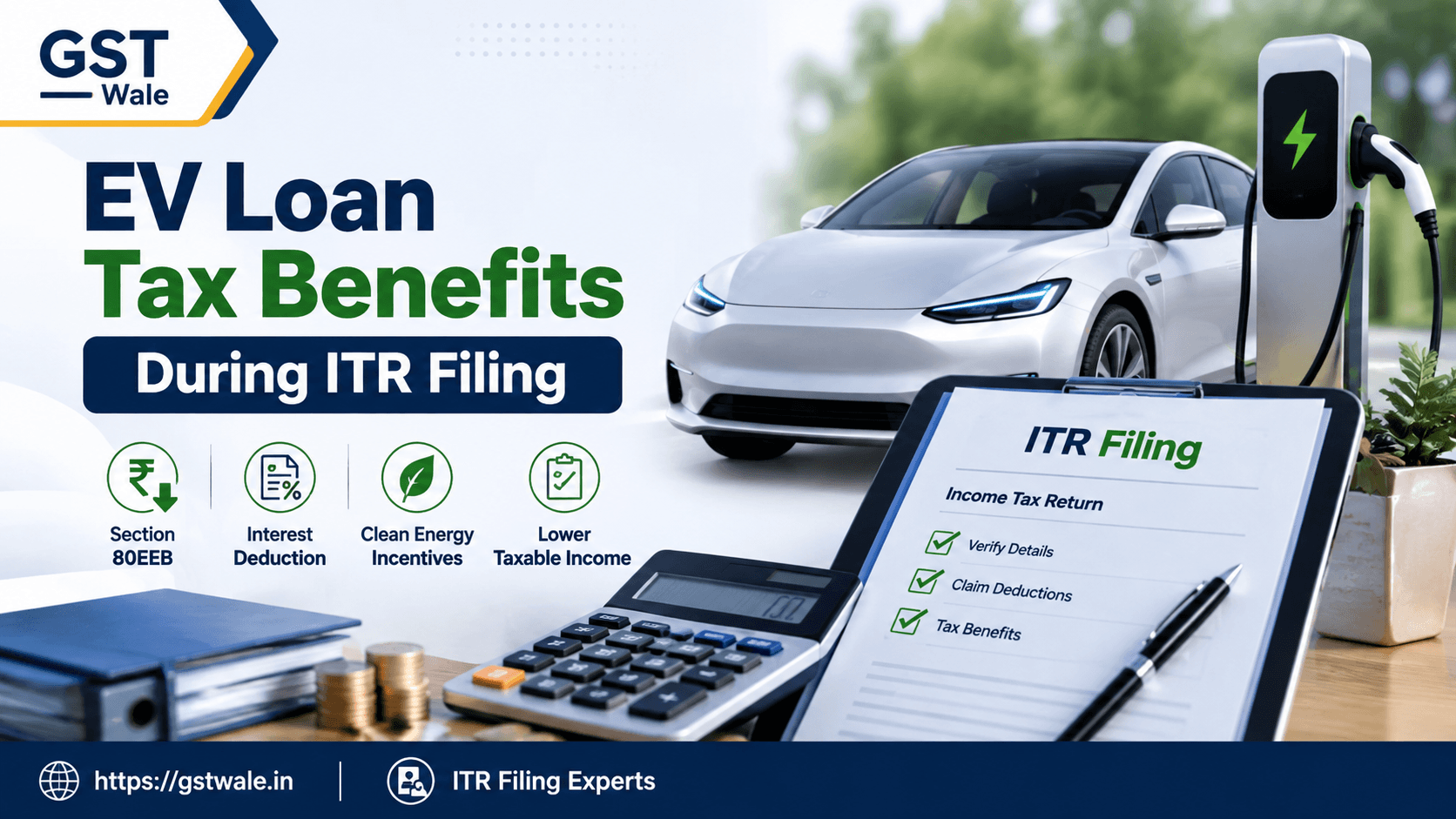
Buying an electric vehicle is no longer only about reducing fuel expenses or choosing a cleaner mode of transport. For eligible taxpayers, it can also bring an income-tax benefit on the interest paid on an EV loan. During income tax return filing, Section 80EEB can allow an individual to claim a deduction of up to ₹1.50 lakh for eligible interest payments. However, there are important conditions relating to the loan sanction date, taxpayer type, vehicle and tax regime.
If you are planning your ITR Filing, understanding these conditions is important because an incorrect claim can result in a mismatch or unnecessary tax demand later. At GST Wale, we believe tax benefits should be understood before filing, rather than discovered after submitting the return.
One important point must be clarified at the beginning: Section 80EEB is a time-bound provision. It applies to qualifying EV loans sanctioned between 1 April 2019 and 31 March 2023. The Income Tax Department continues to list this deduction for eligible taxpayers, with a maximum deduction of ₹1.50 lakh towards qualifying interest.
What Is Section 80EEB for Electric Vehicle Loans?
Section 80EEB was introduced to encourage individuals to purchase electric vehicles and support India's clean energy incentives. Under this provision, an individual can claim a deduction for interest payable on a loan taken from a financial institution for purchasing an eligible electric vehicle.
The maximum deduction available is ₹1.50 lakh in an assessment year. This is a deduction from taxable income, not a direct cash refund from the government.
For example, suppose your eligible EV loan interest during the financial year is ₹1,20,000. If you satisfy all conditions and choose a tax regime under which the deduction is available, you may claim the entire ₹1,20,000 under Section 80EEB.
If the eligible interest is ₹1,80,000, the deduction is restricted to ₹1,50,000.
The Income Tax Department specifically states that the deduction is available to an individual and that the loan must have been sanctioned between 1 April 2019 and 31 March 2023.
Who Can Claim the EV Interest Deduction?
Not every person who has purchased an electric vehicle on finance can automatically claim the benefit.
Generally, the following conditions need to be checked:
- The taxpayer must be an individual.
- The loan must have been taken for purchasing an eligible electric vehicle.
- The loan must be from a qualifying financial institution.
- The loan should have been sanctioned between 1 April 2019 and 31 March 2023.
- The interest claimed should relate to the eligible EV loan.
- The same interest should not be claimed again under another provision.
Section 80EEB defines an electric vehicle as a vehicle powered exclusively by an electric motor, with traction energy supplied exclusively by a traction battery and having an electric regenerative braking system meeting the specified definition.
This means simply owning a vehicle marketed as environmentally friendly is not enough. The actual nature of the vehicle and the loan should satisfy the legal requirements.
Is Section 80EEB Available for a Personal Vehicle?
Yes, the provision is relevant to an individual's purchase of an eligible electric vehicle, including a personal vehicle, provided all statutory conditions are satisfied.
For example, assume Rahul purchased an eligible electric car for personal use and financed it through a bank. His loan was sanctioned in February 2022. During the financial year, he paid ₹95,000 as interest.
If he meets the remaining requirements, ₹95,000 may qualify as an EV interest deduction under Section 80EEB.
However, Rahul cannot claim the deduction merely because the car is electric. The loan sanction date is particularly important.
The Most Important Condition: Loan Approval Timeline
One of the biggest mistakes taxpayers make is looking only at the date on which the electric vehicle was purchased.
For Section 80EEB, the loan approval timeline matters. The law specifies that the financial institution must have sanctioned the loan between 1 April 2019 and 31 March 2023.
Therefore, if you purchased an EV in 2024 or 2025 using a newly sanctioned loan, Section 80EEB cannot generally be claimed for that new loan because the statutory sanction window has already closed.
This is particularly important when people search online for "EV tax benefits" and assume that the ₹1.50 lakh deduction is available for every new electric vehicle loan.
At GST Wale, our practical advice is simple: check the loan sanction date first before calculating the expected tax benefit.
How Much Tax Benefit Can You Actually Get?
The ₹1.50 lakh limit represents the maximum deduction from eligible taxable income. It does not mean every taxpayer will receive ₹1.50 lakh as a tax refund.
Consider this example:
An individual has taxable income of ₹12 lakh before the Section 80EEB deduction.
Suppose eligible EV loan interest is ₹1.20 lakh.
After claiming the deduction, assuming all conditions are satisfied and the taxpayer is eligible to claim it, taxable income could reduce by ₹1.20 lakh.
The actual tax saving depends on the applicable tax rate and the taxpayer's overall income-tax calculation.
Therefore, when doing income tax return filing, it is better to calculate the complete tax position rather than looking at the deduction in isolation.
Section 80EEB and the New Tax Regime
This is an area where taxpayers should be especially careful.
For AY 2026-27, the new tax regime is the default regime for eligible individual taxpayers, while taxpayers meeting the applicable requirements can opt for the old tax regime. The Income Tax Department's guidance lists Section 80EEB among the deductions available in the old-regime framework, while the new regime permits only specified deductions.
Therefore, an eligible EV loan borrower should compare the old and new tax regimes before income tax return filing.
Do not automatically choose the old regime simply because you have an EV loan. Compare your total deductions, exemptions, income, tax slabs and other eligible benefits.
For a person with several substantial deductions, the old regime may sometimes be beneficial. For another taxpayer, the new regime may still result in lower tax despite losing certain deductions.
Documents Required for Claiming Section 80EEB
Proper documentation makes income tax return filing much easier and protects you if the department later asks for clarification.
Keep the following records available:
- Loan sanction letter
- Loan account number
- Name of the bank or financial institution
- Date of loan sanction
- Total loan amount
- Loan outstanding at the end of the financial year
- Interest paid during the year
- Vehicle registration number
- EV purchase invoice and relevant vehicle documents
- Interest certificate or loan statement from the lender
The Income Tax Department specifically requires details such as the lender's name, loan account number, sanction date, loan amount, outstanding balance, eligible interest and vehicle registration number while claiming Section 80EEB in the ITR.
How to Claim the EV Interest Deduction During Income Tax Return Filing
The process is straightforward when your documents are ready.
Step 1: Check Your Eligibility
First, verify that you are an individual and that the EV loan satisfies the Section 80EEB conditions.
Most importantly, verify the loan sanction date.
Step 2: Calculate Eligible Interest
Obtain the annual loan statement or interest certificate from your lender.
Do not use the total EMI amount for calculating the deduction. EMI consists of both principal and interest. Section 80EEB relates specifically to eligible interest.
Step 3: Check the ₹1.50 Lakh Limit
If your eligible interest is ₹80,000, your claim is limited to ₹80,000.
If eligible interest is ₹1.75 lakh, the maximum deduction under Section 80EEB is ₹1.50 lakh.
Step 4: Compare Tax Regimes
Before completing income tax return filing, compare your tax liability under the applicable regimes.
The availability of deductions is one of the factors that can affect this comparison.
Step 5: Enter the Required Details
While preparing the ITR, provide the required Section 80EEB information accurately, including the lender details, loan account number, sanction date, loan amount, outstanding loan, interest and vehicle registration number.
Step 6: Keep Supporting Documents Safe
You generally do not need to upload every supporting document with your return, but you should retain the records safely.
If a clarification or verification is required later, these documents can support your claim.
Common Mistakes to Avoid
Claiming the Benefit for a New EV Loan
The most common mistake is assuming that Section 80EEB continues to apply to every EV loan. The loan sanction window ended on 31 March 2023.
Claiming the EMI Instead of Interest
The deduction is for eligible interest, not the entire EMI. Always refer to the lender's interest statement.
Ignoring the Tax Regime
A deduction that looks attractive may not provide a benefit if you are filing under a regime where it is unavailable. Compare the complete tax calculation.
Claiming the Same Interest Twice
The law specifically provides that where a deduction is allowed under Section 80EEB for qualifying interest, the same interest cannot be claimed under another provision for the same or another assessment year.
Entering Incorrect Loan Details
A mismatch in the loan account number, sanction date, lender information or vehicle registration number can create unnecessary complications.
Does an EV Loan Give Any Other Tax Benefit?
Section 80EEB is the specific income-tax deduction for qualifying EV loan interest. However, taxpayers should distinguish income-tax deductions from other government measures or state-level benefits relating to electric vehicles.
Clean energy incentives can change over time and may differ by state, vehicle category and applicable policy. Therefore, do not assume that a benefit available when you purchased your vehicle is automatically available today.
For business owners, there can also be separate tax and accounting considerations where an electric vehicle is genuinely used for business purposes. Such cases should be examined based on the nature of the business, ownership, usage and applicable provisions rather than treating every vehicle loan as a personal deduction.
FAQs About EV Loans and Income Tax Return Filing
Can I claim Section 80EEB for an EV loan taken in 2025?
Generally, no. Section 80EEB requires the loan to have been sanctioned between 1 April 2019 and 31 March 2023. A newly sanctioned EV loan after that period does not meet this specific condition.
What is the maximum EV interest deduction under Section 80EEB?
The maximum deduction is ₹1.50 lakh for eligible interest payable on a qualifying electric vehicle loan. The actual claim depends on the interest amount paid and other statutory conditions.
Can I claim the entire EMI under Section 80EEB?
No. Section 80EEB provides a deduction for qualifying interest on the EV loan. The principal portion of the EMI should not be treated as the Section 80EEB interest deduction.
Is Section 80EEB available under the new tax regime?
The Income Tax Department lists Section 80EEB among the deductions available under the old-regime framework. The new regime permits only specified deductions, so taxpayers should compare both regimes before income tax return filing.
What documents should I keep for the deduction?
Keep your loan sanction letter, loan statement or interest certificate, loan account details, vehicle registration information, purchase documents and other records supporting the claim.
Plan Your Income Tax Return Filing Carefully
An electric vehicle can provide financial advantages beyond lower fuel and maintenance costs, but taxpayers should not assume that every EV loan automatically qualifies for an income-tax deduction.
Section 80EEB can provide a deduction of up to ₹1.50 lakh for eligible EV loan interest, but the loan sanction period, taxpayer status, nature of the vehicle, interest amount and applicable tax regime all matter. The most important point is that the loan must have been sanctioned between 1 April 2019 and 31 March 2023.
If you are unsure whether your EV loan qualifies, do not make an aggressive claim simply because you have heard about the ₹1.50 lakh benefit. Proper document verification and tax-regime comparison can help you make a more informed decision during income tax return filing.
At GST Wale, we help individuals and businesses understand their tax position, identify eligible deductions and complete their income tax return filing accurately. Get your ITR prepared with the right checks, documentation and professional guidance so that you claim what you are legally entitled to—without unnecessary tax risks.
Tax provisions and return requirements can change. The above guidance is based on the applicable provisions and Income Tax Department guidance available at the time of writing; taxpayers should verify their specific facts before filing.
 Previous