


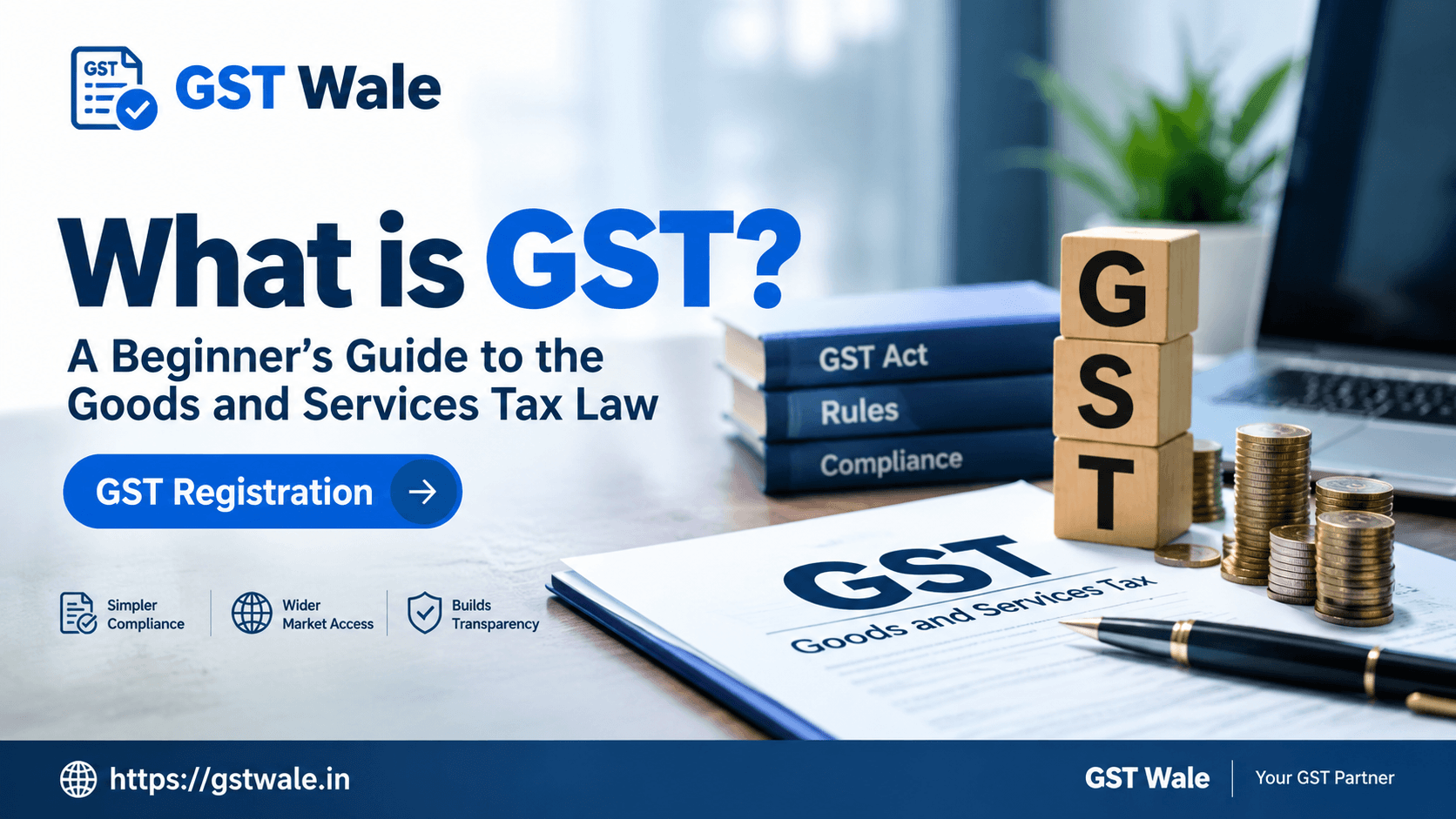
What is GST? A Beginner’s Guide to the Goods and Services Tax Law
What is GST? A Beginner’s Guide to the Goods and Services Tax Law
whatis gst and Why Does It Matter?
If you run a business, provide professional services, sell products online, or are simply trying to understand your tax responsibilities, you have probably searched for whatis gst. GST stands for Goods and Services Tax, a destination-based indirect tax charged on the supply of goods and services in India. It replaced several indirect taxes and created a more unified tax framework across the country.
For a business owner, understanding GST is not just about knowing a tax rate. It is about knowing when registration is required, how invoices should be issued, how a gst return works, and how input tax credit can reduce your tax cost. If you are starting a new business, proper GST Registration is often one of the first compliance matters to evaluate.
At GST Wale, we believe a basic gst guide should explain the law in practical language rather than complicated legal terminology. So, let us understand whatis gst, how it works, and what a taxpayer should know before getting started.
Whatis GST? Understanding the Basic Concept
In simple words, GST is a tax imposed on the supply of goods and services. Instead of having different indirect taxes at different stages, GST brought many of them under a common framework.
Before GST, businesses could encounter taxes such as Central Excise Duty, Service Tax, VAT, and several other state-level levies. The introduction of GST significantly changed this indirect tax system India had followed for decades.
The easiest way to understand whatis gst is to think of it as a tax that generally follows consumption. The tax is ultimately intended to be borne by the final consumer, while businesses collect and pay GST according to the applicable rules.
For example, suppose a manufacturer sells a product to a wholesaler. The wholesaler sells it to a retailer, and the retailer finally sells it to a customer. GST is charged at the relevant stages, but eligible businesses can generally claim credit for GST paid on their purchases. This prevents the same tax from becoming a cost repeatedly at every stage.
Whatis GST: How Does GST Work?
GST works through the concept of taxation on value addition. A registered business collects GST on taxable outward supplies and may claim eligible input tax credit on GST paid for business-related purchases.
Consider a simple example.
A trader purchases goods for ₹50,000 and pays ₹9,000 GST. Later, the trader sells those goods for ₹70,000 and charges ₹12,600 GST.
Subject to eligibility and applicable conditions, the trader may use the ₹9,000 input tax credit against the ₹12,600 output tax liability. The difference, ₹3,600, becomes the net GST payable.
This is one of the most important concepts when learning whatis gst because GST is not simply about collecting tax from customers. Proper records, invoices and eligible credits are equally important.
Types of GST in India
Understanding the different types of GST makes the whatis gst concept much easier.
CGST – Central Goods and Services Tax
CGST is collected by the Central Government on certain intra-state supplies. When a transaction takes place within the same state and is subject to both CGST and SGST, the tax is generally divided between the Centre and the State.
SGST – State Goods and Services Tax
SGST is collected by the respective State Government on applicable intra-state supplies. Therefore, a taxable transaction within a state can involve both CGST and SGST.
IGST – Integrated Goods and Services Tax
IGST generally applies to inter-state supplies and certain other transactions covered under the IGST framework. It is collected by the Centre and apportioned according to the applicable constitutional and statutory mechanism.
UTGST – Union Territory GST
UTGST applies to certain supplies made within Union Territories where the Union Territory GST framework applies.
The actual GST treatment depends on the nature and location of the supply, so businesses should not decide the applicable tax merely by looking at the customer's address.
Whatis GST Registration and Who Needs It?
One of the most common questions after searching whatis gst is whether every business needs GST registration.
The answer is not simply yes or no. Registration requirements depend on factors such as turnover, nature of supplies, state, business activities and specific provisions of GST law. Certain businesses may also need registration because of the nature of their transactions, even where ordinary turnover-based considerations may differ.
A business should therefore evaluate its GST position before beginning taxable operations rather than waiting until a compliance problem arises.
Once registered, a taxpayer receives a GSTIN and becomes responsible for applicable GST compliance. Registration also enables eligible taxpayers to collect GST and claim input tax credit, subject to the conditions prescribed under law.
What Is Input Tax Credit?
Input tax credit is one of the biggest advantages of understanding whatis gst properly.
Suppose your business purchases office equipment, raw materials or eligible professional services and pays GST on those purchases. If the statutory conditions are satisfied, that GST may be available as input tax credit against your output GST liability.
However, input tax credit should not be treated as an automatic deduction. Businesses need proper tax invoices and must satisfy the applicable conditions and restrictions.
A practical approach is to regularly reconcile purchase records, invoices and GST data rather than checking everything only at the time of gst filing.
Whatis GST Filing and GST Return?
GST compliance does not end after registration. A registered taxpayer may have to furnish applicable statements or returns depending on the taxpayer category and applicable scheme.
A gst return generally contains information relating to taxable supplies, tax liability, eligible credits and other required details.
The exact return and filing frequency can vary according to the taxpayer's registration type and scheme. Therefore, businesses should avoid blindly copying another company's compliance schedule.
For effective goods and services tax filing, maintain accurate records throughout the month or quarter. Waiting until the deadline often increases the possibility of invoice mismatches, incorrect tax calculations or missed credits.
How to Approach GST Filing: A Practical Process
For a small business owner, gst filing becomes much easier when records are maintained consistently.
Step 1: Maintain Sales Records
Record every taxable and applicable exempt or non-taxable transaction correctly. Keep invoices organised and ensure the GSTIN and other mandatory invoice details are accurate where required.
Step 2: Maintain Purchase Records
Keep purchase invoices and supporting documents. These records are particularly important when claiming eligible input tax credit.
Step 3: Reconcile Your Data
Compare your accounting records with relevant GST information available through the GST system. Identify differences before filing.
Step 4: Calculate Tax Liability
Determine your applicable output tax liability and eligible input tax credit according to the GST provisions applicable to your business.
Step 5: File the Applicable Return
Submit the relevant GST return or statement within the applicable deadline and complete the required payment process.
Step 6: Preserve Records
Keep invoices, returns, reconciliations and supporting documents safely. GST compliance is not only about filing; maintaining evidence is equally important.
Common GST Mistakes Beginners Should Avoid
When learning whatis gst, beginners often focus only on rates. In practice, several other mistakes can create compliance issues.
- Using an incorrect GST rate or classification.
- Issuing invoices with incomplete information.
- Claiming input tax credit without checking eligibility.
- Ignoring differences between books and GST records.
- Missing applicable filing deadlines.
- Treating GST collected from customers as business income.
- Failing to maintain proper purchase and sales documentation.
- Assuming that GST registration automatically means every transaction has the same tax treatment.
A good accounting system and timely professional review can prevent many of these problems.
Whatis GST: Why Professional Guidance Can Help
GST law has several rules covering registration, place of supply, classification, invoicing, input tax credit, returns, payments and other compliance matters. For a small business owner, keeping track of everything while managing day-to-day operations can be challenging.
Professional guidance becomes especially useful when your business has interstate transactions, multiple locations, e-commerce sales, significant input tax credit, or unusual transactions.
At GST Wale, our approach is simple: understand the business first, identify the applicable GST requirements, and then handle compliance systematically.
Frequently Asked Questions About Whatis GST
What is GST in simple words?
GST means Goods and Services Tax. It is an indirect tax charged on the supply of goods and services in India. Businesses collect GST where applicable and comply with registration, invoicing, return filing and payment requirements according to the GST law.
Is GST applicable to every business?
No. GST registration and tax liability depend on factors such as turnover, nature of supplies, location and specific provisions of law. Certain categories of businesses may have registration requirements based on their activities.
What is a GST return?
A GST return is a prescribed statement or return through which a registered taxpayer reports relevant transaction and tax information and fulfils applicable GST compliance requirements.
What is input tax credit?
Input tax credit allows an eligible registered taxpayer to claim credit for qualifying GST paid on business inputs, subject to statutory conditions, restrictions and documentation requirements.
Is GST filing mandatory after registration?
Registered taxpayers generally have ongoing GST compliance obligations, although the specific return, frequency and requirements depend on their taxpayer category and applicable scheme.
What is GST and What Should You Remember?
So, whatis gst? In simple terms, GST is India's comprehensive indirect tax framework on the supply of goods and services. But understanding GST goes beyond knowing its full form. A responsible taxpayer should understand registration, invoicing, applicable tax treatment, input tax credit, record keeping and timely return compliance.
If you are starting a business or are unsure about your existing GST obligations, don't wait until a notice, mismatch or filing deadline creates unnecessary pressure. GST Wale can help you understand the requirements and approach compliance with greater confidence.
 Previous