


Mastering GSTR-3B: The Ultimate Guide to Error-Free Filing
Mastering GSTR-3B: The Ultimate Guide to Error-Free Filing
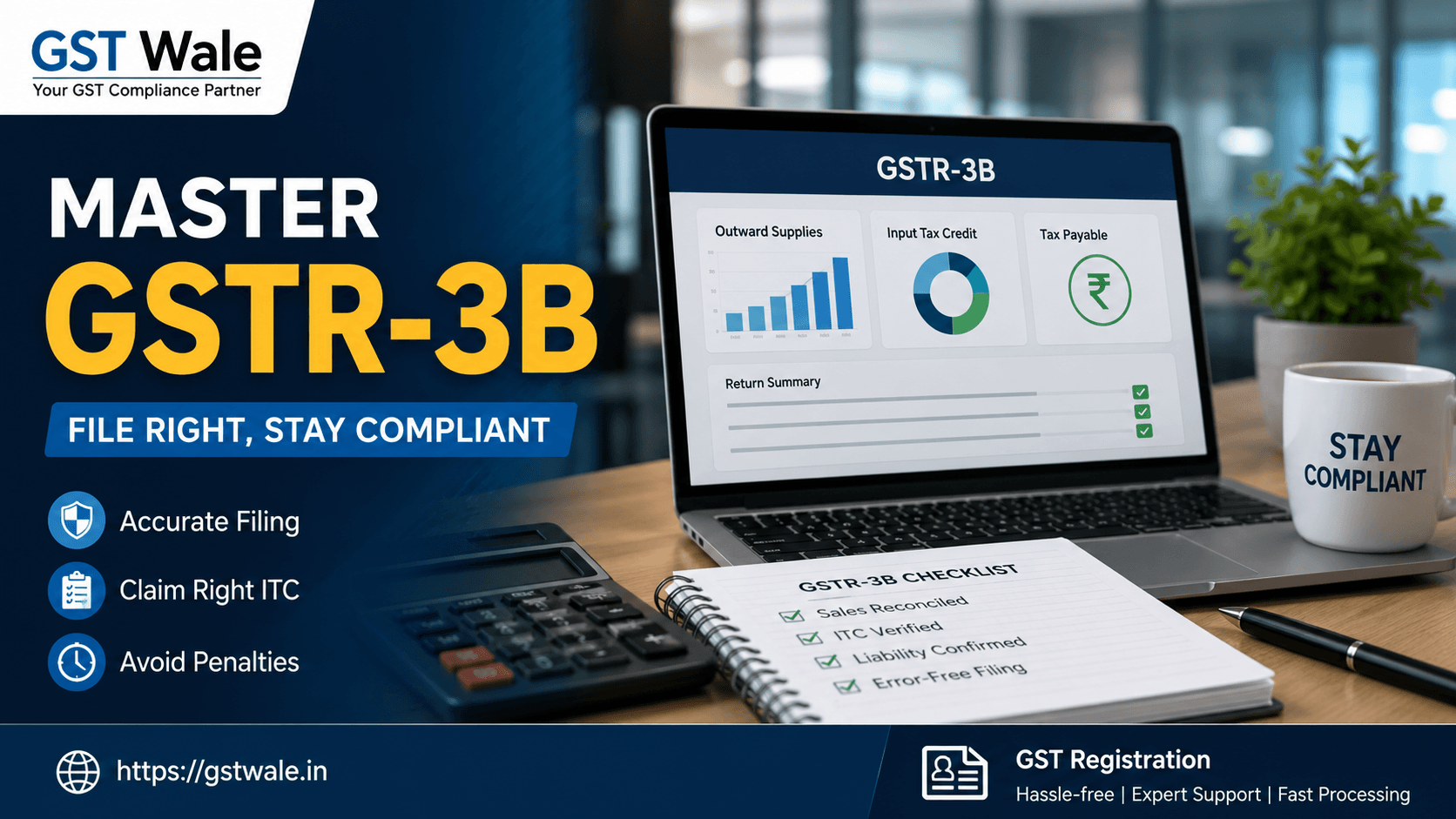
For many business owners, gstr 3 b is more than just another compliance form—it is one of the most important monthly or quarterly GST filings. A small mistake in reporting sales, tax liability, or input tax credit can create unnecessary notices, interest, or reconciliation problems later. At GST Wale, we regularly see businesses struggle not because GST rules are impossible, but because they rush through filing without properly checking their books and GST data.
Before you begin your regular GST filing, it is also important to ensure that your basic registration details, business information, and GSTIN are correct. If your business is newly registered or your registration details need attention, professional GST Registration support can help you start your compliance journey correctly.
The good news is that gstr 3 b becomes much easier when you follow a systematic process. In this guide, GST Wale explains how to prepare, review, and file your return accurately while avoiding the mistakes that commonly affect Indian businesses.
What Is GSTR 3 B?
gstr 3 b is a summary GST return used by registered taxpayers to declare their taxable supplies, tax liability, eligible input tax credit and the tax payable for a particular tax period.
Unlike a detailed invoice-level return, this return presents consolidated figures. That makes accurate accounting and reconciliation especially important.
A typical gstr 3 b filing involves reviewing:
- Outward supplies and applicable GST
- Reverse-charge transactions, wherever applicable
- Eligible input tax credit
- Ineligible or reversed input tax credit
- Tax liability
- Interest or late fees, if applicable
- Final tax payment through the GST portal
Think of the return as a financial summary of your GST position for the relevant period. The figures you enter should therefore be supported by your books, sales records, purchase records and other relevant documents.
Why Accurate GSTR 3 B Filing Matters
A GST return is not simply a compliance form that should be submitted before the deadline. The information reported can affect your cash flow, input tax credit and future reconciliation.
Suppose a trader records taxable outward supplies of ₹10 lakh in the accounting system but accidentally reports only ₹8 lakh in gstr 3 b. The immediate issue is under-reporting of tax liability. If the error is discovered later, the business may have to deal with additional tax, interest and reconciliation work.
Similarly, claiming excess input tax credit can create another compliance problem.
For this reason, businesses should treat gstr 3 b as a monthly or quarterly financial control exercise rather than a last-minute filing activity.
How to Prepare for GSTR 3 B
Reconcile Your Sales Before Filing
Start by comparing your sales register with the GST-related data available for the relevant period.
Check whether all invoices, credit notes, debit notes and other adjustments have been properly recorded. Pay special attention to cancelled invoices and transactions that may have been entered twice.
Your outward supplies should match your accounting records as closely as possible after considering legitimate adjustments.
Review Input Tax Credit Carefully
Input tax credit can significantly reduce your GST payable, but it should not be claimed merely because an invoice exists in your purchase register.
Before claiming ITC, review whether the relevant purchases qualify under the applicable GST provisions and whether the required conditions have been satisfied.
A practical review should include:
- Checking purchase invoices
- Matching available GST data with your records
- Identifying credit notes and reversals
- Separating eligible and ineligible ITC
- Reviewing blocked credits wherever applicable
- Checking whether previous-period adjustments need attention
If the purchase register shows ₹2 lakh of GST but only ₹1.7 lakh is eligible after reconciliation and reversals, blindly reporting ₹2 lakh can create problems later.
Check Reverse-Charge Transactions
Businesses should also identify transactions on which GST may be payable under the reverse-charge mechanism.
Do not assume that reverse-charge liability will automatically appear in the same way as your normal purchase transactions. Review applicable expenses and supporting records before finalising the return.
Step-by-Step GSTR 3 B Filing Process
Step 1: Log In to the GST Portal
Access your GST account and select the relevant return period. Make sure you are working with the correct GSTIN and tax period before entering figures.
Step 2: Prepare Your Figures
Keep your sales register, purchase register, tax calculation, ITC reconciliation and previous return available while preparing gstr 3 b.
Avoid entering figures directly from memory or incomplete accounting records.
Step 3: Report Outward Supplies
Enter the applicable figures for taxable outward supplies and other relevant categories according to the nature of your transactions.
Check the tax rates and taxable values carefully. A wrong classification can result in incorrect tax liability.
Step 4: Report Eligible ITC
Enter the eligible input tax credit after completing your reconciliation. Do not treat the entire purchase GST as automatically claimable.
Step 5: Calculate Tax Payable
After considering output tax liability and eligible ITC, review the resulting tax payable. Also check whether interest or other amounts are applicable.
Step 6: Make Payment and File
If additional tax needs to be paid, ensure that the required amount is available in the appropriate electronic ledger before completing the filing process.
Finally, verify the return using the applicable authorised method and retain the acknowledgement and supporting records.
Common GSTR 3 B Mistakes to Avoid
Reporting Sales Incorrectly
One of the most common errors is a mismatch between books and the return. Missing invoices, duplicate entries and incorrect credit notes can all affect the final figures.
Claiming Excess ITC
Another frequent problem is claiming ITC without adequate reconciliation. Businesses should distinguish between eligible ITC, reversals and credits that cannot legally be claimed.
Ignoring Previous Errors
If an earlier gstr 3 b contained an error, do not simply ignore it. Discuss the appropriate correction or adjustment with a GST professional based on the circumstances.
Filing at the Last Minute
Waiting until the due date creates unnecessary pressure. Technical issues, missing documents or accounting discrepancies can turn a simple GST filing into an urgent problem.
Not Maintaining Supporting Records
Every figure reported in the return should be traceable to your accounting records and relevant documentation. Good record-keeping makes future reconciliation and departmental queries much easier to handle.
Practical Tips for Error-Free GST Filing
A disciplined process can make gstr 3 b considerably easier.
First, close your accounting records for the relevant period before starting the return. Second, reconcile sales and purchase data rather than relying solely on the previous month's figures. Third, maintain a simple GST working sheet showing output tax, eligible ITC, reversals and net liability.
It is also useful to have a second person review significant figures before final submission, particularly for businesses with high transaction volumes.
For growing businesses, monthly reconciliation is much better than waiting until the end of the financial year. Small discrepancies are easier to identify and correct when the transactions are still fresh.
GSTR 3 B and Other GST Returns
Businesses should understand that gstr 3 b does not operate in isolation. Information reported through different GST compliance mechanisms may need to be reconciled.
For example, sales information and ITC-related data may need to be compared with relevant records and statements available through the GST system.
This is why GST compliance should be approached as a complete process rather than treating each gst return as an independent form.
The objective is not simply to submit the return. The objective is to ensure that your books, invoices, tax liability and reported figures tell the same financial story.
Frequently Asked Questions
Is GSTR 3 B mandatory for GST-registered businesses?
For taxpayers required to furnish it, gstr 3 b is an important GST compliance requirement. The applicable filing frequency and deadlines depend on the taxpayer and the relevant GST provisions.
Can I revise GSTR 3 B after filing?
Generally, gstr 3 b does not provide a simple revision facility like editing an already submitted form. Errors may need to be dealt with through subsequent returns or other permitted mechanisms, depending on the nature of the mistake.
How can I avoid ITC errors?
Reconcile your purchase records with available GST data, review eligibility conditions, account for credit notes and reversals, and avoid claiming credits merely because an invoice appears in your books.
What happens if GST is paid late?
Late payment can result in applicable interest and other consequences. The exact impact depends on the nature and duration of the delay, so businesses should avoid waiting until the deadline whenever possible.
Can a CA help with GSTR 3 B filing?
Yes. A qualified GST professional can help with reconciliation, tax calculations, ITC review, return preparation and compliance checks, especially where a business has complex or high-volume transactions.
Accurate gstr 3 b filing is ultimately about preparation, reconciliation and attention to detail. When your outward supplies, tax liability and input tax credit are properly reviewed before submission, the chances of avoidable mistakes reduce significantly.
At GST Wale, our approach is simple: understand your transactions, verify the numbers, follow the applicable GST provisions and file with confidence. Whether you are a small business owner, professional, trader or growing company, proper GST compliance can save you considerable time and unnecessary stress.
 Previous