


Why the 40% GST Slab Exists: Tracking Luxury and Sin Goods Taxation
Why the 40% GST Slab Exists: Tracking Luxury and Sin Goods Taxation
Why Does a 40% GST Slab Exist?
If you have been following recent GST reforms, you may have noticed something unusual: while India has simplified its main GST structure around 5% and 18%, a special 40% gst slab has been retained for selected luxury and sin goods. For businesses, understanding this distinction is important because the tax rate directly affects pricing, invoicing, margins and compliance. If you are setting up a new business, getting your GST Registration correctly is an important first step.
So, why does the government charge 40% GST on certain products while everyday essentials may attract only 5% or 18%? The answer is not simply "because they are expensive." There is a broader tax policy behind it involving luxury consumption, negative externalities, revenue protection and the gradual restructuring of India's GST system.
The 40% gst slab became part of the next-generation GST reforms effective from 22 September 2025. The GST Council described it as a special de-merit rate applicable to a limited category of goods and services, predominantly luxury and sin goods.
What Is GST and How Does the GST Slab System Work?
Before discussing 40%, let's quickly understand whatis gst.
GST, or Goods and Services Tax, is an indirect tax charged on the supply of goods and services in India. Instead of having several different indirect taxes operating independently, GST brought them into a largely unified framework.
Under the revised structure, most goods and services broadly fall into:
- 5% merit rate
- 18% standard rate
- 40% special de-merit rate for selected luxury and sin goods
The reform removed the earlier 12% and 28% rates for most products and created a simpler two-rate structure, while keeping 40% for a small group of specially identified products.
This is where the gst slab concept becomes important. Not every product is taxed according to its price alone. The government also considers the nature of consumption, social impact and revenue implications.
Why Was the 40% GST Slab Introduced?
1. Taxing Luxury Consumption
Luxury products are generally considered capable of bearing a higher tax burden because they are not basic necessities.
For example, high-end cars, yachts and private aircraft fall into a category where consumption is associated with substantial purchasing power. Applying the 40% gst slab allows the government to maintain a higher tax incidence without increasing the tax burden on ordinary household consumption.
The GST Council has specifically identified high-end cars and other luxury goods among the products covered by the special rate.
2. Addressing Sin Goods and Negative Externalities
The second major reason is the taxation of "sin goods."
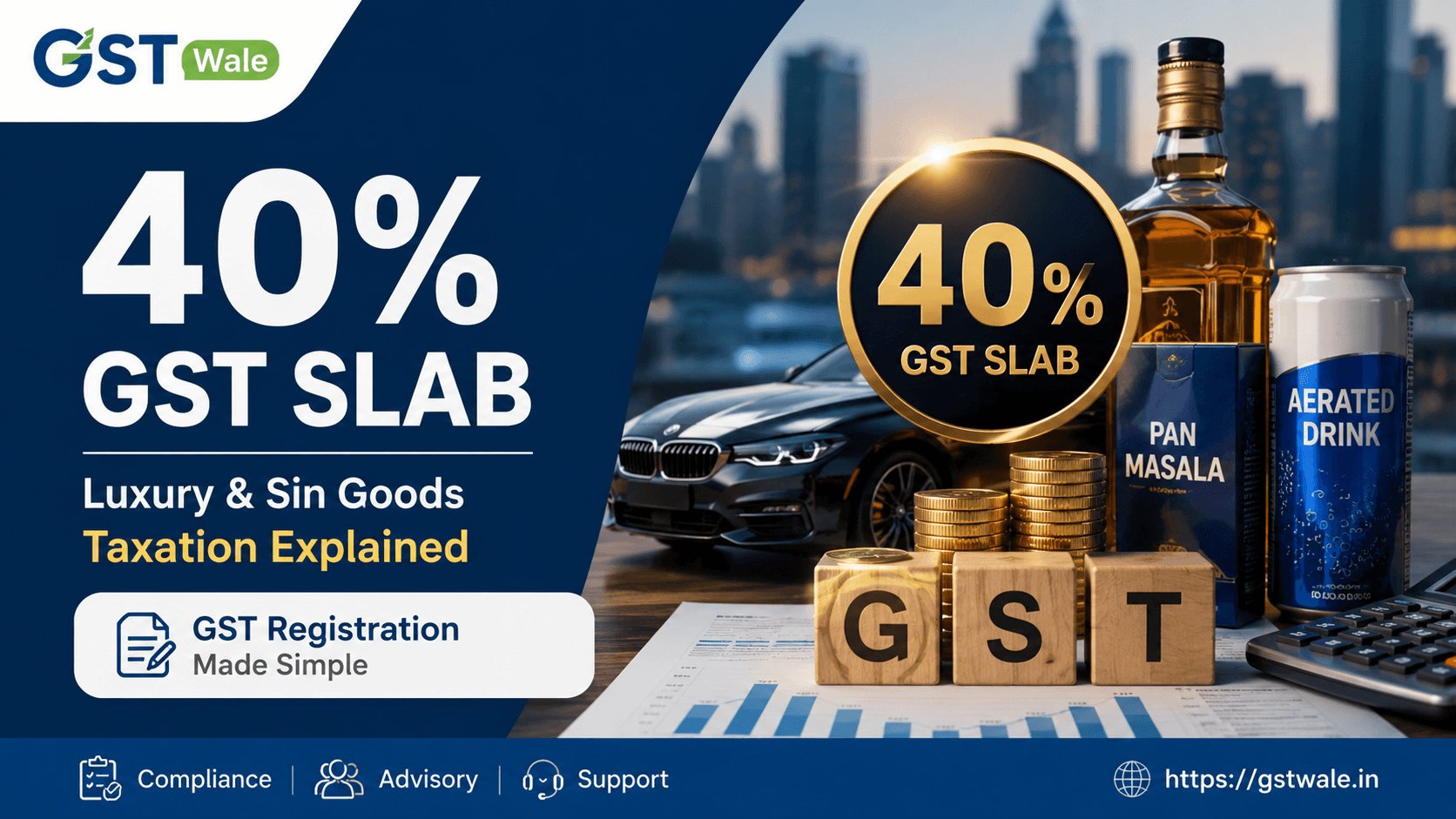
These are products whose consumption may create broader social or economic costs. Tobacco, pan masala and certain aerated beverages are examples.
The logic is straightforward: if a product creates negative externalities, taxation can serve two purposes—raising revenue and discouraging excessive consumption.
This concept is not new. Even before the latest reforms, India's GST policy treated luxury and sin goods differently. The earlier GST framework had a 28% rate along with compensation cess on several such products.
3. Protecting Government Revenue
This is perhaps the most practical reason behind the 40% gst slab.
When the government reduced rates on many products, it had to ensure that the overall tax system remained financially sustainable. High-tax categories can help compensate for revenue reductions elsewhere.
The latest reforms therefore combine lower rates on mass-consumption goods with a special rate for selected luxury and sin goods. The government's stated objective is to maintain revenue balance while simplifying the overall tax structure.
The Logic Behind Luxury and Sin Goods Taxation
What Is the Tax Structure Logic?
The tax structure logic can be understood through a simple principle: essential consumption should not carry the same tax burden as discretionary or socially costly consumption.
Consider two products:
- A basic household product used by millions of families
- A high-end luxury vehicle purchased by a relatively small number of consumers
Applying the same tax treatment to both would not necessarily achieve the government's policy objectives.
The revised gst slab system therefore attempts to separate common consumption from special categories.
This approach also gives the government greater flexibility. Rather than imposing higher taxation across the entire economy, it concentrates the highest rate on specific products.
How Did Compensation Cess Lead to the 40% GST Slab?
From 28% GST Plus Cess to a Special Rate
This is an important point for businesses.
Under the earlier structure, several luxury and sin goods attracted 28% GST plus compensation cess. The cess was introduced primarily to compensate states for revenue losses arising from GST implementation.
With the new reforms, compensation cess was discontinued for the affected categories and, in many cases, its tax incidence was effectively incorporated into the 40% GST rate.
The GST Council's FAQ explains that the special rate helps maintain the previous tax incidence on many such goods while ending the compensation cess mechanism.
So, the 40% gst slab should not be viewed simply as a sudden tax hike. For several products, it represents a restructuring of an existing high-tax burden.
Examples of Products Facing the 40% GST Slab
The special rate applies to selected categories rather than every expensive product.
Important examples include:
- Tobacco and tobacco products
- Pan masala
- Certain aerated drinks
- High-end and larger vehicles
- Yachts
- Private aircraft
- Certain other identified luxury or sin categories
The government has also highlighted lottery and online gaming within the broader luxury/sin taxation framework.
Aerated Drinks Tax
The aerated drinks tax is a good example of the policy behind the special rate.
Aerated beverages are not essential goods, and policymakers can justify a higher rate both from a revenue perspective and from a consumption-policy perspective. Therefore, businesses dealing in affected beverages need to carefully verify the applicable classification and rate before preparing invoices.
Pan Masala Cess
Similarly, the earlier pan masala cess regime is useful for understanding the transition.
Businesses that previously calculated GST and compensation cess separately may now need to work with the revised GST rate structure. This makes accurate product classification and updated accounting software particularly important.
What Does the 40% GST Slab Mean for Premium Vehicles?
The automobile sector provides one of the clearest examples.
The new framework places a 40% GST rate on specified mid-size and big cars, with compensation cess no longer applicable.
For buyers considering premium vehicles, the tax impact can be substantial.
For example, suppose the taxable value of an eligible vehicle is ₹20 lakh. At a 40% GST rate, GST alone would amount to ₹8 lakh, before considering other applicable costs and charges.
This is why businesses and consumers should never calculate the final price of a luxury vehicle simply by looking at the manufacturer's base price.
How Businesses Should Handle the 40% GST Slab
If your business deals in products covered by the special rate, do not rely on old tax tables.
Follow these practical steps:
- Identify the correct HSN classification.
Tax rates depend on the precise nature and classification of goods. - Check the latest GST notification.
Rate changes should always be verified against the applicable notification rather than an outdated chart. - Update billing software.
Your accounting or invoicing system should reflect the correct GST rate. - Review pricing contracts.
Existing B2B or B2C agreements may need revision if the tax incidence changes. - Check input tax credit treatment.
Businesses should ensure eligible ITC is properly recorded and reconciled. - Train the billing team.
A wrong GST rate can create tax shortfalls, notices and interest exposure.
For businesses operating in luxury or sin-goods sectors, professional GST review can prevent expensive compliance mistakes.
Does a 40% GST Slab Mean Every Luxury Product Is Taxed at 40%?
No.
This is one of the most common misconceptions.
A product being expensive does not automatically place it under the 40% gst slab. The applicable rate depends on the specific classification and notification issued under GST law.
For instance, a product may have a high market value but still fall under the 5% or 18% rate if it is not specifically covered by the 40% category.
Therefore, businesses should always check the applicable HSN and notification rather than deciding the tax rate based solely on the selling price.
FAQs About the 40% GST Slab
Is 40% the normal GST rate in India?
No. The normal structure primarily consists of 5% and 18%, while 40% is a special rate applicable to selected luxury and sin goods.
Why are tobacco and pan masala taxed heavily?
These products are treated as sin goods because their consumption can create negative externalities. Higher taxation also provides significant government revenue.
Does the 40% GST slab replace compensation cess?
For affected categories, the new structure incorporates the earlier tax incidence into the special GST rate, while compensation cess has been discontinued.
Are all premium vehicles taxed at 40%?
Not necessarily. The applicable rate depends on the vehicle's classification and the specific GST notification. Businesses and buyers should verify the exact category before calculating tax.
Can the GST rate change again?
Yes. GST rates are determined through the GST Council and can be revised through future policy decisions and notifications.
Understanding the GST Slab Is More Important Than Ever
The 40% gst slab is not simply a tax on expensive products. It reflects a deliberate policy choice: keep everyday consumption relatively affordable while applying a higher tax burden to selected luxury and sin goods.
The broader tax structure logic is to simplify the GST system, protect government revenue, and maintain higher taxation where policymakers consider consumption discretionary or socially costly.
For business owners, the key takeaway is simple: never assume the applicable rate based on an old GST chart. Check the current HSN classification, notification and tax treatment before invoicing.
At GST Wale, we help businesses understand GST requirements in practical terms—from registration and invoicing to compliance and tax-rate interpretation. If you are unsure whether your product falls under the 40% gst slab, getting professional advice can save you from costly tax errors.
 Previous