


How to Seamlessly Handle a Notice for Defective Return Under Section 139(9) During Income Tax E Filing
How to Seamlessly Handle a Notice for Defective Return Under Section 139(9) During Income Tax E Filing
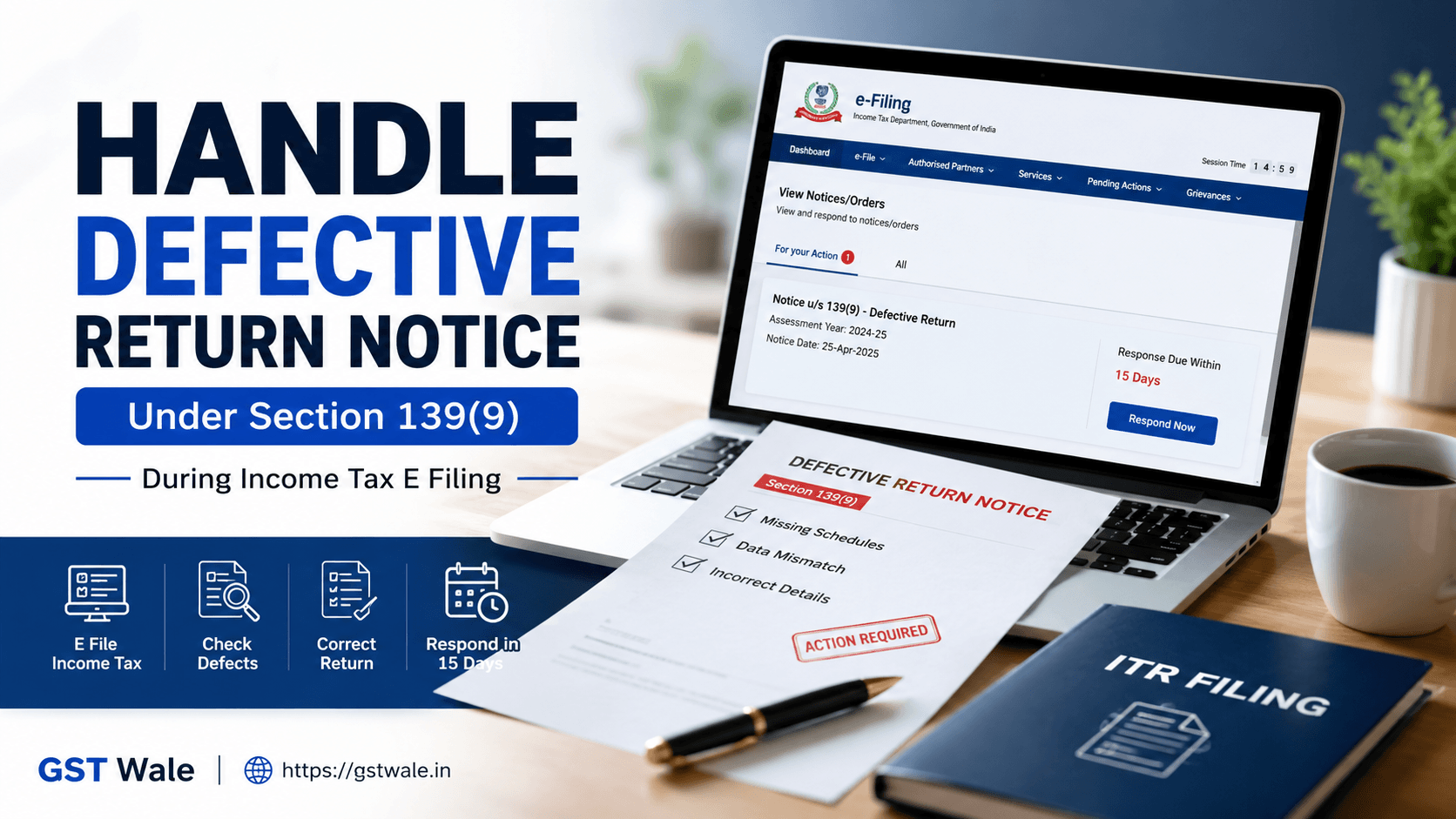
Receiving a notice for a defective return can make any taxpayer nervous, especially when it arrives after you thought your income tax e filing was successfully completed. The good news is that a notice under Section 139(9) does not automatically mean that you have committed a serious tax violation. In many cases, the issue is simply an incomplete schedule, inconsistent information, or a mismatch that needs to be corrected. If you need professional assistance with your return, ITR Filing support can help you review the return and respond correctly.
At GST Wale, we often see taxpayers ignore these notices because they are unsure what the error means or assume that the department will automatically correct it. That is risky. A defective ITR needs timely attention because failure to respond within the prescribed period can result in the return being treated as invalid. Let us understand how to handle the entire process smoothly.
What Is a Defective ITR Under Section 139(9)?
Under Section 139(9) of the Income Tax Act, a return may be considered defective when it contains incomplete or inconsistent information in the return or its schedules. The Income Tax Department generally communicates the defect through a notice available on the e-filing portal and may also send the communication to the taxpayer's registered email address.
A defective ITR does not necessarily indicate tax evasion or deliberate wrongdoing. It may happen because of a simple reporting mistake. For example, a taxpayer may claim TDS credit without reporting the corresponding income, leave mandatory details incomplete, or fail to provide the required financial statements when reporting business or professional income.
The important point is to read the notice carefully and identify exactly what needs to be corrected before making a response.
Why Does a Defective ITR Notice Matter During Income Tax E Filing?
When completing income tax e filing, taxpayers generally focus on submitting the return before the due date. However, successful submission does not always mean that the return is free from defects.
The department may subsequently identify an inconsistency during processing. If a defective return notice is issued, the taxpayer must either correct the defect or explain why the return should not be treated as defective.
According to the Income Tax Department, the usual 15-day response time is counted from the date of receiving the notice, unless another period is specifically mentioned in the notice. An extension may also be requested in appropriate circumstances.
Therefore, do not keep the notice aside. Treat it as a compliance task with a deadline.
Common Reasons for Receiving a Defective ITR Notice
Understanding the reason behind the notice is the first step toward a successful response to notice.
Some common reasons include:
- TDS credit has been claimed, but the related income has not been reported.
- Gross receipts reflected in Form 26AS or AIS are higher than receipts reported in the ITR.
- Income or heads of income have been entered as zero while tax liability has been calculated.
- The taxpayer's name in the return does not match PAN records.
- Business or professional income has been reported without completing the required Balance Sheet or Profit and Loss details.
- Mandatory information or missing schedules has not been provided.
- Information entered in different sections of the return is inconsistent.
These examples are also reflected in the Income Tax Department's guidance on defective returns.
How to Check a Defective ITR Notice Online
The first practical step in income tax e filing is to access the notice directly through the official portal instead of relying only on an email summary.
Log in to your income tax e-filing account and navigate to the pending actions or e-Proceedings section. The Income Tax Department's current guidance identifies the path as Dashboard → Pending Action → e-Proceeding → For Your Action.
Open the relevant notice and download the notice PDF. Check:
- Assessment Year
- Date of notice
- Notice identification details
- Section under which the notice has been issued
- Specific defect or error code
- Deadline for responding
- Instructions for filing the corrected return
Do not start changing your return until you understand the exact defect.
Step-by-Step Process for Responding to a Section 139(9) Notice
Step 1: Read the Notice Carefully
Start by identifying the precise reason mentioned in the notice. An error code may point toward a particular section or schedule that requires correction.
For example, if the notice indicates that TDS has been claimed but the corresponding income is missing, simply submitting the same return again will not solve the problem.
Step 2: Reconcile Your Tax Information
Before making changes, compare your ITR with relevant records such as Form 26AS, AIS, TIS, Form 16, Form 16A, bank statements and books of accounts, wherever applicable.
This is especially important for business owners and professionals. A small mismatch between reported receipts and tax credits can trigger a defective return notice.
Step 3: Identify Missing Schedules or Incorrect Information
Check whether any required schedule was left incomplete. Missing schedules are a common practical reason for returns becoming defective.
Review income details, deductions, TDS, tax payments, business information, capital gains and other applicable schedules. Do not make unnecessary changes to sections that are already correct.
Step 4: Prepare the Corrected Return
If the defect is genuine, prepare a corrected return with the necessary information. The response process allows taxpayers to correct the defect online in the ITR form in applicable cases.
When preparing the corrected return, pay attention to the section under which it is being filed and ensure that the original return details are correctly referenced wherever required.
Step 5: Submit Your Response to Notice
The official e-Proceedings process provides an option to submit a response to a defective notice. Depending on the circumstances, the taxpayer can agree with the defect and provide the corrected return or disagree and provide an appropriate explanation.
If you disagree with the alleged defect, do not simply select "Disagree" without explanation. Provide a clear, factual reason supported by the information available in your return and records.
Step 6: Complete Verification and Preserve the Acknowledgement
After submission, save the acknowledgement and relevant confirmation details. Keep a copy of the defective notice, corrected return and response for your records.
This is an important part of responsible income tax e filing because you may need these documents later if there is another communication from the department.
What Happens If You Ignore the Notice?
Ignoring a defective ITR notice can create unnecessary complications. If the taxpayer fails to respond within the stipulated period, the return may be treated as invalid. Depending on the circumstances, this can affect processing and may have consequences relating to interest, penalty, carry-forward of losses or certain exemptions.
In simple terms, do not assume that silence means the issue has disappeared.
If you genuinely need more time, check whether an extension or adjournment can be requested. The Income Tax Department specifically states that taxpayers may seek an extension in appropriate cases.
Corrected Return or Revised Return: What Should You Do?
One common confusion during income tax e filing is whether the taxpayer should file a fresh or revised return or respond directly to the defective notice.
The Income Tax Department states that a fresh or revised return may be possible if the applicable time for filing that return has not expired. Once that period has lapsed, the taxpayer generally needs to respond to the Section 139(9) notice rather than simply filing another fresh or revised return.
This distinction matters because filing another return without following the notice instructions may not resolve the original defect.
Practical Example: How a Simple Error Can Become a Notice
Suppose Rahul runs a small consultancy business. During his income tax e filing, he claimed TDS of ₹30,000 based on his Form 26AS. However, he accidentally omitted one professional receipt against which the TDS had been deducted.
The department identifies that TDS has been claimed but the corresponding income is not adequately reflected. Rahul receives a defective return notice.
Instead of ignoring it, he compares his books, invoices, Form 26AS and return. He identifies the omitted receipt, corrects the relevant information, checks the tax calculation and submits the appropriate response within the 15-day response time specified in the notice.
This is exactly why checking the defect before responding is important. A quick, careless response can create another mismatch.
Mistakes to Avoid While Handling a Defective ITR
Do Not Ignore the Deadline
The 15-day response time should be treated seriously unless the notice specifies a different period. Waiting until the last day can leave little room to resolve technical problems.
Do Not Copy the Same Return Again
If the department has identified a genuine defect, submitting substantially the same information will not solve the underlying problem.
Do Not Change Unrelated Information
Correct only what is necessary and ensure that any changes are supported by actual records.
Do Not Guess the Error Code
If the error code or defect is unclear, examine the notice and supporting information carefully before making a correction. For complicated business, capital gains or tax-credit issues, professional review can prevent further mistakes.
Do Not Forget Record Keeping
Maintain the notice, response, corrected return and acknowledgement together. Good documentation makes future communication much easier.
Frequently Asked Questions About Income Tax E Filing and Defective Returns
What is a defective ITR?
A defective ITR is a return that the department considers incomplete or inconsistent because of errors in the return or its schedules, or for another prescribed reason. The taxpayer receives a notice explaining the defect and is generally required to correct it or provide an appropriate response.
What is the response to notice under Section 139(9)?
The response to notice is the taxpayer's formal submission against the defective return communication. Depending on the situation, the taxpayer may agree with the defect and submit the corrected information or disagree and provide reasons explaining why the return should not be treated as defective.
How much time do I get to respond to a defective return notice?
The standard 15-day response time applies from the date of receiving the notice, unless the notice specifies another period. In suitable cases, the taxpayer can seek an extension or adjournment.
Can I file a corrected return after receiving a defective ITR notice?
Yes, where applicable, the defect can be corrected through the prescribed response process. Whether a revised or fresh return is separately possible depends on the filing period and circumstances. Once the applicable filing period has expired, responding to the Section 139(9) notice becomes particularly important.
Can I modify my response after submitting it?
The Income Tax Department states that a response submitted on the e-filing portal cannot be updated or withdrawn after submission. Therefore, review the response and corrected information carefully before final submission.
Handle Income Tax E Filing Notices Without Panic
A Section 139(9) notice is a compliance issue that should be handled promptly, but it is not a reason to panic. The right approach is to read the notice, understand the error code, reconcile your tax records, correct missing schedules or inconsistent information and submit the appropriate response within the prescribed deadline.
At GST Wale, our approach to income tax e filing is simple: understand the numbers first, correct the actual issue and document every step. If you have received a defective ITR notice and are unsure how to proceed, getting professional assistance can help you avoid further errors and unnecessary tax complications.
 Previous