


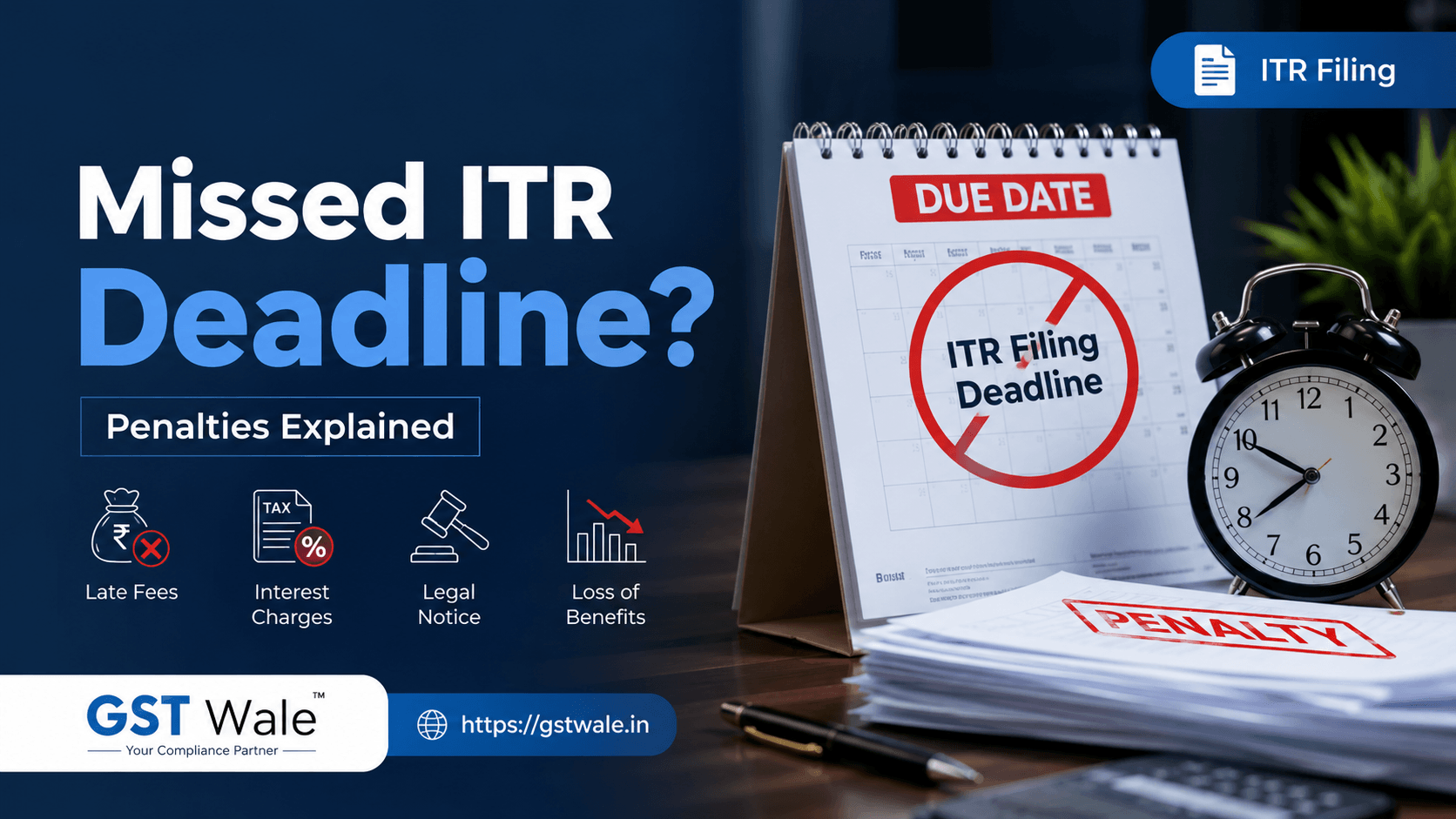
What Happens If You Miss the ITR Return Filing Deadline? Penalties Explained
What Happens If You Miss the ITR Return Filing Deadline? Penalties Explained
Every year as July approaches, the buzz around income tax filings intensifies across India. For salaried individuals, small business owners, and large corporations alike, completing your annual tax compliance is a crucial financial responsibility. However, life gets busy. Between managing a growing business, balancing family life, and navigating daily operational challenges, it is incredibly easy to lose track of the calendar. If you suddenly realize that the July 31st deadline has passed and you haven’t filed your taxes yet, panic usually sets in. At GST Wale, we regularly encounter clients who come to us in a state of stress after a missed tax deadline. The good news is that the sky isn’t falling down, but the bad news is that delaying your compliance further will cost you hard-earned money. Understanding the precise rules surrounding your ITR return filing can save you from unnecessary financial stress and legal complications.
If you find yourself in this situation, the most important thing is to understand your options and take swift action. Getting your ITR Filing done correctly, even if it is after the original due date, is the only way to mitigate further losses. In this comprehensive guide, we will break down exactly what happens when you miss the target date, how the legal provisions apply to your situation, and how you can rectify the error with minimal damage to your financial health.
The Immediate Consequences of a Missed Tax Deadline
When the government sets a deadline for ITR return filing, it expects taxpayers to comply in an orderly manner. Missing this timeline transitions your case from a routine file to a late submission category. The Income Tax Department has structured specific mechanisms to discourage delays. The primary income tax consequences of failing to file on time include mandatory financial penalties, interest on unpaid taxes, and the loss of specific tax benefits that you would otherwise be legally entitled to claim.
It is vital to realize that even if your employer has deducted Tax Deducted at Source (TDS) and your net tax liability is zero, you are still legally obligated to complete your ITR return filing if your total income exceeds the basic exemption limit. Assuming that "no tax due equals no need to file" is a highly risky misconception that lands thousands of taxpayers in trouble every single year.
Deconstructing the Section 234F Penalty
The most immediate and transparent blow to your pocket after missing the deadline is the statutory fine levied by the department. Under the Indian Income Tax Act, this is governed strictly by specific legal frameworks designed to penalize non-compliance.
What is the Section 234F Penalty?
Introduced to instill a stricter sense of discipline among taxpayers, the Section 234F penalty dictates a clear flat-fee structure for any returns filed after the standard due date. If your ITR return filing is executed after the deadline, this fine is automatically calculated by the income tax portal before you can successfully submit your form.
The Fee Structure You Need to Know
For Total Income Exceeding Rs. 5 Lakhs: If your total taxable income during the financial year is more than Rs. 5,00,000, a flat late tax filing fee of Rs. 5,000 is levied automatically.
For Small Taxpayers (Income up to Rs. 5 Lakhs): To ensure that small earners and micro-businesses are not crushed under heavy compliance costs, the law provides a relaxation. If your total income is below Rs. 5,00,000 but above the basic tax exemption limit, the late tax filing fee is capped at a maximum of Rs. 1,000.
Expert Insight from GST Wale: Think of this late fee as a completely avoidable expense. For a small business owner or an individual, spending Rs. 1,000 to Rs. 5,000 purely because of a delay provides zero business value. Timely compliance keeps this money in your business account rather than sending it to the government treasury as a penalty.
Accumulation of Interest Under Section 234A
The flat penal fee is only one side of the coin. If you owe outstanding taxes to the government, a missed tax deadline triggers an ongoing interest clock that compounds your financial liability month over month.
Under Section 234A of the Income Tax Act, interest is levied at the rate of 1% per month or a fraction of a month on the outstanding tax amount due. This interest starts accumulating immediately from the day following the original due date and continues until the actual date you complete your ITR return filing.
Let's look at a practical example: If you have an outstanding tax liability of Rs. 50,000 and you delay your filing by 4 months, you will face an interest charge calculated as follows:
When you add this interest to the flat Section 234F penalty, the cost of procrastination becomes painfully evident. This is why we advise our clients to pay their self-assessment tax immediately, even if they take a few extra days to organize their paperwork for the final upload.
The Solution: Filing a Belated ITR
If you have missed the bus on July 31st, what is the next course of action? The income tax laws allow you a window of redemption known as a belated ITR. This is governed under Section 139(4) of the Income Tax Act.
A belated ITR allows you to submit your tax details for the previous financial year after the deadline has lapsed. However, this window does not remain open forever. Typically, you can file a belated return only up to December 31st of the assessment year (unless extended by the government under special circumstances). If you miss even the December 31st deadline for your ITR return filing, your options shrink dramatically, and you can no longer file your return voluntarily without facing explicit notices or utilizing complex updated return provisions (ITR-U) which carry even higher penalty structures.
Other Critical Income Tax Consequences of Delay
Beyond the direct financial hits of interest and penalties, delaying your tax compliance hurts your financial health in several indirect ways:
1. Inability to Carry Forward Business and Capital Losses
One of the biggest setbacks for businesses and active stock market investors who miss the timeline is the restriction on carrying forward losses. If your business suffered a loss or if you incurred short-term or long-term capital losses in the stock market, you can normally carry these losses forward for up to 8 subsequent years to offset future profits. However, if your ITR return filing is late, you lose this privilege entirely. The only exception is an unabsorbed depreciation loss.
2. Delays in Receiving Tax Refunds
If you have paid excess tax through TDS or advance tax, you are legally eligible for a refund plus interest from the department. However, if you file a belated ITR, the processing of your return is pushed to the back of the queue. Your refund will be substantially delayed, and you may lose out on the interest that the department pays on delayed refunds for the period of your delay.
3. Difficulties in Loan Sanctions and Visa Applications
Whether you are applying for a home loan, a business expansion credit line, or a visa for international travel, financial institutions and consulates invariably ask for the last three years of your tax acknowledgments. A late filing record, stamped with a Section 234F penalty payment, signals poor financial discipline to underwriters and authorities, potentially complicating your approvals.
A Quick Checklist to Handle a Missed Deadline
If you have missed the tax deadline, do not panic. Follow this systematic approach recommended by GST Wale to resolve the matter:
Calculate Outstanding Tax Liability: Review your Form 26AS, AIS (Annual Information Statement), and TIS to determine if any tax remains unpaid.
Pay Outstanding Taxes with Interest: If there is tax due, pay it immediately online via self-assessment tax to freeze the Section 234A interest accumulation.
Gather Relevant Documents: Collect your Form 16, bank statements, profit and loss statements, and investment proofs.
Execute Your Belated ITR return filing: Prepare your tax form, pay the mandatory late fee under Section 234F, and upload the return before December 31st.
Verify Your Return: Do not forget to e-verify your return within the mandated timeframe via Aadhaar OTP or net banking. An unverified return is treated as invalid by the department!
Frequently Asked Questions (FAQs)
Q1: Can I avoid the Section 234F penalty if my income is below the taxable limit?
Yes. If your total gross income does not exceed the basic exemption limit (which depends on the tax regime you choose), you are not liable to pay a late fee under Section 234F, provided you are not filing due to special conditions like high electricity consumption or foreign travel.
Q2: What happens if I miss the December 31st deadline for a belated return?
If you miss the December 31st deadline, you cannot file a regular return. Your only option may be to file an Updated Return (ITR-U) under Section 139(8A), which allows filing up to 2 years later but comes with an additional tax penalty ranging from 25% to 50% of the aggregate tax and interest due.
Q3: Can a late tax filing fee be waived off by the IT Department?
Practically speaking, the automated system on the income tax portal does not allow any waiver of the Section 234F fee at the time of submission. Only under extremely rare, national-level emergencies does the CBDT issue explicit notifications extending deadlines or waiving fees.
Q4: Will I face jail time for a missed tax deadline?
For routine delays where taxes are paid along with late fees, criminal prosecution is not initiated. However, willful evasion of taxes and absolute refusal to file returns despite receiving formal statutory notices can lead to severe legal penalties and prosecution under Section 276CC.
Act Swiftly with GST Wale
Missing your annual tax submission date is undoubtedly stressful, but it is a manageable error if handled with speed and professional accuracy. Procrastinating further only multiplies your financial liabilities via accumulating interest and restricts your access to vital banking features. Promptly executing your ITR return filing as a belated return is the best strategy to protect your hard-earned profits and maintain your financial credibility.
Let GST Wale Take Care of Your Taxes
At GST Wale, we understand that tax laws can feel overwhelming for busy professionals and business operators. Our team of experienced Chartered Accountants and tax practitioners handles everything from calculating your correct liabilities, processing late filings with precision, minimizing interest outgoes, and ensuring you remain fully compliant with the law. Don't let compliance errors drag your business down. Reach out to GST Wale today, and let us clear your tax backlog seamlessly while you focus on what you do best—growing your business!
 Previous