


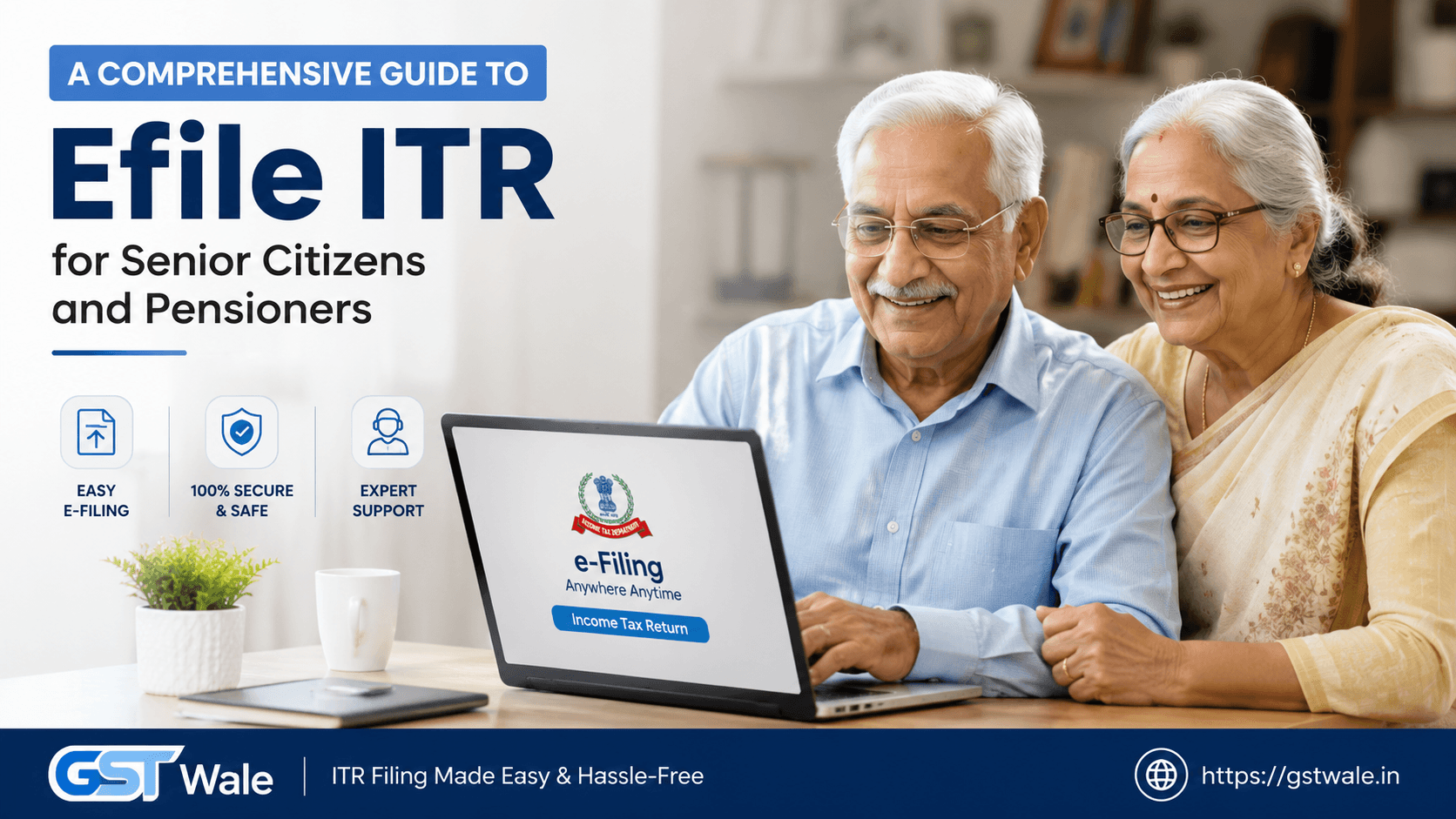
A Comprehensive Guide to Efile ITR for Senior Citizens and Pensioners
A Comprehensive Guide to Efile ITR for Senior Citizens and Pensioners
Retirement is meant to be a time of relaxation, a well-earned reward after decades of hard work. However, as July approaches each year, many retirees in India face a familiar wave of anxiety: dealing with taxes. If you are a senior citizen or a pensioner, navigating the income tax portal can feel like trying to decode a completely different language.
At GST Wale, we believe that managing your post-retirement finances should be stress-free. That is why we have put together this comprehensive guide to help you efile ITR smoothly, correctly, and without any last-minute panic. If you ever feel overwhelmed by the process, remember that professional help is always available to handle your ITR Filing accurately and secure all your hard-earned tax benefits.
Let’s break down everything you need to know about navigating the income tax landscape in your golden years.
Understanding Senior Citizen Tax Rules
Before you log in to efile ITR, it is crucial to understand how the Income Tax Department categorizes individuals based on age, as the rules change significantly.
Senior Citizens: Individuals who are 60 years or older but less than 80 years old at any time during the previous financial year.
Super Senior Citizens: Individuals who are 80 years or older.
The senior citizen tax rules offer higher basic exemption limits compared to younger taxpayers. Under the Old Tax Regime, a senior citizen enjoys a tax exemption up to ₹3,000,000, while a super senior citizen is exempt up to ₹5,000,000. Under the New Tax Regime—which is now the default option—the basic exemption limit is ₹300,000 for everyone, but senior citizens still benefit heavily from standard deductions and tax rebates under Section 87A.
Taxability of Pension Income ITR
A common misconception among retirees is that pensions are entirely tax-free. In reality, the taxability depends on the nature of the pension you receive:
1. Uncommuted Pension
This is the regular monthly pension you receive from your employer. It is treated exactly like salary income. Therefore, when you prepare to efile ITR, this amount must be reported under the head "Income from Salaries." The biggest advantage here is that pensioners are entitled to a flat Standard Deduction of ₹50,000 (under both old and new regimes), just like salaried employees.
2. Commuted Pension
If you opted to receive a lump-sum amount upfront instead of a monthly payout, this is called a commuted pension. For government employees, this lump sum is entirely tax-exempt. For non-government employees, it is partially exempt based on whether you also received a gratuity.
3. Family Pension
If a dependent family member receives a pension after the demise of the pensioner, it is taxed under "Income from Other Sources." Under the Old Regime, a deduction of 1/3rd of the pension amount or ₹15,000 (whichever is lower) is allowed.
Key Tax Exemptions for Seniors You Must Claim
When you efile ITR, leaving money on the table is the last thing you want to do. Make sure you claim these specific tax exemptions for seniors to minimize your liability:
Section 80TTB (Interest on Deposits): Senior citizens can claim a deduction of up to ₹50,000 on interest earned from savings accounts, fixed deposits (FDs), and post office schemes.
Section 80D (Medical Insurance Premium): Medical expenses can skyrocket during retirement. Seniors can claim a deduction of up to ₹50,000 for health insurance premiums. If you don't have insurance, you can claim this deduction against actual medical expenditures incurred for your health.
Section 194P (Exemption from Filing): If you are 75 or older, have only pension and interest income, and receive both from the same bank, you are exempt from filing an ITR altogether. The bank will calculate and deduct your tax automatically. However, if you have other income sources like capital gains or rental income, you still need to efile ITR.
The Role of Form 15H Filing
TDS (Tax Deducted at Source) can unnecessarily lock up your cash flow. If your total estimated taxable income for the financial year is below the basic exemption limit, you can request banks not to deduct TDS on your fixed deposit interest.
This is done through Form 15H filing. It is a self-declaration form meant exclusively for senior citizens. We highly recommend submitting Form 15H to your bank at the very beginning of the financial year. If you forget to submit it and the bank deducts tax, your only remedy is to efile ITR to claim a refund.
Step-by-Step Guide to E-Filing for Retirees
The process of e-filing for retirees has become significantly automated over the years, but it still requires careful validation. Here is how you can efile ITR independently:
Step 1: Gather Your Documents
Before opening the portal, gather your Form 16 (provided by your pension-disbursing bank), Bank Passbooks, FD Interest Certificates, and investment proofs for deductions.
Step 2: Download AIS and TIS
Log into the Income Tax e-filing portal and download your Annual Information Statement (AIS) and Taxpayer Information Summary (TIS). The department tracks all your financial footprints here, including stock transactions, property sales, and dividend income.
Step 3: Choose the Right ITR Form
For most pensioners with income from salary/pension, one house property, and interest income, ITR-1 (Sahaj) is the appropriate form. If you have capital gains from selling mutual funds or property, you will need to use ITR-2.
Step 4: Verify Pre-filled Data
The portal will pre-fill most of your pension income ITR details and interest data. Carefully cross-verify these figures with your bank statements and Form 26AS.
Step 5: Claim Deductions and Compute Tax
Ensure that deductions under Section 80C, 80D, and 80TTB are fully reflected. The system will automatically calculate whether you owe any tax or are eligible for a refund.
Step 6: E-Verify Your Return
Your filing is incomplete without verification. You can easily e-verify using an Aadhaar OTP sent to your registered mobile number within 30 days of filing.
Frequently Asked Questions (FAQs)
Q1. Is my monthly pension taxable if it is my only source of income?
Yes, monthly pension is treated as salary income and is taxable. However, you will not pay any tax if your total income stays below the basic exemption threshold after claiming the ₹50,000 standard deduction and other exemptions.
Q2. Can senior citizens claim deductions for medical expenses if they don't have health insurance?
Yes. Under Section 80D, senior citizens who do not have a health insurance policy can claim a deduction of up to ₹50,000 for actual medical expenditures incurred during the year.
Q3. What happens if I miss the due date to efile ITR?
If you miss the July 31st deadline, you can still file a delayed return (Belated ITR) until December 31st. However, you will have to pay a late filing fee of up to ₹5,000 under Section 234F, and you will lose the ability to carry forward certain losses.
Q4. Is interest earned on Senior Citizens Savings Scheme (SCSS) tax-free?
No, the interest earned on SCSS is taxable. However, you can claim a deduction up to ₹50,000 on this interest income under Section 80TTB.
Let GST Wale Handle the Heavy Lifting
Filing your taxes does not have to be a stressful annual chore. By understanding the specific senior citizen tax rules and utilizing available deductions, you can safeguard your retirement nest egg effectively.
While the income tax portal is designed to be accessible, a simple oversight—like choosing the wrong form or missing an updated disclosure requirement—can lead to frustrating compliance notices. Let our seasoned team of experts at GST Wale take care of the complexities for you. We will evaluate your income sources, optimize your deductions, and seamlessly efile ITR on your behalf so you can focus entirely on enjoying your retirement. Reach out to us today to get started!
 Previous