


A Detailed Guide to Declaring Director Details and Unlisted Equity Shares in ITR 2.0
A Detailed Guide to Declaring Director Details and Unlisted Equity Shares in ITR 2.0
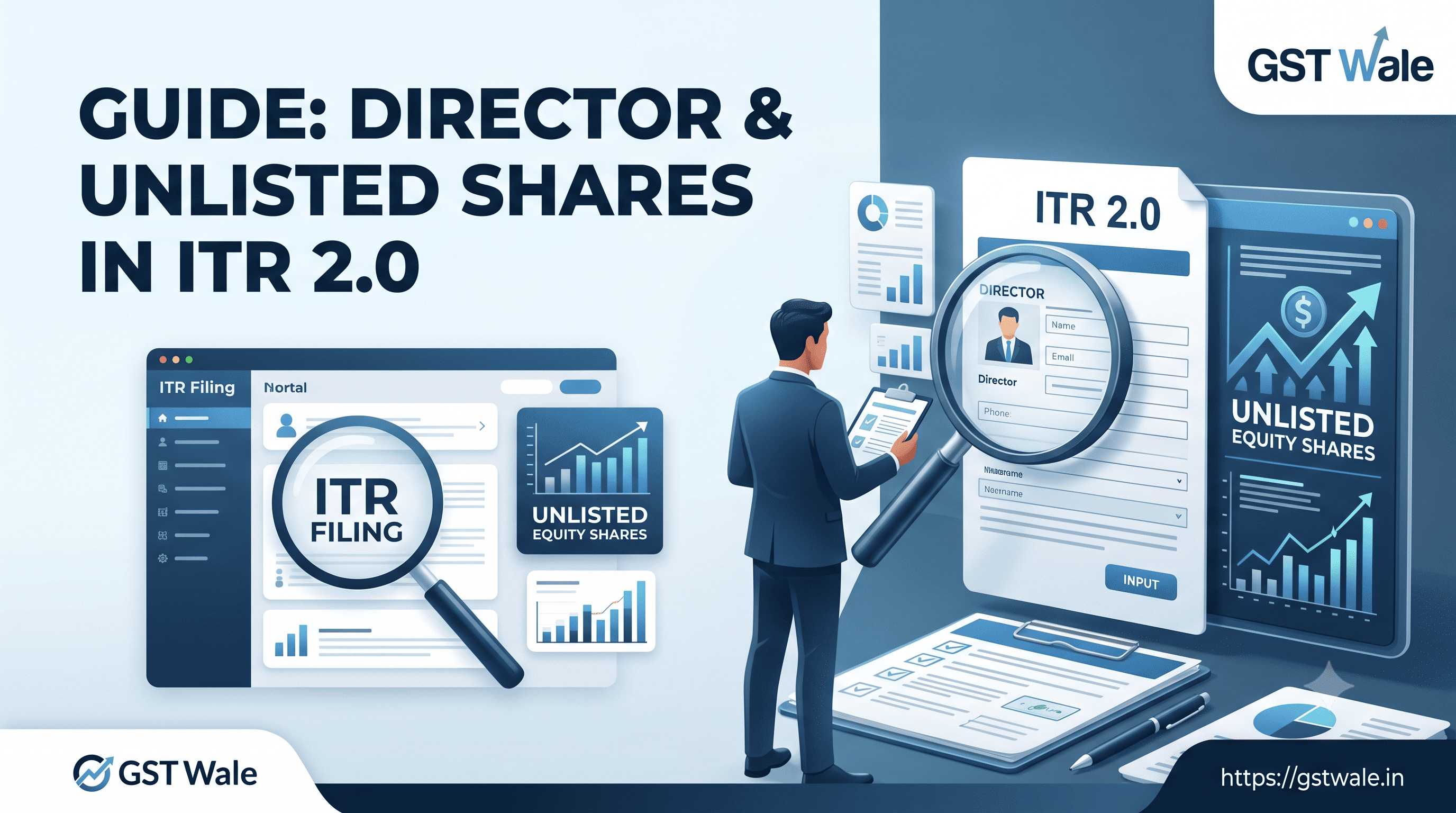
Filing your income tax return has become more detailed over the years, and itr 2.0 requires taxpayers to disclose specific financial information accurately. If you are a company director or hold unlisted equity shares, these disclosures are no longer optional. Incorrect or incomplete reporting may lead to notices from the Income Tax Department and unnecessary compliance issues.
At GST Wale, we regularly assist taxpayers with accurate return filing and tax compliance. If you are looking for professional assistance with https://gstwale.in/services/income-tax/itr-filing">ITR Filing, it is always advisable to seek expert guidance before submitting your return. Understanding the disclosure requirements in itr 2.0 can help you avoid common mistakes and ensure your income tax return form is filed correctly.
What is ITR 2.0?
The term itr 2.0 is commonly used to refer to the updated version of the ITR 2 income tax return form that includes enhanced disclosure requirements. This version of the itr form is applicable to individuals and Hindu Undivided Families (HUFs) who do not have income from business or profession but may have income from salary, capital gains, house property, or other sources.
One of the significant improvements in itr 2.0 is the requirement to provide detailed information regarding:
- Directorship in companies
- Ownership of unlisted equity shares
- Additional financial disclosures
- Capital gains reporting
- Foreign assets, where applicable
These additions improve transparency and enable the Income Tax Department to verify taxpayer information efficiently.
Who Should Use ITR 2?
Before discussing disclosures, it is important to understand whether itr 2 is the correct return for you.
Generally, itr 2 is suitable if you:
- Earn salary or pension income
- Own more than one house property
- Have capital gains
- Hold foreign assets or foreign income
- Are a company director
- Hold unlisted equity shares
- Do not have business or professional income
Choosing the correct income tax return form is the first step towards hassle-free tax compliance.
Director Details in ITR 2.0
One of the biggest additions in itr 2.0 is the mandatory disclosure for company directors.
If you served as a director in any company during the financial year, you must provide complete information while filing your return.
Information Required
Typically, you need to disclose:
- Name of the company
- PAN of the company
- DIN (Director Identification Number)
- Type of company
- Whether the company is listed or unlisted
This information helps the Income Tax Department match records maintained with the Ministry of Corporate Affairs (MCA).
Who Must Report Director Details?
You must provide director details if you were:
- Executive Director
- Managing Director
- Whole-Time Director
- Independent Director
- Nominee Director
- Additional Director
Even if your directorship existed only for part of the financial year, the disclosure is generally required in itr 2.0.
Practical Example
Suppose Mr. Raj became a director in ABC Private Limited in October 2025. Even though he served only for six months during the financial year, he must report this information while filing itr 2.0.
Failing to disclose such details may result in mismatches during verification.
Reporting Unlisted Equity Shares in ITR 2.0
Another important disclosure introduced in itr 2.0 relates to unlisted equity shares.
These are shares of companies that are not traded on recognised stock exchanges.
Many taxpayers mistakenly believe that reporting is necessary only when shares are sold. However, itr 2.0 requires reporting even if the shares are simply held during the financial year.
Details Required
The itr form generally requires the following information:
- Name of the company
- PAN of the company
- Opening balance of shares
- Shares acquired during the year
- Date of acquisition
- Purchase cost
- Shares transferred during the year
- Sale consideration
- Closing balance
This information enables proper tracking of ownership and transactions.
Why Has the Government Introduced These Disclosures?
The Government has strengthened reporting requirements to improve tax compliance.
The objectives include:
- Increasing transparency
- Preventing tax evasion
- Tracking investments in private companies
- Matching company records with taxpayer information
- Detecting undisclosed investments
The additional disclosures in itr 2.0 support better data verification and reduce the possibility of incorrect reporting.
Common Mistakes While Filing ITR 2.0
Many taxpayers make avoidable errors while completing the income tax return form.
Some common mistakes include:
- Not reporting directorship.
- Ignoring unlisted equity share disclosures.
- Providing incorrect PAN of the company.
- Mentioning incorrect purchase cost.
- Entering inaccurate acquisition dates.
- Choosing the wrong itr form.
- Forgetting to verify the return after submission.
These mistakes can delay processing and may trigger notices from the tax department.
Step-by-Step Process to Report Director Details
Follow these simple steps while preparing itr 2.0:
Step 1
Collect your Director Identification Number (DIN).
Step 2
Verify the company PAN.
Step 3
Check your appointment and resignation dates.
Step 4
Enter the information exactly as required in the return.
Step 5
Review all disclosures before submission.
Accuracy is essential because the department cross-checks the information with official records.
Step-by-Step Process to Report Unlisted Equity Shares
For correct reporting in itr 2.0, keep the following documents ready:
- Share certificates
- Share allotment letters
- Purchase agreements
- Valuation reports (if applicable)
- Company PAN
- Transfer documents
- Sale records
Entering details directly from authentic records reduces the possibility of errors.
Benefits of Accurate ITR 2.0 Filing
Proper compliance offers several advantages.
These include:
- Faster processing of returns
- Reduced chances of receiving tax notices
- Better financial documentation
- Easier loan approvals
- Improved credibility with financial institutions
- Smooth future assessments
Accurate it filing also reflects responsible financial management.
Tips from GST Wale
As tax professionals, we recommend the following best practices:
- Maintain complete investment records.
- Keep copies of company documents.
- Verify PAN details carefully.
- Reconcile share transactions before filing.
- Use the correct income tax return form.
- Review every disclosure before final submission.
- Complete verification immediately after filing.
These simple precautions can save considerable time and prevent unnecessary complications.
Can You File Income Tax Return Online?
Yes. Taxpayers can easily file income tax return online through the Income Tax Department's official portal.
However, returns involving directors, capital gains, or unlisted equity shares often require careful review because even a minor reporting error may lead to discrepancies.
If your return contains complex disclosures, professional assistance can help ensure complete accuracy.
Frequently Asked Questions
Is director disclosure mandatory in itr 2.0?
Yes. If you were a director in any company during the financial year, you must disclose the required information while filing itr 2.0.
Do I need to report unlisted equity shares if I did not sell them?
Yes. Merely holding unlisted equity shares during the financial year generally requires disclosure in itr 2.0, even if there was no sale transaction.
Can salaried employees file itr 2.0?
Yes. Salaried individuals who satisfy the eligibility conditions for itr 2 can use this return if they have capital gains, multiple house properties, directorship, or unlisted equity shares.
What documents should I keep ready before filing?
Keep your PAN, Aadhaar, Form 16, capital gain statements, director details, company PAN, share documents, and bank account information ready before preparing your itr form.
What happens if I miss reporting director details?
Failure to provide mandatory disclosures may result in queries, notices, or requests for clarification from the Income Tax Department. It is always advisable to review all disclosures carefully before submitting itr 2.0.
The introduction of enhanced reporting requirements in itr 2.0 reflects the government's continued focus on transparency and accurate tax reporting. Whether you are a company director or an investor in unlisted equity shares, understanding these disclosure requirements is essential for smooth tax compliance. Choosing the correct income tax return form, maintaining accurate records, and completing it filing carefully can help you avoid future issues and ensure a hassle-free experience.
At GST Wale, our experienced tax professionals assist individuals, directors, investors, and salaried taxpayers with accurate return preparation and compliance. If you want to file income tax return online without errors or need expert guidance for itr 2.0, contact GST Wale today and let our specialists help you file with complete confidence.
 Previous