


The Impact of High-Value Cash Transactions on Your Annual income tax return itr
The Impact of High-Value Cash Transactions on Your Annual income tax return itr
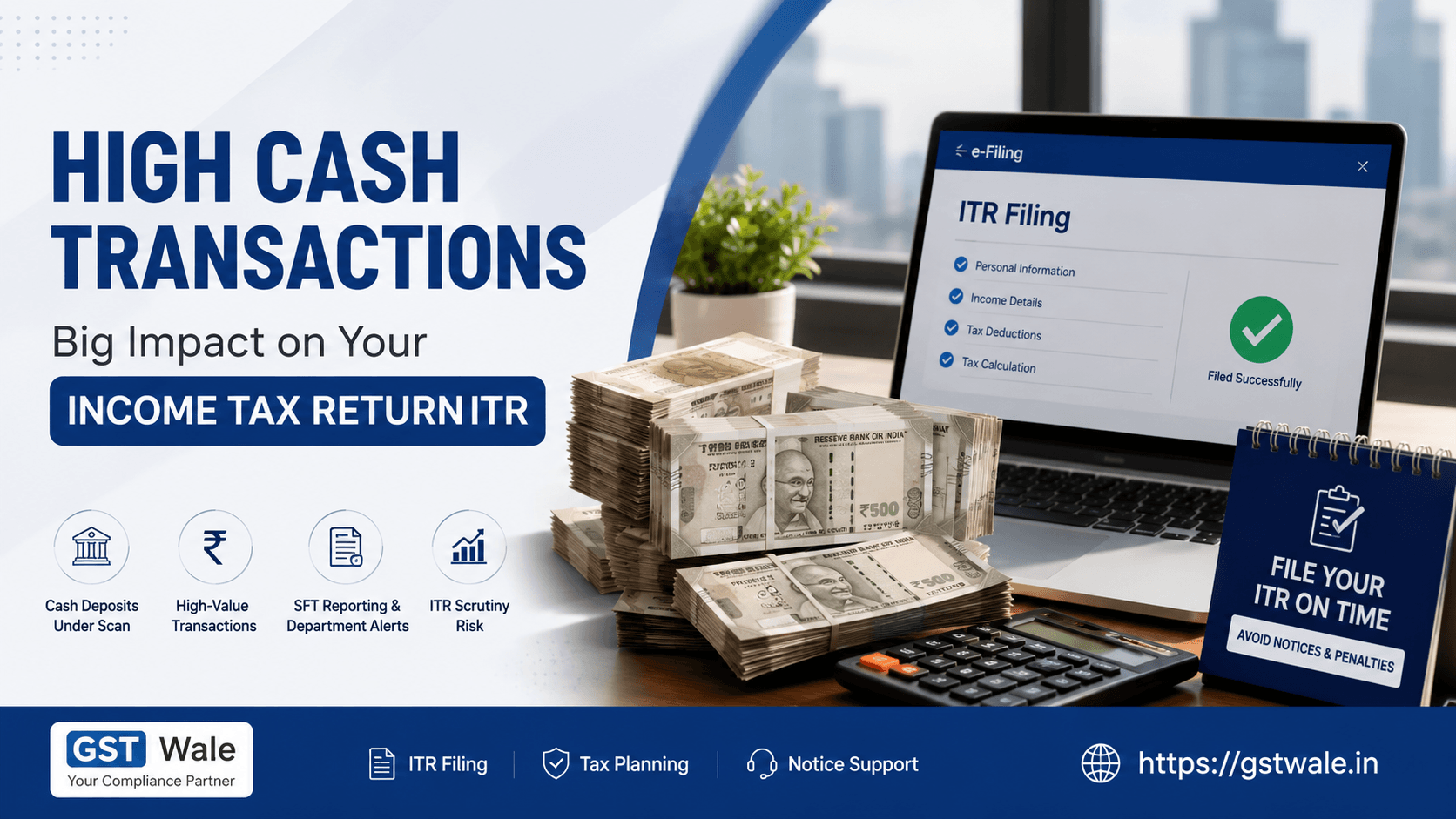
In today’s digital tax environment, the Income Tax Department closely tracks high-value financial activities. Whether it is a large cash deposit, property purchase, luxury spending, or credit card payment, every major transaction can directly affect your income tax return itr. Many taxpayers unknowingly attract scrutiny simply because their financial transactions do not match the income declared in their returns.
At GST Wale, we regularly help individuals, professionals, and business owners handle income tax notices arising from suspicious cash activities and reporting mismatches. If you are planning your annual tax compliance, proper ITR Filing is essential to avoid future complications and penalties.
Understanding how high-value cash transactions are monitored can help you stay compliant and protect yourself from unwanted notices.
What Are High-Value Cash Transactions?
High-value cash transactions refer to financial activities above certain thresholds that banks, financial institutions, registrars, and other authorities are required to report to the Income Tax Department.
These transactions are tracked through the statement of financial transactions (SFT) mechanism. The purpose is simple — to identify cases where spending patterns do not match declared income.
Some common examples include:
- Large cash deposits in savings accounts
- Huge cash withdrawals
- Purchase of property in cash
- Buying luxury assets cash taxes concerns
- High credit card bill payments
- Investments in mutual funds, shares, or bonds
- Fixed deposits above prescribed limits
If these transactions are not properly explained in your income tax return itr, they may trigger tax scrutiny.
How the Income Tax Department Tracks Your Transactions
The Income Tax Department now uses advanced data analytics and AI-driven systems to compare your financial activities with your reported income.
Reporting Through Statement of Financial Transactions
Under the statement of financial transactions system, banks and institutions must report specific transactions exceeding defined limits.
Some examples include:
| Transaction Type | Reporting Threshold |
|---|---|
| Cash deposit in savings account | ₹10 lakh or more annually |
| Cash deposit in current account | ₹50 lakh or more annually |
| Credit card bill payment in cash | Above ₹1 lakh |
| Property purchase | ₹30 lakh or more |
| Fixed deposits | ₹10 lakh or more |
If your transactions exceed these limits, they automatically become visible to tax authorities.
Impact of High Cash Deposits on income tax return itr
One of the most common reasons for tax notices today is large cash deposits.
High Balance Cash Deposit Alerts
Banks generate high balance cash deposit alerts when unusual or heavy cash deposits are observed in your account. These alerts are shared with the Income Tax Department.
For example:
- A salaried employee earning ₹6 lakh annually deposits ₹18 lakh cash in a year.
- A small trader deposits cash regularly without maintaining proper books.
- A taxpayer deposits old savings but fails to explain the source.
Such cases often result in scrutiny or notice issuance.
Real-World Example
Suppose a shop owner reports annual income of ₹5 lakh in the income tax return itr but deposits ₹22 lakh in cash into multiple bank accounts during the year.
The department may ask:
- What is the source of cash?
- Was GST applicable?
- Are books of accounts maintained?
- Was the income underreported?
Without proper evidence, the taxpayer may face penalties and additional tax liability.
Unexplained Transactions Can Trigger Notices
Understanding Unexplained Cash Credit Notices
If the Income Tax Department believes cash deposits or transactions are unsupported, it may issue unexplained cash credit notices under Section 68 of the Income Tax Act.
These notices generally arise when:
- Cash deposits lack supporting documents
- Income declared is too low compared to expenses
- Loans or gifts are not properly documented
- Business turnover does not match GST returns
- Property investments are disproportionate to income
In such situations, taxpayers must provide proper explanations and documentary proof.
Buying Luxury Assets and Tax Implications
Large cash spending on luxury items also attracts attention.
Buying Luxury Assets Cash Taxes Concerns
The Income Tax Department monitors purchases such as:
- Luxury cars
- Jewellery
- Expensive watches
- Foreign travel
- High-end electronics
- Premium real estate
If you purchase these assets using cash while reporting low income, your income tax return itr may be selected for verification.
For instance, buying a luxury SUV worth ₹25 lakh while reporting annual income of ₹4 lakh can create suspicion.
Consequences of Mismatch in income tax return itr
Ignoring discrepancies between your transactions and declared income can lead to serious consequences.
Possible Outcomes Include:
- Income tax scrutiny
- Penalty proceedings
- Demand notices
- Interest on unpaid taxes
- Reassessment of income
- Prosecution in severe cases
In some situations, unexplained income may be taxed at a higher rate under Section 115BBE.
How to Safely Handle Large Cash Transactions
The good news is that high-value transactions are not illegal if properly documented and disclosed.
Maintain Proper Documentation
Always keep records such as:
- Sale deeds
- Loan agreements
- Gift deeds
- Business invoices
- Bank statements
- Agricultural income proof
Documentation is your strongest defense during scrutiny.
Declare Correct Income
Do not underreport income simply to save tax. Your income tax return itr should accurately reflect:
- Business turnover
- Professional income
- Rental income
- Capital gains
- Interest earnings
Consistency between income and financial transactions is extremely important.
Avoid Excessive Cash Transactions
Where possible, use banking channels like:
- UPI
- NEFT
- RTGS
- Cheque payments
Digital transactions create transparency and reduce tax risks.
Important Tips for Business Owners
Business owners are more vulnerable to scrutiny due to regular cash dealings.
Key Compliance Tips
Maintain Proper Books of Accounts
Accurate accounting records help explain cash deposits easily.
Reconcile GST and Income Tax Data
Mismatch between GST turnover and income tax return itr often triggers investigation.
Avoid Splitting Transactions
Breaking large deposits into smaller amounts does not prevent reporting. Banks monitor aggregate annual transactions.
File Returns on Time
Late filing increases the chances of notices and penalties.
FAQs on High-Value Cash Transactions and income tax return itr
Can cash deposits lead to income tax notices?
Yes. Large or suspicious deposits may trigger high balance cash deposit alerts and scrutiny if unsupported by declared income.
Is depositing cash illegal?
No. Cash deposits are legal if the source of funds is genuine and properly disclosed in your income tax return itr.
What is the statement of financial transactions?
The statement of financial transactions is a reporting system through which banks and institutions share high-value transaction data with the Income Tax Department.
What happens if I cannot explain cash deposits?
You may receive unexplained cash credit notices, and the amount could be taxed along with penalties.
Are luxury purchases monitored by the tax department?
Yes. Buying luxury assets cash taxes monitoring is common, especially when spending patterns do not match reported income.
The Income Tax Department has become highly technology-driven, making it easier to detect suspicious financial activity. High-value cash transactions are no longer hidden from tax authorities. Whether you are a salaried individual, trader, freelancer, or business owner, your income tax return itr must accurately reflect your financial profile.
At GST Wale, we strongly advise taxpayers to maintain transparency, proper documentation, and timely compliance. A carefully prepared income tax return itr not only helps avoid notices but also builds financial credibility for loans, visas, and future investments.
If you need expert assistance with tax planning, notice handling, or return filing, connect with GST Wale today and stay fully compliant with confidence.
 Previous