


How to Easily Carry Forward Capital Losses in Your ITR return This Season
How to Easily Carry Forward Capital Losses in Your ITR return This Season
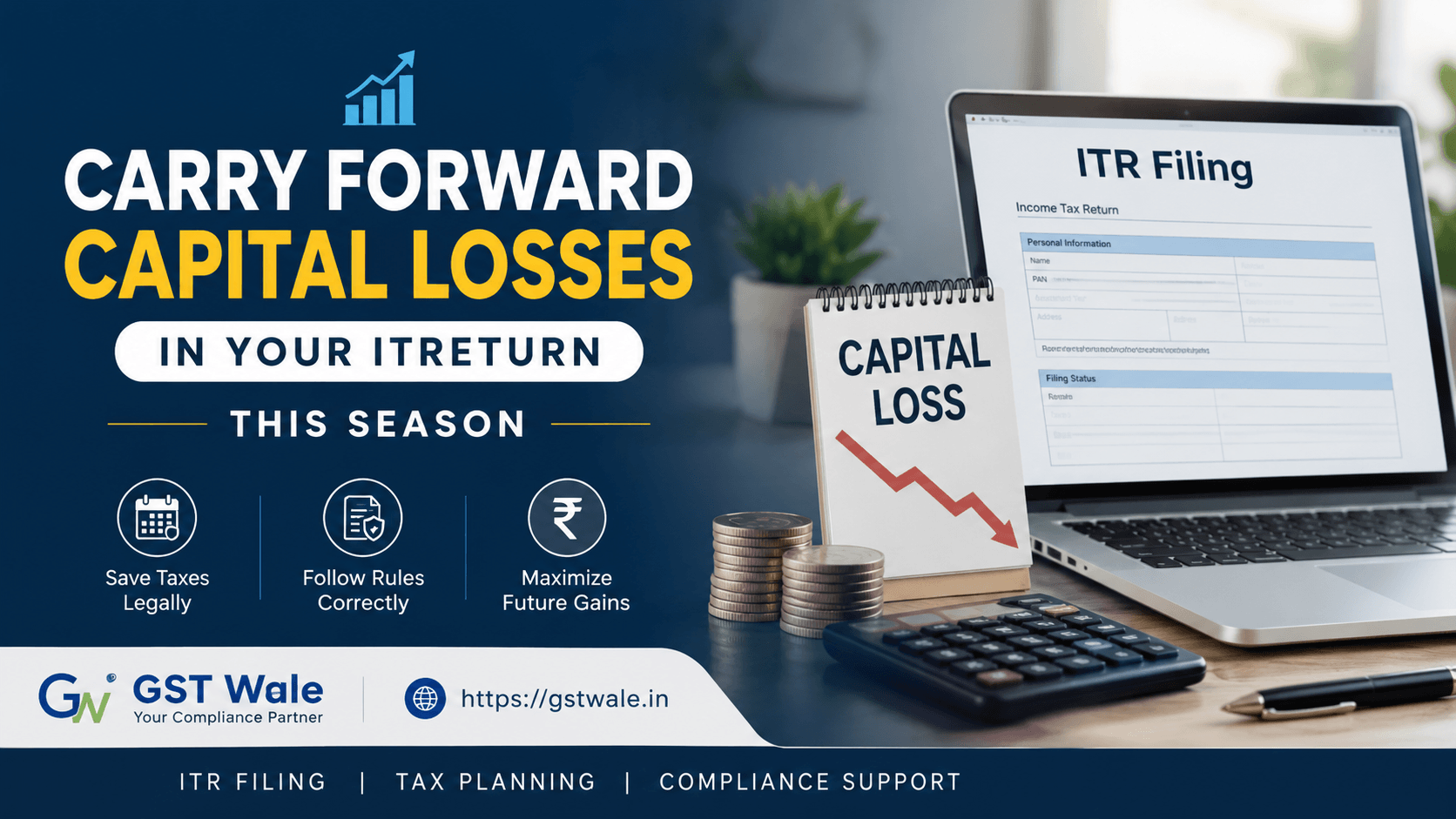
Filing your ITR return is not just about reporting income and paying taxes. It is also an opportunity to reduce your future tax burden legally by carrying forward eligible capital losses. Many taxpayers in India miss this benefit simply because they are unaware of the rules or file their ITR return incorrectly.
At GST Wale, we often meet taxpayers who have incurred losses in shares, mutual funds, property, or other investments but fail to claim them properly in their ITR return. As a result, they lose the chance to offset these losses against future gains.
The good news is that the process is not complicated if you understand the basics and follow the correct steps while filing your ITR Filing. In this guide, we will explain everything you need to know in simple language.
Why Carrying Forward Losses in Your ITR return Matters
Capital losses can become valuable tax-saving tools when reported correctly in your ITR return. The Income Tax Act allows taxpayers to carry forward eligible losses and adjust them against future capital gains.
For example:
- If you sold shares at a loss this year
- Or sold a property below purchase price
- Or incurred losses in mutual funds
You may be able to use these losses in future years to reduce taxable gains.
This process helps in:
- Lowering future tax liability
- Better tax planning
- Maintaining proper investment records
- Avoiding unnecessary tax payments
However, the biggest condition is timely and accurate filing of your ITR return.
Understanding Capital Losses Before Filing ITR return
Before entering details in your ITR return, you should understand the two main categories of capital losses.
Short-Term Capital Loss (STCL)
A short-term capital loss occurs when assets are sold within the specified holding period and result in a loss.
Examples include:
- Equity shares sold within 12 months
- Property sold within 24 months
- Debt mutual funds sold within short duration
Long-Term Capital Loss (LTCL)
A long-term capital loss arises when long-term capital assets are sold below their purchase value.
These may include:
- Long-term property investments
- Long-term equity investments
- Gold or bonds held for extended periods
Your ITR return must clearly classify these losses correctly because adjustment rules differ.
Short Term Loss Offset Rules You Must Know
One of the most important parts of filing your ITR return is understanding the short term loss offset rules.
Under Indian tax laws:
- Short-term capital losses can be adjusted against both short-term and long-term capital gains.
- Long-term capital losses can only be adjusted against long-term capital gains.
This is where many taxpayers make mistakes while preparing their ITR return.
Example of Short-Term Loss Adjustment
Suppose:
- You earned ₹2 lakh from property sale
- You incurred ₹80,000 loss from equity trading
In your ITR return, the short-term capital loss can be adjusted against the property gain, reducing taxable income.
This reduces your tax burden significantly.
Long Term Capital Gains Balancing Explained
Long term capital gains balancing is another important concept that taxpayers should understand while preparing their ITR return.
If you have long-term capital losses, they cannot be adjusted against short-term gains. They are allowed only against long-term gains.
Example
Suppose:
- Long-term capital gain from property: ₹5 lakh
- Long-term capital loss from shares: ₹2 lakh
You can balance the gains and losses in your ITR return and pay tax only on ₹3 lakh.
This is why accurate reporting becomes extremely important.
Conditions to Carry Forward Losses in ITR return
Not every taxpayer automatically qualifies for carrying forward losses. Your ITR return must satisfy certain conditions.
File Your ITR return Before Due Date
This is the most critical requirement.
If your ITR return is filed after the due date under Section 139(1), you may lose the benefit of carrying forward capital losses.
Maintain Proper Documentation
Keep records such as:
- Contract notes
- Purchase and sale deeds
- Broker statements
- Mutual fund reports
- Bank statements
These documents support the claims made in your ITR return.
Correct ITR Form Selection
Using the wrong form may create issues in processing your ITR return.
For example:
- ITR-2 is generally used for capital gains without business income
- ITR-3 may apply for traders with business income
Choosing the correct form matters.
Step-by-Step Process to Report Losses in ITR return
Here is a simple process taxpayers can follow.
Step 1: Calculate Total Capital Loss
Compute:
- Purchase price
- Sale value
- Brokerage and expenses
- Indexation benefits if applicable
Step 2: Categorize the Loss
Separate:
- Short-term losses
- Long-term losses
This classification is mandatory in your ITR return.
Step 3: Enter Details Under Capital Gains Schedule
Report all transactions accurately.
Even if there is no tax payable, losses should still be disclosed in the ITR return.
Step 4: Fill Schedule CFL
The schedule cfl guide becomes important here.
Schedule CFL in your ITR return records:
- Current year losses
- Losses adjusted during the year
- Remaining losses to carry forward
Incorrect Schedule CFL reporting is one of the biggest reasons for mismatch notices.
Step 5: Verify and Submit ITR return
After checking all figures carefully:
- Complete verification
- Submit before due date
- Save acknowledgment copy
Loss Tracking Over Eight Years
Many taxpayers are unaware that eligible capital losses can be carried forward for up to eight assessment years.
Proper loss tracking over eight years helps taxpayers maximize future tax savings.
For example:
- Loss incurred in FY 2025-26
- Can be carried forward till AY 2034-35
However, if your ITR return is not filed correctly or on time, this benefit may be lost entirely.
At GST Wale, we recommend maintaining a yearly loss register for smooth tracking.
Common Mistakes Taxpayers Make in ITR return
Here are some common errors we regularly notice.
Ignoring Small Losses
Even small losses should be reported in your ITR return because they can help reduce future taxes.
Missing Due Date
Late filing can cancel carry-forward benefits.
Incorrect Classification
Confusing short-term and long-term losses leads to wrong tax calculations.
Skipping Schedule CFL
Many taxpayers forget this section completely.
Mismatch With AIS or Broker Reports
Always reconcile your ITR return with:
- Annual Information Statement (AIS)
- Broker summaries
- Form 26AS
Practical Example for Better Understanding
Let us understand with a realistic scenario.
Rahul sold:
- Equity shares at ₹1.5 lakh loss
- Property at ₹6 lakh gain
Since the share loss is short-term, he can adjust it against property gain in his ITR return.
Taxable gain becomes:
₹6 lakh – ₹1.5 lakh = ₹4.5 lakh
This reduces tax liability substantially.
Had Rahul ignored the loss while filing his ITR return, he would have paid higher taxes unnecessarily.
FAQs on Carrying Forward Losses in ITR return
Can I carry forward losses if my ITR return is filed late?
Generally, no. Capital losses can usually be carried forward only if the ITR return is filed within the due date.
How many years can losses be carried forward?
Eligible capital losses can be carried forward for eight assessment years.
Is Schedule CFL mandatory in ITR return?
Yes. Schedule CFL is important for reporting and tracking carried-forward losses properly.
Can long-term capital loss offset short-term gain?
No. Long-term capital loss can only be adjusted against long-term capital gains.
Should I file ITR return even if I only have losses?
Yes. Filing your ITR return allows you to preserve those losses for future tax adjustment.
A properly filed ITR return can do much more than simply meet compliance requirements. It can help you save taxes legally through smart loss adjustment and future planning.
Understanding short term loss offset rules, long term capital gains balancing, proper schedule cfl guide usage, and loss tracking over eight years can make a significant difference to your finances.
At GST Wale, we help individuals, traders, investors, and businesses file accurate ITR return documents while maximizing eligible tax benefits. Whether you have stock market losses, property losses, or mutual fund losses, our experts can ensure everything is reported correctly and efficiently.
Connect with GST Wale today and make your ITR return filing smooth, compliant, and tax-efficient.
 Previous