


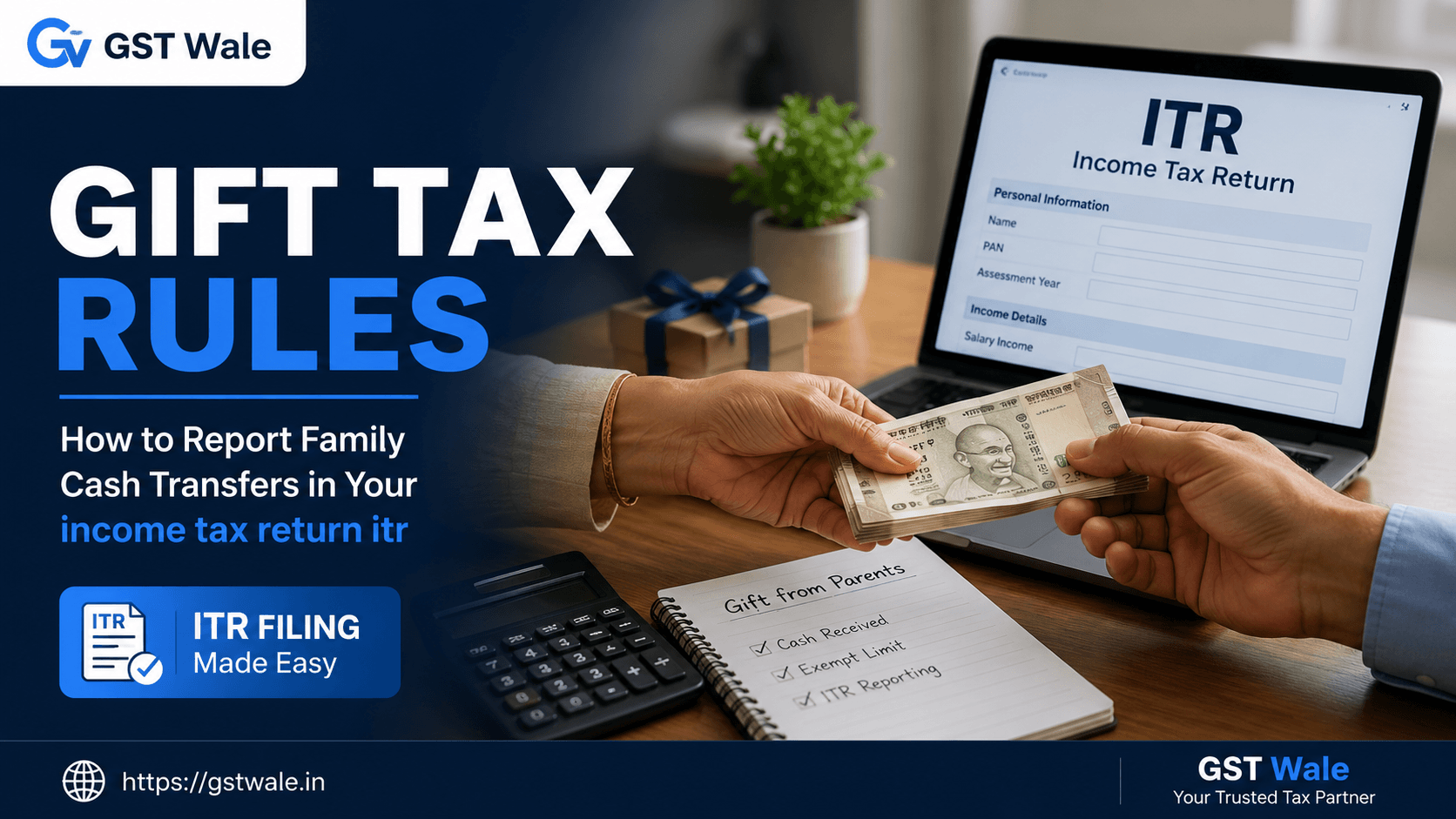
Gift Tax Rules: How to Report Family Cash Transfers in Your income tax return itr
Gift Tax Rules: How to Report Family Cash Transfers in Your income tax return itr
Family members often transfer money to each other for support, weddings, education, medical emergencies, or property purchases. While these transactions may look simple, many taxpayers become confused about whether such gifts are taxable and how they should be disclosed in the income tax return itr.
At GST Wale, we regularly see taxpayers receiving notices simply because cash transfers were not properly explained in their income tax return itr. Understanding the rules can help you stay compliant and avoid unnecessary tax scrutiny.
If you are planning your yearly ITR Filing, it is important to know which gifts are taxable, which are exempt, and how to report them correctly.
What Is Considered a Gift Under Income Tax Law?
Under the Income Tax Act, a gift can be:
- Cash transfer
- Bank transfer
- Immovable property
- Jewellery
- Shares or securities
- Valuable movable assets
A gift becomes taxable when a person receives money or property without consideration beyond the specified threshold.
For proper disclosure in your income tax return itr, you should maintain documentary evidence for all major family transactions.
When Are Gifts Taxable?
As per current tax provisions, gifts received from non-relatives exceeding ₹50,000 in a financial year become taxable under “Income from Other Sources.”
However, there are several important exemptions.
Gifts From Relatives Are Generally Exempt
One of the most important concepts taxpayers must understand is the tax exempt relatives definition under the Income Tax Act.
The following persons are treated as relatives:
- Spouse
- Brother or sister
- Brother or sister of spouse
- Brother or sister of parents
- Lineal ascendants and descendants
- Spouse’s lineal ascendants and descendants
For example:
- Father gifting ₹10 lakh to son – exempt
- Brother transferring ₹2 lakh to sister – exempt
- Grandmother gifting jewellery to granddaughter – exempt
Even though these gifts are exempt, proper disclosure in the income tax return itr is advisable when the amount is substantial.
How to Report Family Cash Transfers in Income Tax Return ITR
Many taxpayers wrongly assume exempt gifts do not need any documentation. That is a risky approach.
Step 1: Maintain Proper Evidence
Always keep:
- Bank statements
- Gift deed for large transfers
- Identity proof of donor
- Relationship proof
- Transaction records
Cash transactions without banking trails may create scrutiny issues during assessment.
Step 2: Classify the Gift Properly
If the amount is exempt because it is received from a relative, mention it under exempt income wherever applicable in the income tax return itr.
If the amount is taxable, disclose it under “Income from Other Sources.”
Step 3: Avoid Mixing Gifts With Business Income
Small business owners often deposit family money into business accounts. This can create confusion during assessment.
For example:
- A father transfers ₹5 lakh to support his son’s business.
- The son deposits it into his current account.
- If unsupported, the department may question the source.
Proper narration and disclosure in the income tax return itr help avoid notices.
Important Exemptions You Should Know
Gifts Received During Marriage
One of the biggest exemptions available is for marriage gifts.
Under marriage gift reporting exclusions, gifts received by an individual on the occasion of marriage are fully exempt without any monetary limit.
Examples include:
- Cash gifts from relatives
- Jewellery from friends
- Wedding contributions from family members
However, the exemption applies only to the individual getting married, not parents or relatives organizing the wedding.
Gifts Through Inheritance or Will
Money or property received through inheritance is exempt from tax.
Still, if the inherited asset later generates income, such as rent or capital gains, that income must be reported in the income tax return itr.
Gifts From Local Authorities or Charitable Institutions
Certain gifts from registered charitable institutions or approved authorities are also exempt under tax laws.
Tax on High Value Friendly Loans
Many taxpayers try to avoid gift taxation by calling transfers “friendly loans.” However, this strategy can create complications.
The issue of tax on high value friendly loans becomes important when:
- There is no written agreement
- No repayment schedule exists
- No interest is charged
- Transactions appear suspicious
Income tax officers may treat such loans as unexplained cash credits.
Best Practices for Friendly Loans
To stay safe:
- Prepare a simple loan agreement
- Use banking channels only
- Keep repayment proof
- Avoid large cash transactions
Proper reporting in the income tax return itr is essential if the amount is significant.
Common Mistakes Taxpayers Make
Ignoring Large Cash Deposits
Sudden deposits in savings accounts can trigger scrutiny under data analytics systems used by the department.
Assuming Family Transfers Need No Proof
Even exempt gifts require documentary support if questioned.
Not Reporting Exempt Income
Many taxpayers leave exempt gifts completely undisclosed in the income tax return itr. While not mandatory in every case, disclosure improves transparency.
Accepting Cash Beyond Reasonable Limits
Large cash gifts may create practical difficulties during assessment proceedings.
Avoiding Gift Tax Traps
Understanding the rules is the best way of avoiding gift tax traps and unnecessary notices.
Here are some practical recommendations from GST Wale:
- Prefer bank transfers over cash
- Create gift deeds for high-value gifts
- Maintain donor identity proof
- Keep relationship records
- Avoid fake loan arrangements
- Disclose substantial exempt gifts properly
- Match transactions with bank statements
These precautions can protect your income tax return itr from future disputes.
Real-Life Example
Let us understand with a practical example.
Raj received:
- ₹8 lakh from his father for house purchase
- ₹1 lakh from a friend
- ₹3 lakh wedding gifts from relatives
Tax treatment:
- Father’s gift: Exempt
- Friend’s gift: Taxable because it exceeds ₹50,000
- Marriage gifts: Exempt
While filing the income tax return itr, Raj should properly disclose taxable and exempt portions separately with supporting documents.
How Income Tax Notices Usually Arise
In recent years, the department has increased monitoring of financial transactions.
Common triggers include:
- High-value cash deposits
- Property purchases
- Mismatch between income and bank credits
- Repeated large transfers
If you cannot explain the source of money, penalties and additional tax liabilities may arise.
That is why proper disclosure in the income tax return itr is extremely important.
FAQs on Gift Tax and Income Tax Return ITR
Is money received from parents taxable?
No. Gifts received from parents are fully exempt under the relative exemption rules.
Should exempt gifts be reported in income tax return itr?
Yes, substantial exempt gifts should ideally be disclosed for transparency and documentation purposes.
Are marriage gifts taxable?
No. Gifts received on the occasion of marriage are fully exempt without any upper limit.
Can cash gifts create tax notices?
Yes. Large unexplained cash deposits may attract scrutiny, especially if supporting documents are unavailable.
Is a loan from a friend taxable?
A genuine loan is not taxable, but unsupported or suspicious transactions may be questioned by the department.
Family support and gifting are common in India, but taxpayers must understand the legal implications before filing their income tax return itr. Incorrect disclosure or poor documentation can lead to avoidable notices and tax complications.
Whether you receive money from parents, relatives, or friends, maintaining proper records and reporting transactions correctly in your income tax return itr is the safest approach.
At GST Wale, we help individuals, professionals, and business owners handle complex tax matters with complete compliance and practical guidance. If you need expert assistance with gift taxation, documentation, or return filing, connect with GST Wale today and file your taxes confidently.
 Previous