


Mistakes to Avoid When Registering Your Mobile and Email for Incometax Communications
Mistakes to Avoid When Registering Your Mobile and Email for Incometax Communications
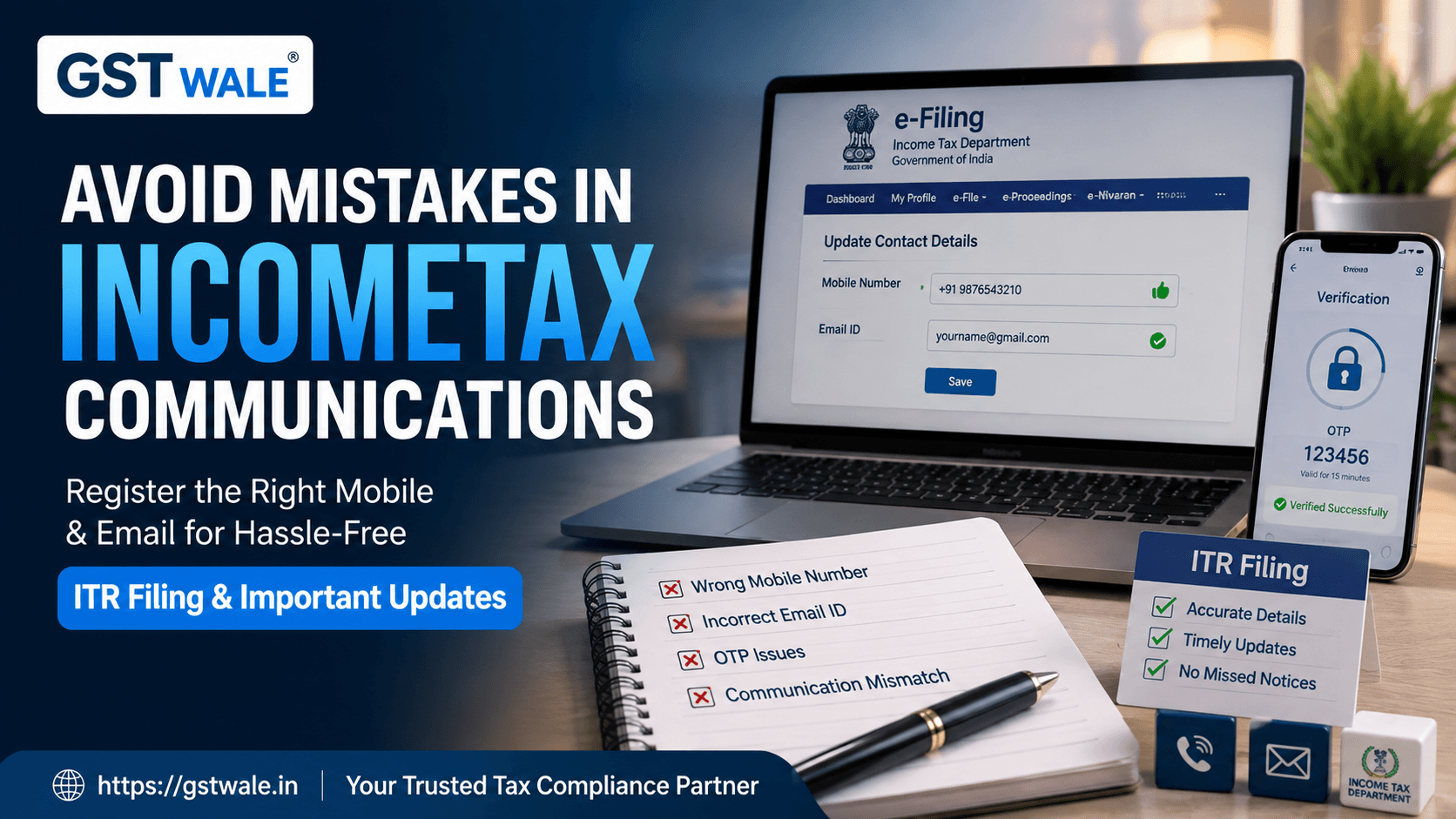
Your mobile number and email address may look like simple contact details, but when it comes to incometax communications, they play a very important role. From OTP verification and ITR-related updates to important notices and account alerts, the Income Tax Department uses registered contact details to communicate with taxpayers.
The Income Tax e-Filing portal allows taxpayers to update their mobile number and email ID through their profile. Keeping these details accurate can also help ensure smoother tax compliance and reduce unnecessary problems while completing your ITR Filing.
At GST Wale, we often come across cases where a taxpayer has entered an old mobile number, an inactive email address, or someone else's contact details. These small mistakes can become frustrating when an OTP is required or an important tax communication is missed.
Let us understand the most common mistakes and how you can avoid them.
Why Incometax Contact Details Matter
The registered mobile number and email ID are not merely used for receiving routine messages. They can be important for registration, verification, password-related services and other e-Filing activities.
During e-Filing registration, taxpayers are required to provide a valid mobile number and email ID. Separate OTPs may be sent for verification, and the Income Tax Department states that the OTP has a limited validity period.
The Department also recommends keeping profile information updated so taxpayers can receive timely communications and benefit from accurate information being used for pre-filling applicable forms and ITRs.
That is why a small error in your contact details can create a much bigger compliance problem later.
Common Incometax Registration Mistakes to Avoid
Using an Old Mobile Number
One of the most common mistakes is registering a mobile number that you no longer use.
For example, a person may have registered their e-Filing account several years ago using an old SIM card. The number may have subsequently been discontinued or transferred to another person. When an OTP is required, the taxpayer may suddenly realise that they cannot access the registered number.
Before completing registration or making a contact details update, always confirm that the mobile number is currently active and accessible to you.
Entering the Wrong Email Address
A simple typing mistake in an email address can result in important communications reaching the wrong inbox or becoming undeliverable.
Double-check every character before submitting your details. Pay particular attention to:
- Spelling of your name
- Dots and underscores
- Gmail or other domain names
- Extra spaces
- Incorrect characters
Do not assume that you will be able to correct the mistake later without verification.
Using Someone Else's Mobile or Email as the Primary Contact
Families sometimes use one person's mobile number or email ID for multiple financial accounts. While there can be situations where additional contact details are useful, your primary contact should ideally be controlled by the taxpayer.
The Income Tax Department's profile system allows taxpayers to maintain primary and secondary contact details. This makes it important to understand which number and email are actually marked as primary.
Using a family member's details without a clear reason can create confusion when OTPs, password recovery requests or tax communications are involved.
Ignoring the Primary User Profile
Another mistake is assuming that the details entered during an old registration will always remain correct.
Your primary user profile should be reviewed periodically. The e-Filing portal's My Profile facility allows registered users to view and update contact details, including mobile number and email ID.
If you have recently changed your phone number, switched email accounts, changed your residential status or started managing tax matters through a new contact address, review your profile rather than waiting for a communication problem.
Incometax OTP Issues You Should Prevent
Entering an OTP After It Has Expired
OTP issues are often caused by simple timing problems. According to the Income Tax Department's registration guidance, an OTP is valid for 15 minutes and there are limited attempts to enter the correct OTP.
If you receive multiple OTPs, avoid randomly entering old messages. Use the latest valid OTP displayed or sent by the portal.
Repeatedly Requesting New OTPs
When an OTP does not arrive immediately, people sometimes keep clicking "Resend OTP". This can create confusion because multiple messages may arrive within a short period.
Instead, check your network connection, SMS inbox, email spam or junk folder and wait briefly before requesting another OTP.
Not Checking the Email Spam Folder
Important incometax communications can sometimes be overlooked because users rarely check their spam or junk folders.
Make it a habit to check your registered email account regularly. If you use an email service with strict filtering, ensure that legitimate Income Tax Department communications are not being automatically blocked.
Avoid Communication Mismatch
Communication mismatch happens when the taxpayer's actual contact information differs from what is recorded on the e-Filing profile.
Consider a simple example. Rahul changed his mobile number after moving to a new telecom provider but never updated his e-Filing profile. Months later, he needed an OTP to complete a tax-related process. His current phone could not receive the verification code because the old number was still registered.
This type of situation is avoidable.
Whenever you change your mobile number or primary email address, make the contact details update part of your financial compliance checklist.
How to Register and Maintain Your Incometax Contact Details Correctly
Step 1: Keep Your PAN Information Ready
Before starting registration or making changes, ensure that your PAN information is accurate. The name and other details used during registration should correspond with the information maintained in the tax system.
Step 2: Use an Active Personal Mobile Number
Choose a number that you regularly use and are likely to retain for the foreseeable future.
Avoid using a temporary SIM or a number belonging to a friend unless there is a specific and legitimate reason.
Step 3: Use an Accessible Email Account
Select an email account that you check frequently. If you run a business, make sure the account is actively monitored rather than being an abandoned address created years ago.
Step 4: Complete OTP Verification Carefully
Enter the OTP received on the appropriate registered contact details. Do not share OTPs with unknown people claiming to be tax officials or representatives.
A genuine tax compliance process should never require you to casually disclose sensitive authentication credentials to strangers.
Step 5: Review Your Profile After Registration
Once registration is completed, log in and review your profile. Check the mobile number and email ID carefully.
The Income Tax Department confirms that taxpayers can update primary and secondary contact details through the profile after authentication.
Step 6: Check Your Details Before Filing
Before filing your return, take a minute to confirm that your contact information is still current.
This is especially useful for business owners, professionals, senior citizens and taxpayers who frequently change their phone numbers or email accounts.
Mistakes Business Owners Should Be Especially Careful About
For businesses, contact details can become even more complicated because multiple people may be involved in tax compliance.
A business should clearly identify who is responsible for monitoring the primary user profile and tax communications. If an employee, accountant or consultant is handling routine compliance, the business owner should still understand which contact details are registered with the Income Tax Department.
A change in accountant should also trigger a review of access, contact information and tax communication processes.
Never allow important tax communications to depend entirely on an employee who may leave the organisation.
What to Do If Your Incometax Details Are Already Wrong
If you discover that your registered mobile number or email address is incorrect, do not ignore it.
Log in to the official e-Filing portal and review the My Profile section. The Income Tax Department provides facilities for updating contact information after authentication.
If you are unable to complete the process because you no longer have access to the registered contact details, use the available official help and recovery options rather than relying on unofficial websites or individuals.
Most importantly, never provide your PAN password, OTP or other authentication credentials to an unknown person promising to "fix" your account.
Frequently Asked Questions
Is mobile number registration important for incometax communication?
Yes. A valid and accessible mobile number can be required for OTP-based authentication and other e-Filing services. Keeping your registered contact information updated also helps the Income Tax Department communicate with you when required.
Can I update my mobile number after registering?
Yes. The Income Tax e-Filing portal provides a My Profile facility through which registered taxpayers can update contact details, subject to the applicable verification process.
Why am I not receiving my incometax OTP?
Check whether the registered mobile number or email ID is correct, verify your network connection, check your email's spam or junk folder and make sure you are using the latest OTP. OTPs also have limited validity.
Should I use my CA's mobile number for tax registration?
It is generally better for the taxpayer to maintain control of their primary contact details. A CA or tax professional can assist with compliance, but the taxpayer should remain aware of the mobile number and email ID registered with the tax portal.
How often should I check my tax profile?
There is no need to change your details unnecessarily. However, you should review them whenever your mobile number, email address or other relevant information changes. Regularly checking your profile can help prevent communication mismatch.
Keep Your Incometax Profile Updated
Your mobile number and email ID are small details with a significant role in modern tax compliance. A wrong number, inactive email account, missed OTP or communication mismatch can create unnecessary delays when you need to access an incometax service.
The best approach is simple: use an active personal contact number, maintain an accessible email account, complete verification carefully and review your primary user profile whenever your contact information changes.
At GST Wale, we believe good tax compliance is not only about filing returns on time. It is also about keeping your records accurate and being prepared for important notices and communications.
If you need professional assistance with ITR Filing, tax compliance or other income-tax related requirements, connect with GST Wale and get practical guidance from experienced tax professionals
 Previous