


How to File an Appeal Against an Unfair Assessment Order Online via the Incometax Portal
How to File an Appeal Against an Unfair Assessment Order Online via the Incometax Portal
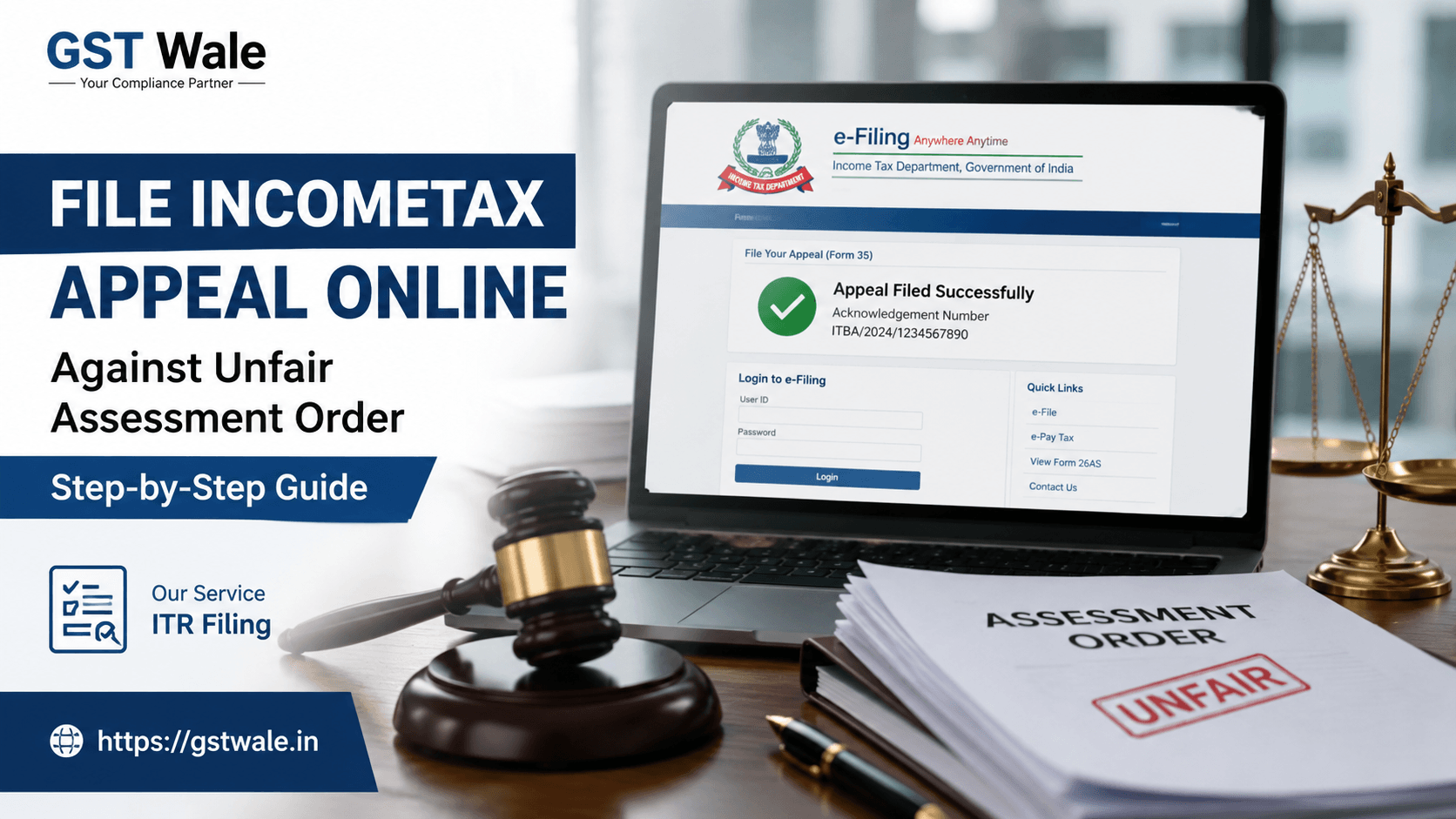
Receiving an incometax assessment order that you believe is incorrect can be stressful, especially when it results in an unexpected tax demand. However, an assessment order is not necessarily the final word. If an Assessing Officer (AO) has made an addition, disallowance, or adjustment that you believe is not justified, you generally have the right to challenge it through the prescribed appeal process.
The incometax portal has made the first-level appeal process largely digital. If you are already managing your annual ITR Filing, it is equally important to understand what to do when the department raises a disputed demand later. At GST Wale, we recommend reviewing the assessment order carefully before deciding whether to accept the demand or file an appeal.
Understanding an Incometax Assessment Order
An assessment order is issued when the Income Tax Department determines your taxable income, tax liability, refund, penalty, or other matters after processing or examining your return.
For example, suppose you reported business expenses of ₹5 lakh, but the AO disallows ₹2 lakh because supporting documents were considered insufficient. This addition increases your taxable income and may create an additional tax demand.
If you have valid evidence to support the expenses, an appeal may be appropriate.
Common situations where an assessee may consider an appeal include:
- Unjustified additions to taxable income
- Disallowance of legitimate business expenses
- Incorrect treatment of income
- Denial of eligible deductions or exemptions
- Incorrect tax or interest computation
- Certain adverse orders passed after scrutiny or reassessment
- Adjustments that were not properly explained or considered
The Income Tax Department confirms that several specified orders can be appealed, including certain orders under sections 143(1), 143(3), 144, 147/150 and other provisions listed under the law.
Incometax Appeal: Who Can File It?
An assessee or deductor aggrieved by an eligible order of the Assessing Officer can generally file an appeal before the Joint Commissioner (Appeals) or Commissioner of Income Tax (Appeals), as applicable.
The first appeal is commonly referred to as a CIT appeal, although the current appellate structure also includes Joint Commissioners (Appeals). The appeal is filed electronically through Form 35 on the incometax e-Filing portal.
Before filing, do not simply disagree with the demand emotionally. Read the order and identify exactly which findings you want to challenge.
Check the Incometax Appeal Time Limit
One of the most important points is the deadline.
Generally, an appeal must be filed within 30 days from the relevant date prescribed under section 249(2). For an assessment or penalty matter, the period generally runs from the date of service of the notice of demand relating to the assessment or penalty order.
Do not wait until the last few days.
If the 30-day period has already expired, an appeal may still be possible where there is a reasonable cause for the delay and the appellate authority accepts the request for condonation. However, you should clearly explain the reason for the delay and provide supporting evidence wherever possible.
Documents Required for Form 35
Before starting the online incometax appeal, keep the relevant documents ready. According to the Income Tax Department's Form 35 guidance, these can include the assessment order, demand notice, appeal fee details, tax payment details, statement of facts, grounds of appeal and documentary evidence.
A practical file checklist should include:
- Copy of the assessment or appealable order
- Notice of demand
- Computation of income and tax
- Relevant ITR acknowledgement
- Supporting documents and evidence
- Details of taxes already paid
- Appeal fee payment details
- Statement of facts
- Grounds of appeal
- Details of any pending appeal, where applicable
Keep your documents organised before beginning the form. It reduces the chances of entering inconsistent information.
How to Pay the Incometax Appeal Fee
An appeal fee has to be paid before filing Form 35. The fee is generally linked to the total income determined by the AO.
As stated in the current Income Tax Department guidance:
- Assessed total income up to ₹1 lakh: ₹250
- Assessed total income above ₹1 lakh and up to ₹2 lakh: ₹500
- Assessed total income above ₹2 lakh: ₹1,000
- Appeals involving other matters: ₹250
The portal's Form 35 manual instructs taxpayers to use the e-Pay Tax facility, select Income Tax, choose the relevant assessment year, select "Other Receipts (500)" and then select "Appeal Fees."
Save the payment details carefully because they will be required while completing Form 35.
How to File Form 35 on the Incometax Portal
Step 1: Log in to the Incometax Portal
Log in using your PAN or TAN credentials and password.
The Income Tax Department currently provides two routes to access Form 35. You can go through Pending Actions > E-Proceedings and select the option to file an appeal where available. Alternatively, you can navigate through e-File > Income Tax Forms > File Income Tax Forms and select Form 35.
Step 2: Select the Assessment Year and Order Details
Select the appropriate assessment year and start the form.
The portal will ask you to identify whether the appeal relates to an order with a DIN or without a DIN. You may then need to provide details such as the relevant section, order number, order date and notice of demand details.
Check these details against the actual order before proceeding.
Step 3: Complete the Basic Information
Review your personal or business details and update mandatory address information if required.
Make sure your PAN, contact details and other basic information are correct. Errors at this stage can create unnecessary problems later.
Step 4: Provide Order and Pending Appeal Details
Enter details of the order against which you are appealing.
The form also asks whether any appeal is already pending before the Joint Commissioner (Appeals) or Commissioner (Appeals). If another appeal exists, provide the requested details accurately.
Step 5: Prepare the Statement of Facts
The statement of facts should explain what actually happened.
Think of this section as telling the appellate authority the story of your case in a clear, chronological manner. Avoid emotional language or unnecessary allegations.
For example, instead of writing, "The AO made a completely unfair decision," explain:
"The assessee submitted invoices and bank payment evidence during the proceedings. However, the expenditure was disallowed in the assessment order on the ground that sufficient documentary evidence was not available."
A good statement of facts should be factual, concise and supported by documents.
Step 6: Draft Strong Grounds of Appeal
The grounds of appeal are different from the statement of facts.
The statement of facts explains the background. The grounds of appeal identify the specific legal or factual points on which you challenge the order.
For example, depending on the facts, a ground may challenge an addition because the AO failed to properly consider evidence submitted during assessment proceedings.
Each ground should be specific and connected to the disputed portion of the order. Avoid putting every argument into one long paragraph.
Step 7: Enter Tax Payment and Appeal Details
Provide the required information regarding taxes paid, returned income and other applicable details.
The portal also asks whether there is any delay in filing. If there is a delay, the relevant grounds for condonation need to be provided. Details of the appeal fee payment must also be entered.
Step 8: Upload Supporting Evidence
Upload the assessment order, demand notice and relevant documentary evidence.
The current Form 35 manual states that individual attachments should not exceed 5 MB and the combined attachment size should not exceed 50 MB. Attachments are generally required in PDF or ZIP format, with ZIP files containing PDFs.
Do not upload every document you have without purpose. Attach evidence that directly supports your statement of facts and grounds of appeal.
Step 9: Verify and Submit Form 35
After completing all sections, review the entire form carefully.
Check:
- Assessment year
- Order number and date
- Amount of income assessed
- Appeal fee
- Statement of facts
- Grounds of appeal
- Tax payment details
- Attachments
- Verification details
Then complete the applicable verification process and submit the appeal.
What Happens After Filing an Incometax Appeal?
Filing Form 35 does not automatically mean that the disputed addition has been deleted. The appeal will go through the appellate process, and you may receive notices or requests for further submissions.
The Income Tax Department's guidance explains that first appeals operate within the faceless appellate ecosystem, with appeals allocated through the system. The framework also provides for requesting a personal hearing through video conferencing in applicable circumstances.
Therefore, do not ignore subsequent notices simply because Form 35 has already been filed.
Common Mistakes to Avoid in CIT Appeals
Missing the 30-Day Deadline
This is one of the biggest mistakes. Even if you have a strong case, delaying the appeal can create an additional procedural issue.
Writing Weak Grounds of Appeal
A vague statement such as "the order is wrong" does not adequately explain what is being challenged. Grounds should correspond to the actual additions, disallowances or findings.
Ignoring Documentary Evidence
If your argument depends on invoices, agreements, bank statements, confirmations or other records, make sure the relevant evidence is properly identified and submitted.
Entering Incorrect Appeal Fee Details
The Income Tax Department specifically notes that Form 35 may show an error if the appeal fee details do not correspond with information such as the assessed income.
Treating Faceless Assessment and Appeal as the Same Thing
A faceless assessment and the appellate process are related but distinct stages. Receiving an order through a digital process does not remove your right to challenge an eligible adverse order.
When Should You Take Professional Help?
Simple cases with clear factual errors may be manageable with proper documentation. However, professional assistance is advisable where the matter involves substantial additions, complex business transactions, reassessment proceedings, multiple years, unexplained credits, international transactions or complicated legal issues.
A tax professional can help distinguish between facts, legal grounds and supporting evidence. This is particularly useful when preparing CIT appeals because the quality and clarity of the grounds can materially affect how your case is presented.
FAQs About Incometax Appeals
Can I file an incometax appeal online?
Yes. Eligible appeals against an Assessing Officer's order can generally be filed electronically through Form 35 on the Income Tax e-Filing portal.
What is Form 35 used for?
Form 35 is used by an assessee or deductor to file an appeal against an eligible order of the Assessing Officer before the applicable first appellate authority.
What is the deadline for filing an appeal?
Generally, the appeal must be filed within 30 days from the relevant date prescribed under section 249(2). A delayed appeal may be considered where there is sufficient reasonable cause and the delay is condoned by the competent authority.
What are grounds of appeal?
Grounds of appeal are the specific points on which the taxpayer challenges the assessment order. They should clearly identify the errors or disputed findings rather than simply expressing disagreement.
Is an appeal automatically successful after filing Form 35?
No. Filing Form 35 starts the appeal process; it does not guarantee that the disputed addition or demand will be deleted. The appellate authority examines the case and supporting submissions before passing its decision.
Handle Your Incometax Appeal Carefully
An incorrect assessment order can have a significant financial impact, but taxpayers should not assume that an unexpected demand must simply be accepted. The incometax appeal mechanism provides a structured route to challenge eligible orders before the appropriate appellate authority.
From checking the 30-day limitation period to paying the correct appeal fee, preparing a clear statement of facts, drafting precise grounds of appeal and uploading relevant evidence, every stage deserves attention.
If you are unsure whether an assessment order should be challenged or need professional assistance with Form 35, GST Wale can help you review the matter and prepare the next steps carefully. Get in touch with GST Wale for practical, professional tax support and make sure your incometax appeal is handled with the documentation and attention it deserves.
 Previous