


How to Report Capital Gains from Stocks and Crypto in Your Income Tax Return Filing
How to Report Capital Gains from Stocks and Crypto in Your Income Tax Return Filing
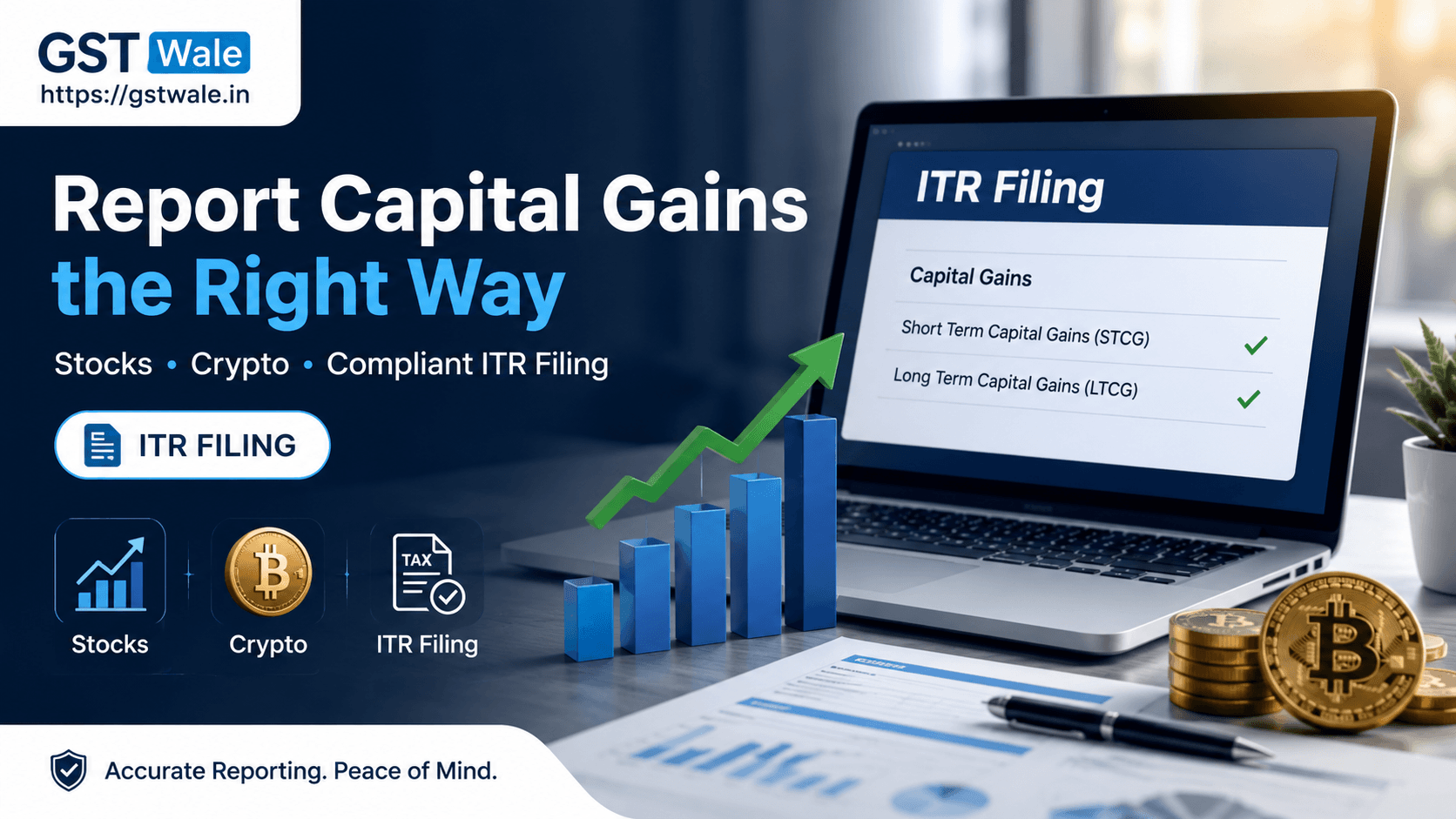
Investing in stocks and cryptocurrencies has become increasingly popular among Indian taxpayers. However, many investors are still unsure about how to disclose these gains correctly during income tax return filing. Reporting your profits accurately is not only a legal requirement but also helps you avoid notices, penalties, and unnecessary tax disputes.
If you have earned profits from selling shares, mutual funds, or cryptocurrencies during the financial year, understanding the applicable tax rules is essential. If you need professional assistance with ITR Filing, GST Wale can help ensure your return is filed accurately and on time.
Why Income Tax Return Filing Matters for Capital Gains
Many taxpayers believe that only salary or business income needs to be reported. In reality, capital gains from investments are equally important during income tax return filing. The Income Tax Department receives transaction details from stock exchanges, brokers, depositories, and crypto exchanges. Any mismatch between your transactions and your tax return can trigger scrutiny.
Accurate reporting helps you:
- Stay compliant with income tax laws.
- Avoid penalties and notices.
- Claim eligible deductions and exemptions.
- Maintain proper financial records.
- Plan your taxes efficiently.
Understanding Capital Gains on Stocks
Capital gains arise when you sell a capital asset for more than its purchase price. For listed shares, the tax treatment depends on how long you held the investment.
Short Term Capital Gains
Short term capital gains generally arise when listed equity shares or equity-oriented mutual funds are sold within 12 months of purchase.
These gains are taxed at the applicable rate prescribed under the Income-tax Act, subject to the relevant conditions. During income tax return filing, you must report these gains under the Capital Gains schedule.
Example:
Rohan purchased shares worth ₹2,00,000 in January and sold them in August for ₹2,60,000. His gain of ₹60,000 will generally be treated as short term capital gains.
Long Term Capital Gains
Long term capital gains generally arise when listed equity shares are held for more than 12 months before sale.
While calculating taxable gains, factors such as exemptions, applicable limits, and prevailing tax provisions should be considered carefully during income tax return filing.
Example:
Priya purchased shares in 2022 and sold them in 2025 after holding them for over a year. Her profits would typically fall under long term capital gains.
How to Calculate Capital Gains Correctly
One of the biggest mistakes taxpayers make during income tax return filing is calculating gains incorrectly.
Basic Formula
Capital Gain = Sale Value – Cost of Acquisition – Eligible Expenses
The cost of acquisition includes the purchase price and certain eligible costs directly related to acquiring the asset.
Keep the following documents ready:
- Broker statements
- Contract notes
- Demat account statement
- Bank statements
- Annual tax statement
- Capital gains report from your broker
Reporting Crypto Transactions During Income Tax Return Filing
Cryptocurrency taxation has become an important part of income tax return filing. Whether you traded Bitcoin, Ethereum, or any other virtual digital asset, these transactions must be disclosed properly.
What Is Crypto Tax?
Crypto tax refers to the tax applicable on profits earned from transferring Virtual Digital Assets (VDAs). Even if the gain appears small, it should still be reported correctly.
Many investors assume crypto profits are invisible to tax authorities. This is a misconception. Exchanges maintain records, and taxpayers should maintain proper documentation of every transaction.
What Is Schedule VDA?
The Income Tax Return forms include Schedule VDA, specifically introduced for reporting Virtual Digital Asset transactions.
While completing income tax return filing, you should provide:
- Name of the virtual digital asset
- Date of acquisition
- Date of transfer
- Sale consideration
- Cost of acquisition
- Income earned from each transfer
Reporting through Schedule VDA ensures transparency and compliance.
Common Mistakes to Avoid During Income Tax Return Filing
Even experienced investors sometimes make avoidable mistakes.
- Ignoring small stock transactions.
- Not reporting crypto profits.
- Using incorrect cost of acquisition.
- Failing to reconcile broker statements.
- Missing details required in Schedule VDA.
- Incorrect classification of short term capital gains and long term capital gains.
- Submitting returns without verification.
Can Tax Harvesting Help Reduce Tax Liability?
Tax harvesting is a legitimate tax planning strategy where investors sell certain investments to realise losses or gains strategically before the financial year ends.
Proper tax harvesting can help optimise your tax position while remaining fully compliant with the law.
However, every investment portfolio is different. Before implementing any tax-saving strategy, it is advisable to evaluate your overall financial situation.
Documents Required for Income Tax Return Filing
Before starting income tax return filing, collect all relevant documents.
- PAN and Aadhaar
- Form 26AS
- Annual Information Statement (AIS)
- Broker capital gains statement
- Demat account statement
- Crypto exchange transaction reports
- Bank account statements
- Investment purchase records
Organising these records beforehand reduces the chances of errors and speeds up the filing process.
Expert Tips from GST Wale
At GST Wale, we regularly assist investors with accurate income tax return filing. Based on our practical experience, here are a few recommendations:
- Maintain transaction records throughout the year instead of waiting until the filing season.
- Reconcile your broker statements with AIS before filing.
- Report every crypto transaction, even if no tax is payable.
- Preserve supporting documents for future reference.
- Seek professional advice if you have multiple investment accounts or complex transactions.
Frequently Asked Questions
1. Do I need to report every stock sale during income tax return filing?
Yes. All reportable stock sale transactions should be disclosed correctly, whether they result in profits or losses, as applicable under tax laws.
2. Is crypto income mandatory to disclose?
Yes. Crypto transactions should be reported appropriately, including details in Schedule VDA, wherever applicable.
3. How do I determine the cost of acquisition?
The cost of acquisition generally includes the purchase price and eligible acquisition-related expenses. Maintain proper purchase records to support your calculations.
4. What is the difference between short term capital gains and long term capital gains?
The primary difference is the holding period of the investment before sale. Different assets have different holding period rules and tax treatment.
5. Is tax harvesting legal in India?
Yes. Tax harvesting is a legitimate tax planning strategy when implemented in accordance with applicable tax laws.
Correctly reporting stock and cryptocurrency investments during income tax return filing is essential for staying compliant and avoiding unnecessary tax issues. Understanding short term capital gains, long term capital gains, crypto tax, Schedule VDA, cost of acquisition, and effective tax harvesting strategies can make the filing process much smoother.
At GST Wale, we simplify complex tax compliance for individuals, professionals, and businesses. Whether your investments involve stocks, mutual funds, or cryptocurrencies, our experienced tax professionals can help you complete your income tax return filing accurately, maximise compliance, and avoid costly mistakes. Get in touch with GST Wale today for reliable, hassle-free tax filing support you can trust.
 Previous