


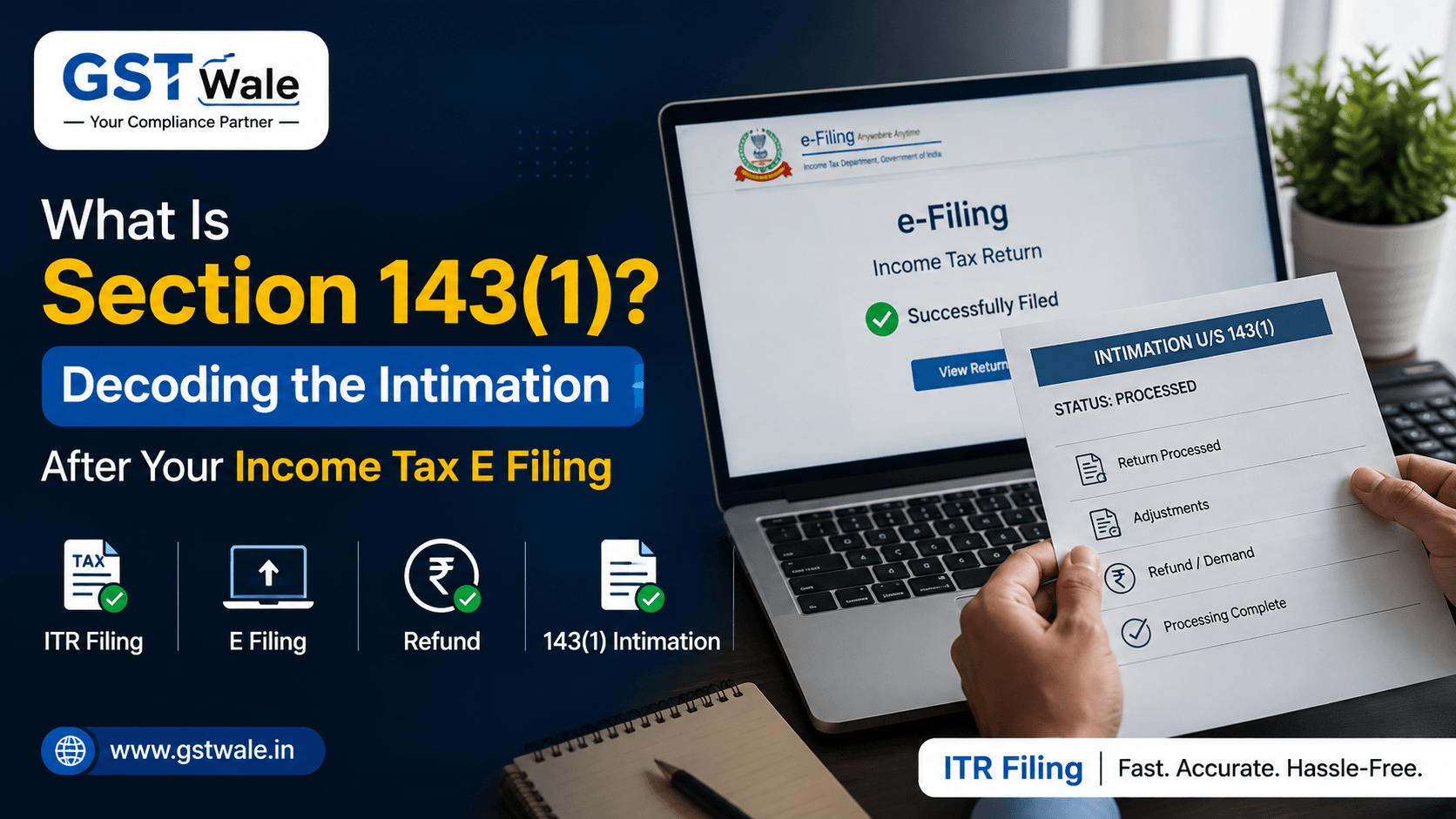
What Is Section 143(1)? Decoding the Intimation After Your Income Tax E Filing
What Is Section 143(1)? Decoding the Intimation After Your Income Tax E Filing
What Is Section 143(1)? Decoding the Intimation After Your Income Tax E Filing
Completing your income tax e filing is only one part of the tax compliance process. Many taxpayers assume that once the return is submitted, the process is over. However, the Income Tax Department carefully processes every return and sends an intimation under Section 143(1) of the Income Tax Act.
If you've recently completed your income tax e filing, receiving an email titled "Intimation under Section 143(1)" may leave you wondering whether it is a tax notice or something to worry about. In most cases, it is simply a communication informing you about the outcome of your return processing.
If you need professional assistance with ITR Filing GST Wale can help you file accurately and minimize unnecessary notices or mismatches in your tax return.
In this guide, we'll explain what Section 143(1) means, why you receive this intimation after income tax e filing, how to interpret it, and what actions you should take if there is any discrepancy.
What Is Section 143(1) in Income Tax?
Section 143(1) refers to the preliminary processing of your return after income tax e filing. During this stage, the Income Tax Department performs an automated verification of the information furnished in your Income Tax Return (ITR).
The purpose is to:
- Verify the mathematical accuracy of your return.
- Match your income with available tax records.
- Validate tax payments and TDS credits.
- Identify any prima facie adjustments.
- Determine whether a refund or additional tax is payable.
This is not a detailed scrutiny assessment. Instead, it is an automated review carried out using information available with the department.
Why Do You Receive an Intimation After Income Tax E Filing?
After your income tax e filing, the Centralized Processing Centre (CPC) processes your return and issues an intimation under Section 143(1).
This communication serves one of the following purposes:
- Your return is accepted without any changes.
- Certain adjustments have been made.
- A tax demand has been raised.
- Your refund processed status has been confirmed.
Receiving this intimation does not automatically mean that you have done something wrong. It simply communicates the processing result.
Possible Outcomes of Section 143(1) Intimation
Return Accepted Without Changes
This is the ideal scenario after income tax e filing.
The figures reported in your return perfectly match the department's records. No further action is generally required.
Refund Processed
If excess tax has been paid through TDS, advance tax, or self-assessment tax, the department will issue a refund.
Your Section 143(1) intimation will mention that the refund processed amount has been approved and will be credited to your validated bank account.
Tax Demand Raised
Sometimes, the department may identify a mismatch that results in additional tax liability.
A tax demand may arise because of:
- Incorrect TDS claim
- Omission of certain income
- Incorrect tax calculation
- Mismatch with Form 26AS or AIS
- Claiming ineligible deductions
Before making any payment, carefully review the reason mentioned in the intimation.
Prima Facie Adjustments
One of the most common reasons for receiving an adjusted intimation after income tax e filing is prima facie adjustments.
These include:
- Arithmetic mistakes
- Incorrect deduction claims
- Inconsistencies in tax calculations
- Mismatch between return data and departmental records
- Incorrect carry-forward of losses
These adjustments are made based on available records without conducting a detailed assessment.
How to Read Your Section 143(1) Intimation
Many taxpayers get confused because the document contains multiple figures.
Pay special attention to the following sections:
- Income declared by you
- Income considered by the department
- Tax computation
- Interest calculation
- Refund amount
- Outstanding tax demand
- Remarks explaining adjustments
Always compare these figures with the ITR that you originally filed.
Common Reasons for Differences After Income Tax E Filing
There are several reasons why the figures may differ after income tax e filing.
Incorrect TDS Credit
Sometimes employers or deductors file revised TDS returns after you submit your return.
Income Not Reported
Interest income, freelance income, rental income, or capital gains may not have been disclosed correctly.
Deduction Mismatch
Claims under Sections 80C, 80D, or other deductions may differ from departmental records.
Mathematical Errors
Even small calculation mistakes can result in automated corrections.
AIS and Form 26AS Differences
The department compares your return with AIS, Form 26AS, and TDS statements during processing.
What Should You Do After Receiving Section 143(1)?
Once you receive the intimation after income tax e filing, follow these steps:
- Download the intimation from the Income Tax portal.
- Compare it with your original return.
- Verify the reasons for any adjustment.
- Check whether the refund or demand is correct.
- Keep a copy of the intimation for future reference.
If everything is correct, no further action is necessary.
What If You Disagree with the Intimation?
If you believe the adjustment is incorrect, don't panic.
You may submit a rectification request under Section 154 if the mistake is apparent from the records.
Examples include:
- Incorrect TDS credit
- Wrong tax computation
- Data entry mistakes
- Clerical errors
A rectification request allows the department to correct genuine mistakes without initiating lengthy proceedings.
However, ensure you have supporting documents before filing the request.
Processing Timeline for Section 143(1)
One common question taxpayers ask after income tax e filing is how long processing takes.
The processing timeline varies depending on:
- Volume of returns filed
- Accuracy of information
- Verification status
- System workload
In many cases, returns are processed within a few weeks, while some may take several months.
Generally, the department aims to issue the Section 143(1) intimation within the prescribed timelines under the Income Tax Act.
Practical Example
Let's understand this with a simple example.
Rahul completed his income tax e filing and claimed ₹25,000 under Section 80D. During processing, the department found that only ₹20,000 was eligible based on available records.
As a result:
- A prima facie adjustment was made.
- Taxable income increased slightly.
- A small tax demand was generated.
- Rahul reviewed the intimation and found supporting documents for the full deduction.
- He submitted a rectification request, and the department corrected the error after verification.
This example shows why carefully reviewing the intimation is essential.
Tips to Avoid Issues After Income Tax E Filing
To reduce the chances of adjustments:
- Verify Form 26AS before filing.
- Review AIS carefully.
- Report every source of income.
- Claim only eligible deductions.
- Validate your bank account.
- Double-check tax calculations.
- Preserve all supporting documents.
- File your return well before the due date.
Taking these precautions makes your income tax e filing smoother and reduces the likelihood of receiving unexpected adjustments.
Frequently Asked Questions
Is Section 143(1) a tax notice?
No. Although many people consider it a tax notice, it is primarily an intimation explaining the outcome of return processing.
Can I ignore the Section 143(1) intimation?
No. Always review the document carefully to ensure there are no incorrect adjustments or outstanding tax demand.
What happens if my refund is approved?
If the refund processed status is mentioned, the approved refund will generally be credited to your validated bank account after processing.
How can I correct an error in the intimation?
If the error is apparent from the records, you can file a rectification request through the Income Tax portal.
How long does the processing take after income tax e filing?
The processing timeline depends on multiple factors, but returns are generally processed within a few weeks to a few months, depending on verification and departmental workload.
Receiving an intimation under Section 143(1) after income tax e filing is a normal part of the return processing cycle. It helps taxpayers understand whether their return has been accepted, whether a refund has been approved, or whether any prima facie adjustments or tax demand have been identified.
Instead of worrying about the communication, review it carefully, verify the details, and take timely action if required. A prompt response, including filing a rectification request where applicable, can help resolve genuine errors quickly.
At GST Wale, we assist individuals, professionals, and businesses with accurate income tax e filing, expert tax planning, return verification, and post-filing support. If you want a hassle-free filing experience and professional guidance at every stage, connect with GST Wale today and let our experts handle your tax compliance with confidence.
 Previous