


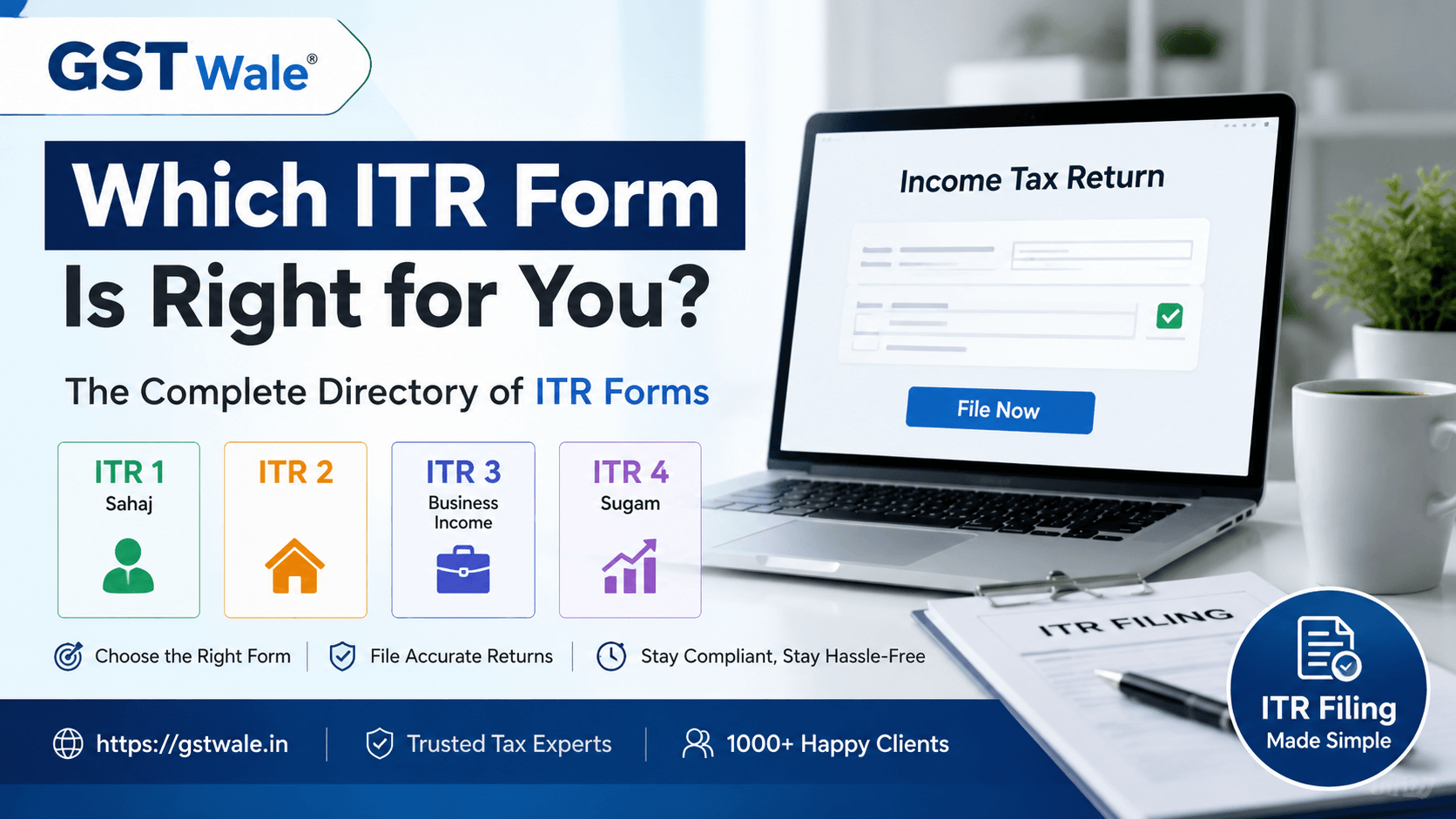
The Complete Directory of ITR Forms: Which One Is Right for Your ITR Filing?
The Complete Directory of ITR Forms: Which One Is Right for Your ITR Filing?
Every taxpayer in India knows that income tax return filing is not just a yearly formality anymore. With stricter compliance checks and automated scrutiny by the Income Tax Department, selecting the correct ITR form has become extremely important for smooth itr filing.
At GST Wale, we often see taxpayers filing the wrong form simply because they are unaware of the differences between ITR 1 Sahaj, ITR 2, ITR 3, and ITR 4 Sugam. A wrong selection can lead to notices, delayed refunds, or even defective return issues.
If you are planning your ITR Filing, this detailed guide will help you understand which form is suitable based on your income type, resident status, and financial activities.
Why Choosing the Correct ITR Form Matters in itr filing
Many taxpayers assume all income tax returns are the same. However, each ITR form is designed for specific categories of taxpayers.
The right form depends on factors such as:
- Type of income earned
- Annual income level
- Resident status
- Presence of business income
- Capital gains transactions
- Foreign assets or foreign income
- Presumptive taxation scheme eligibility
Using the wrong form can create unnecessary complications during itr filing. Therefore, understanding each form properly is essential.
ITR 1 Sahaj – Best for Salaried Individuals
Who Can File ITR 1 Sahaj?
ITR 1 Sahaj is the simplest return form available for resident individuals earning basic income.
You can use ITR 1 Sahaj if you have:
- Salary or pension income
- One house property
- Income from other sources like bank interest
- Total income up to ₹50 lakh
Who Cannot Use ITR 1 Sahaj?
You cannot use this form if you have:
- Capital gains income
- More than one house property
- Foreign income or foreign assets
- Business income
- Agricultural income above ₹5,000
Practical Example
Suppose Mr. Sharma works in a private company in Noida with an annual salary of ₹12 lakh and earns fixed deposit interest from banks. In this case, ITR 1 Sahaj would be the correct choice for itr filing.
ITR 2 – For Capital Gains and Multiple Properties
Who Should File ITR 2?
ITR 2 is suitable for individuals and Hindu Undivided Families (HUFs) who do not have business income but earn income from other complex sources.
This form is applicable when you have:
- Capital gains from shares, mutual funds, or property
- More than one house property
- Foreign assets or overseas income
- Agricultural income above ₹5,000
- Director position in a company
Important Situations for ITR 2
Nowadays, many salaried individuals invest in stock markets and cryptocurrencies. If you sold shares or mutual funds during the financial year, your itr filing may require ITR 2.
Practical Example
A salaried employee earning ₹18 lakh annually also sold equity shares with profits during the year. Since capital gains are involved, ITR 2 becomes mandatory.
ITR 3 – For Professionals and Business Owners
When Is ITR 3 Applicable?
ITR 3 is designed for individuals and HUFs earning business income or professional income.
This form applies to:
- Freelancers
- Consultants
- Doctors
- Chartered accountants
- Shop owners
- Agency owners
- Proprietors
Key Features of ITR 3
ITR 3 includes detailed reporting requirements such as:
- Profit and loss account
- Balance sheet details
- GST information
- Sundry debtors and creditors
- Tax audit details if applicable
Why Professionals Need Expert Guidance
Many professionals incorrectly file simpler forms to avoid compliance complexity. However, incorrect itr filing may trigger notices from the Income Tax Department.
At GST Wale, we advise business owners to maintain proper books of accounts and reconcile GST returns before filing ITR 3.
Practical Example
A digital marketing consultant earning ₹22 lakh annually through freelance projects must use ITR 3 because the income falls under professional income.
ITR 4 Sugam – Simplified Form Under Presumptive Taxation
What Is ITR 4 Sugam?
ITR 4 Sugam is meant for taxpayers opting for presumptive taxation under Sections 44AD, 44ADA, or 44AE.
This form simplifies itr filing for small businesses and professionals.
Who Can Use ITR 4 Sugam?
You can use ITR 4 Sugam if:
- Your business turnover is within prescribed limits
- You declare income on presumptive basis
- You are a resident individual, HUF, or partnership firm
Benefits of Presumptive Taxation
Under presumptive taxation:
- Detailed books of accounts are not mandatory
- Audit requirements may reduce
- Compliance becomes simpler
- Tax calculation is easier
Practical Example
A small trader with ₹45 lakh turnover who declares 8% profit under Section 44AD can use ITR 4 Sugam for itr filing.
How Resident Status Impacts itr filing
Why Resident Status Is Important
Your resident status directly affects your tax liability and ITR form selection.
The Income Tax Act classifies taxpayers as:
- Resident and ordinarily resident
- Resident but not ordinarily resident
- Non-resident
Impact on Return Filing
If you are a non-resident with foreign income or foreign assets, forms like ITR 1 Sahaj are generally not allowed.
Choosing the correct form based on resident status helps avoid compliance errors.
Common Mistakes People Make During itr filing
Many taxpayers make avoidable mistakes while selecting ITR forms.
Frequent Errors Include:
- Filing ITR 1 despite capital gains
- Ignoring foreign stock investments
- Using ITR 4 without eligibility
- Incorrectly reporting business income
- Missing AIS and Form 26AS reconciliation
Expert Advice from GST Wale
Before itr filing, always verify:
- PAN-Aadhaar linkage
- TDS entries
- Bank account details
- Investment disclosures
- GST turnover matching
Even small mismatches can result in notices.
Step-by-Step Process to Select the Correct ITR Form
Step 1: Identify Your Income Sources
Check whether your income includes:
- Salary
- Business income
- Capital gains
- Rental income
- Foreign income
Step 2: Verify Resident Status
Your resident status determines eligibility for several forms.
Step 3: Check Presumptive Taxation Eligibility
Small businesses may benefit from ITR 4 Sugam.
Step 4: Review Investments and Property Transactions
If capital gains are involved, simpler forms may not apply.
Step 5: Consult Experts if Needed
Professional guidance can prevent costly mistakes during itr filing.
FAQs on itr filing and ITR Forms
Which ITR form is best for salaried employees?
Most salaried employees with simple income can use ITR 1 Sahaj. However, if capital gains or multiple properties exist, ITR 2 may apply.
Can freelancers use ITR 1 Sahaj?
No. Freelancers earning professional income generally need ITR 3 or ITR 4 Sugam depending on presumptive taxation eligibility.
What happens if I choose the wrong ITR form?
The Income Tax Department may treat your return as defective, leading to notices or delayed processing.
Is ITR 4 Sugam beneficial for small businesses?
Yes. ITR 4 Sugam simplifies compliance under presumptive taxation and reduces bookkeeping burden.
Does resident status affect itr filing?
Yes. Resident status impacts taxability, reporting requirements, and eligibility for specific ITR forms.
Choosing the Right Form for itr filing
Selecting the correct return form is one of the most important parts of itr filing. Whether you are a salaried employee, investor, freelancer, or small business owner, your ITR form should accurately reflect your income structure and compliance requirements.
At GST Wale, we help taxpayers simplify itr filing with proper guidance, accurate documentation, and expert tax support. From ITR 1 Sahaj to ITR 3 and ITR 4 Sugam, our team ensures your return is filed correctly and on time without unnecessary complications.
If you want stress-free itr filing with expert assistance, connect with GST Wale today and file your return with confidence.
 Previous