


How to Link PAN and Aadhaar Before Your Income Tax ITR Filing
How to Link PAN and Aadhaar Before Your Income Tax ITR Filing
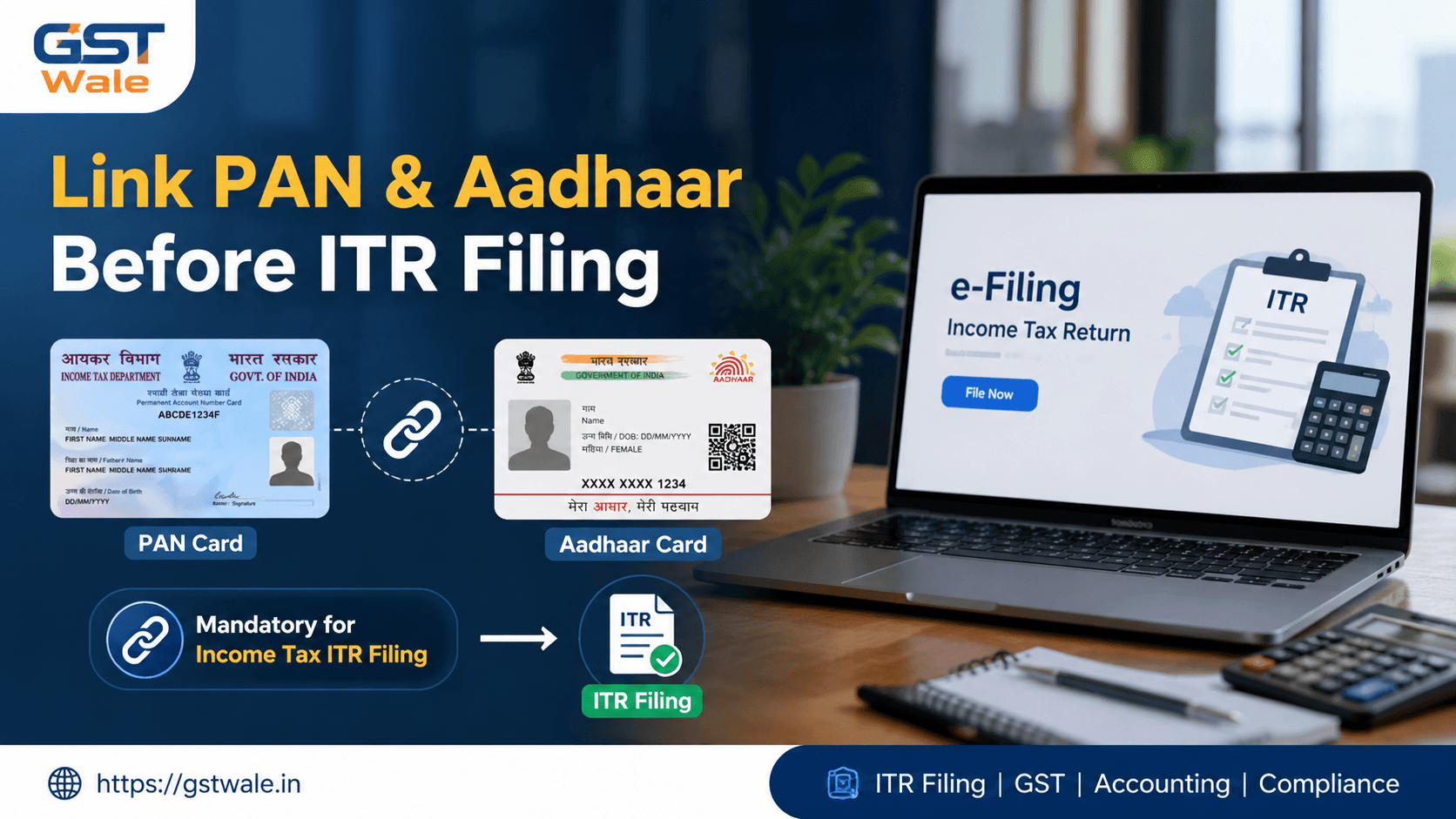
Every year as the tax season approaches, salaried professionals and business owners across India get busy gathering their investment proofs, Form 16s, and bank statements. However, amidst all the paperwork, one critical step often gets overlooked until the last minute: linking your Permanent Account Number (PAN) with your Aadhaar card.
At GST Wale, we interact with hundreds of taxpayers who view tax compliance as a stressful maze. We always tell them that a smooth income tax itr filing journey relies entirely on getting your fundamentals right. Think of PAN-Aadhaar linking not as an administrative chore, but as one of the ultimate tax filing prerequisites that unlocks the portal for your submissions. If these two foundational documents aren’t synced, the Income Tax Department will treat your PAN as "inoperative," which instantly halts your financial workflows. Let's look at why this step is absolutely non-negotiable and how you can complete it without hassle.
Why PAN-Aadhaar Linking is Critical for Income Tax ITR Filing
The Income Tax Department has progressively digitized its systems to curb tax evasion and streamline processing. By mandate, linking these two documents is no longer optional; it is a core mechanism to verify identity and prevent the use of multiple fake PAN cards.
If you attempt your income tax itr filing with an inoperative PAN, you will encounter immediate roadblocks:
Rejection of Return: The e-filing portal will simply not allow you to upload or process your tax returns.
Pending Tax Refunds: Any refund due to you from previous financial years will be withheld indefinitely.
Higher TDS and TCS Rates: Under Section 206AA, if your PAN is inoperative, tax deducted at source (TDS) or tax collected at source (TCS) can skyrocket to a minimum of 20%.
Banking Disruptions: Opening a new bank account, applying for credit cards, or investing in mutual funds exceeding Rs 50,000 will be blocked.
How to Check Your PAN Aadhaar Linking Status
Before you begin the linking process, it is highly possible that you or your previous accountant already completed this years ago. It is always wise to verify your current PAN Aadhaar linking status before attempting a fresh update.
Here is how you can check it in under two minutes:
Navigate to the official Income Tax Portal (e-filing website).
On the homepage, look at the left-hand menu under 'Quick Links' and click on Link Aadhaar Status.
Enter your 10-digit alphanumeric PAN and your 12-digit Aadhaar number.
Click on the button labeled 'View Link Aadhaar Status'.
If a pop-up appears stating "Your PAN is already linked to given Aadhaar", you are fully cleared to proceed with your income tax itr filing whenever the window opens. If it is not linked, it will prompt you to initiate the process immediately.
Step-by-Step Guide to Complete Your PAN Card Link
If your documents are not synced, do not panic. The government allows individuals to resolve this online, provided a standard late fee of Rs 1,000 is cleared via the e-filing portal before submission.
Phase 1: Paying the Fee via e-Pay Tax
Because of the mandatory tax rules currently active, the portal will not process your link request unless the penalty is cleared first.
Go to the Income Tax e-filing portal and click on Link Aadhaar under Quick Links.
Enter your PAN and Aadhaar, then click 'Validate'.
Click on 'Continue to Pay Through e-Pay Tax'.
Provide your mobile number to receive and verify a quick OTP.
Select the Income Tax tile and click 'Proceed'.
Choose the correct Assessment Year (ensure it matches the current active period) and select Other Receipts (500) as the Type of Payment.
The system will automatically auto-populate the Rs 1,000 fee amount. Complete the transaction using Net Banking, Debit Card, or UPI.
Phase 2: Submitting the Link Request
Once the payment is completed, the system usually takes a few hours (sometimes up to 4–5 days if banking servers are slow) to reflect the challan details.
Return to the Link Aadhaar option under Quick Links.
Input your PAN and Aadhaar details again and hit 'Validate'.
The portal will now display a message stating that your payment details are verified. Click 'Continue'.
Enter your name exactly as it appears on your Aadhaar card along with your mobile number.
Click Link Aadhaar. Enter the final OTP received on your phone, and your request will be sent to the UIDAI for validation.
Resolving Name and DOB Mismatches
The single biggest reason taxpayers face failures when trying to establish a PAN card link is a mismatch in data. If your name is spelled "Suresh Kumar" on your PAN card but recorded as "Suresh K." on your Aadhaar card, the automated system will reject the pairing instantly.
How to Fix Data Errors
If you run into a demographic mismatch error, you must correct the data in one of the documents to match the other perfectly.
To Update PAN: Use the NSDL (Protean) or UTITSL website to apply for a correction in your PAN data. You will need to submit supporting identity proof.
To Update Aadhaar: Visit an authorized local Aadhaar Enrolment Centre or use the online UIDAI self-service portal to update your name, date of birth, or gender.
Once the correction is finalized and updated in the central database, you can return to the tax portal to complete your e-filing profile update and finish the linking.
Frequently Asked Questions (FAQs)
1. Is anyone exempt from the mandatory PAN-Aadhaar linking rules?
Yes, certain categories of individuals are exempt from this requirement unless they choose to link voluntarily. This includes Non-Resident Indians (NRIs), individuals who are not citizens of India, senior citizens aged 80 years or older at any time during the previous financial year, and residents of states like Assam, Jammu & Kashmir, and Meghalaya.
2. Can I submit my income tax itr filing if my PAN is inoperative?
No. An inoperative PAN severely restricts your ability to interact with the tax portal. The system will throw an error at the time of validation, preventing you from uploading your tax return data or performing e-verification.
3. I paid the Rs 1,000 fee but my status still shows unlinked. What should I do?
Do not worry; your money is safe. It takes time for the tax portal to sync with bank challan data. Wait for 2 to 3 days after making the payment, then re-visit the 'Link Aadhaar' section. The portal will recognize the existing payment receipt, allowing you to complete the process without paying again.
4. What happens if I accidentally link my PAN to someone else's Aadhaar?
This is a serious issue that usually requires physical intervention. If an incorrect link occurs due to administrative or clerical errors, you must contact your local Jurisdictional Assessing Officer of the Income Tax Department to get the documents de-linked before initiating a correct mapping.
Get Compliant with GST Wale
Filing your taxes shouldn't feel like a race against an unyielding system. Ensuring that your documents conform to all mandatory tax rules well in advance saves you from last-minute tech glitches, steep penalty rates, and delayed financial planning. Checking your status, conducting an e-filing profile update, and securing your documents is the best baseline defense for stress-free asset management.
If you find the technical steps confusing or run into pesky data mismatch errors that are delaying your income tax itr filing, let our team handle the weight. At GST Wale, we specialize in making tax compliance, document corrections, and structural filings completely seamless for individuals and corporate entities alike. Reach out to us today, and let our experienced professionals ensure your portfolio remains flawlessly compliant!
 Previous