


How Senior Citizens Can Claim Deductions Under Section 80TTB During Incometax Efiling
How Senior Citizens Can Claim Deductions Under Section 80TTB During Incometax Efiling
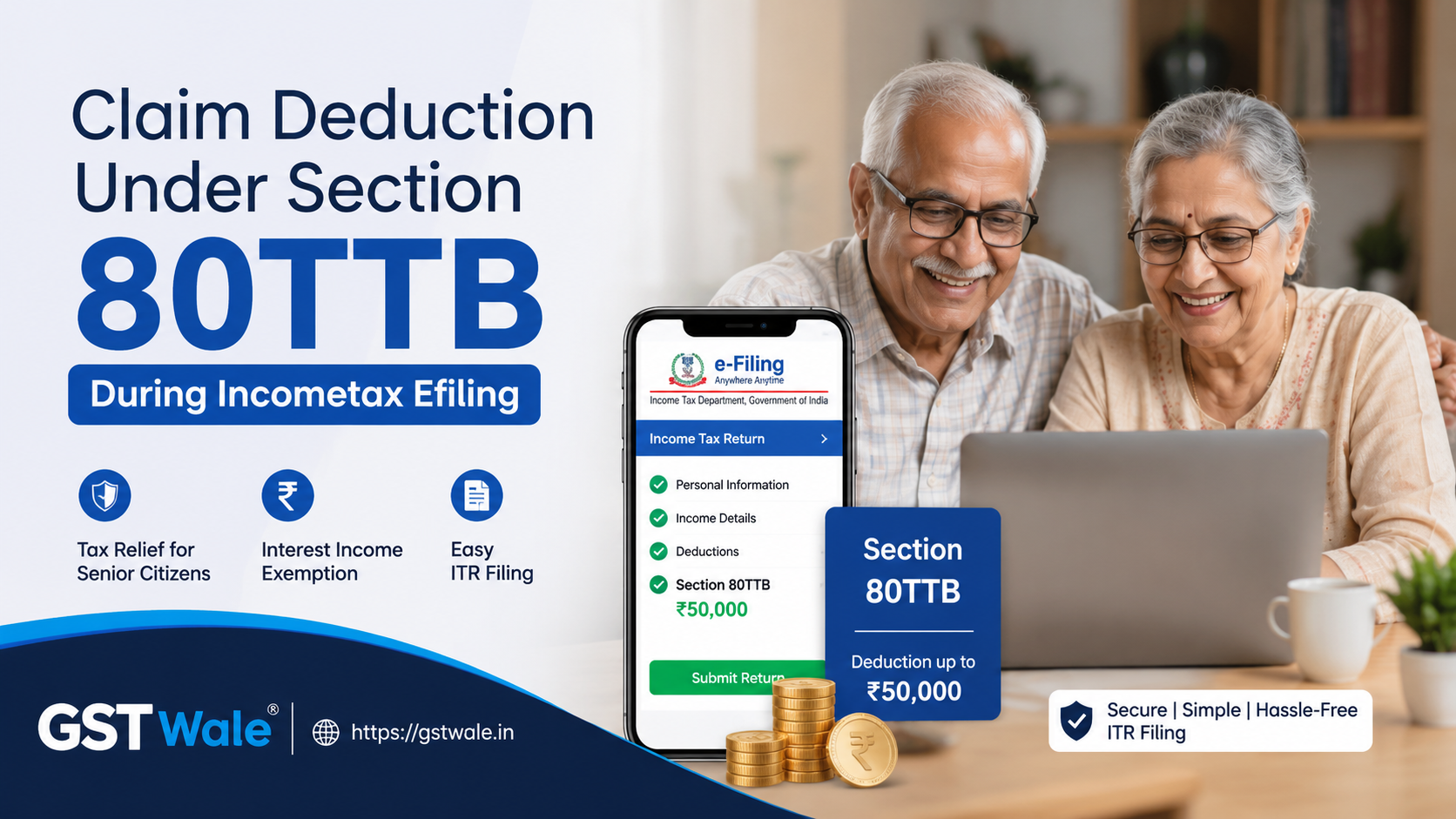
For many senior citizens in India, interest earned from a savings account or fixed deposit becomes a significant source of income after retirement. However, paying unnecessary tax on this income can reduce overall financial security. The good news is that the Income Tax Act provides a valuable benefit through Section 80TTB, allowing eligible senior citizens to claim deductions on interest income during incometax efiling.
Understanding how this deduction works can help you save more while filing your return correctly. If you're planning your ITR Filing , knowing the rules of Section 80TTB can ensure you claim every benefit available under the law. At GST Wale, we regularly help taxpayers maximize eligible deductions and complete their tax filing with confidence.
H2: What is Section 80TTB in Incometax Efiling?
Section 80TTB was introduced to provide additional tax relief to senior citizens. It allows eligible taxpayers aged 60 years or above to claim a deduction of up to ₹50,000 on interest income earned from eligible deposits while completing incometax efiling.
Unlike Section 80TTA, which is available to non-senior citizens only for savings account interest, Section 80TTB offers a broader benefit by including interest earned from:
- Savings account
- Fixed deposit
- Recurring deposit
- Deposits with banks
- Co-operative banks
- Post offices
This deduction can substantially reduce taxable income for retired individuals who depend on interest earnings.
H2: Who Can Claim Section 80TTB?
To claim this deduction during incometax efiling, the following conditions must be satisfied:
- The taxpayer must be an Indian resident.
- The taxpayer should be 60 years of age or older during the financial year.
- Interest income must be earned from eligible deposits.
- The deduction is available only to individuals and not to HUFs or companies.
If these conditions are fulfilled, the taxpayer can claim the deduction while filing the income tax return.
H2: Maximum Deduction Available Under Section 80TTB
The maximum deduction allowed is ₹50,000 in a financial year.
If the total interest income is below ₹50,000, the entire amount can be claimed.
For example:
- Interest from savings account: ₹18,000
- Interest from fixed deposit: ₹22,000
- Total interest income: ₹40,000
Since the total is below ₹50,000, the full ₹40,000 can be claimed during incometax efiling.
Another example:
- Savings account interest: ₹15,000
- Fixed deposit interest: ₹55,000
- Total interest income: ₹70,000
Only ₹50,000 can be claimed as deduction, while the remaining ₹20,000 will remain taxable.
H2: Eligible Interest Income Covered
One of the biggest advantages of Section 80TTB is that it covers multiple sources of interest income.
H3: Savings Account Interest
Interest earned from a regular savings account maintained with a bank, co-operative bank, or post office qualifies for deduction.
H3: Fixed Deposit Interest
Interest earned from a fixed deposit is fully eligible under Section 80TTB up to the prescribed limit.
Many retired individuals invest heavily in fixed deposits for stable income, making this deduction particularly beneficial.
H3: Recurring Deposits
Interest earned from recurring deposits also qualifies if the deposit is maintained with eligible institutions.
H2: Difference Between Section 80TTA and Section 80TTB
Many taxpayers get confused between these two sections during incometax efiling.
| Feature | Section 80TTA | Section 80TTB |
|---|---|---|
| Eligible taxpayers | Individuals below 60 years | Senior citizens |
| Maximum deduction | ₹10,000 | ₹50,000 |
| Savings account interest | Yes | Yes |
| Fixed deposit interest | No | Yes |
| Recurring deposit interest | No | Yes |
Senior citizens should always check eligibility under Section 80TTB instead of Section 80TTA.
H2: How to Claim Section 80TTB During Incometax Efiling
Claiming this deduction is simple if all income details are reported correctly.
H3: Step 1 – Collect Interest Certificates
Obtain interest certificates from:
- Banks
- Co-operative banks
- Post offices
Verify that all interest earned during the financial year has been reported accurately.
H3: Step 2 – Check Form 26AS and AIS
Cross-check the interest income reflected in:
- Form 26AS
- Annual Information Statement (AIS)
This helps avoid mismatches during incometax efiling.
H3: Step 3 – Report Total Interest Income
Enter the complete interest income under the appropriate head while filing the income tax return.
Never report only the taxable portion.
H3: Step 4 – Claim Deduction Under Section 80TTB
In the deductions section, enter the eligible amount under Section 80TTB.
The deduction will automatically reduce your taxable income.
H3: Step 5 – Verify and Submit
Review all entries carefully before submitting the return and complete verification.
H2: Importance of Form 15H
Many senior citizens are familiar with Form 15H, but its purpose is often misunderstood.
Form 15H helps eligible senior citizens request banks not to deduct TDS when their estimated taxable income is below the prescribed limit.
However, submitting Form 15H does not replace incometax efiling.
Even if no TDS has been deducted, eligible taxpayers should file their return whenever applicable and correctly claim deductions under Section 80TTB.
H2: Common Mistakes to Avoid
Avoid these errors while claiming deductions:
- Forgetting to include fixed deposit interest.
- Claiming more than ₹50,000.
- Claiming both Section 80TTA and Section 80TTB.
- Ignoring interest shown in AIS.
- Assuming Form 15H automatically provides deduction.
- Not reporting interest from multiple banks.
Being careful during incometax efiling helps avoid notices and unnecessary tax demands.
H2: Practical Example
Mr. Sharma, aged 68, earns:
- Pension: ₹4,80,000
- Savings account interest: ₹12,000
- Fixed deposit interest: ₹38,000
His total interest income is ₹50,000.
During incometax efiling, he reports the entire ₹50,000 as income and then claims a deduction of ₹50,000 under Section 80TTB.
As a result, his taxable income is reduced significantly, giving him valuable tax relief.
H2: Why Senior Citizens Should Plan Interest Income Carefully
Retired individuals often rely on interest income for monthly expenses.
Proper tax planning can help:
- Reduce overall tax liability.
- Increase post-tax income.
- Avoid unnecessary TDS.
- Improve retirement cash flow.
- Make better investment decisions.
Choosing the right mix of savings account balances and fixed deposit investments while understanding available interest income exemption benefits can make a meaningful difference.
H2: Frequently Asked Questions
H3: Can senior citizens claim Section 80TTB on fixed deposit interest?
Yes. Interest earned from eligible fixed deposit accounts qualifies for deduction up to ₹50,000.
H3: Can both Section 80TTA and Section 80TTB be claimed together?
No. Senior citizens eligible under Section 80TTB cannot simultaneously claim Section 80TTA.
H3: Is Form 15H mandatory to claim Section 80TTB?
No. Form 15H only helps avoid TDS in eligible cases. The deduction is claimed separately during incometax efiling.
H3: Is savings account interest covered under Section 80TTB?
Yes. Interest earned from a savings account maintained with eligible institutions qualifies for deduction.
H3: What is the maximum deduction available?
Eligible senior citizens can claim a deduction of up to ₹50,000 on qualifying interest income under Section 80TTB.
Section 80TTB is one of the most valuable provisions available for retired taxpayers. By understanding the eligibility conditions and correctly reporting interest income during incometax efiling, senior citizens can legally reduce their tax burden and enjoy meaningful tax relief. Whether the income comes from a savings account or a fixed deposit, claiming this deduction correctly ensures that retirement savings work more efficiently.
At GST Wale, our experienced tax professionals help senior citizens complete accurate incometax efiling, claim every eligible deduction, and comply with the latest income tax provisions. If you want a hassle-free filing experience with expert guidance, connect with GST Wale today and let us help you file your return accurately while maximizing your tax savings.
 Previous