


How Agricultural Income Affects Your Tax Slab and Your Overall ITR Filing
How Agricultural Income Affects Your Tax Slab and Your Overall ITR Filing
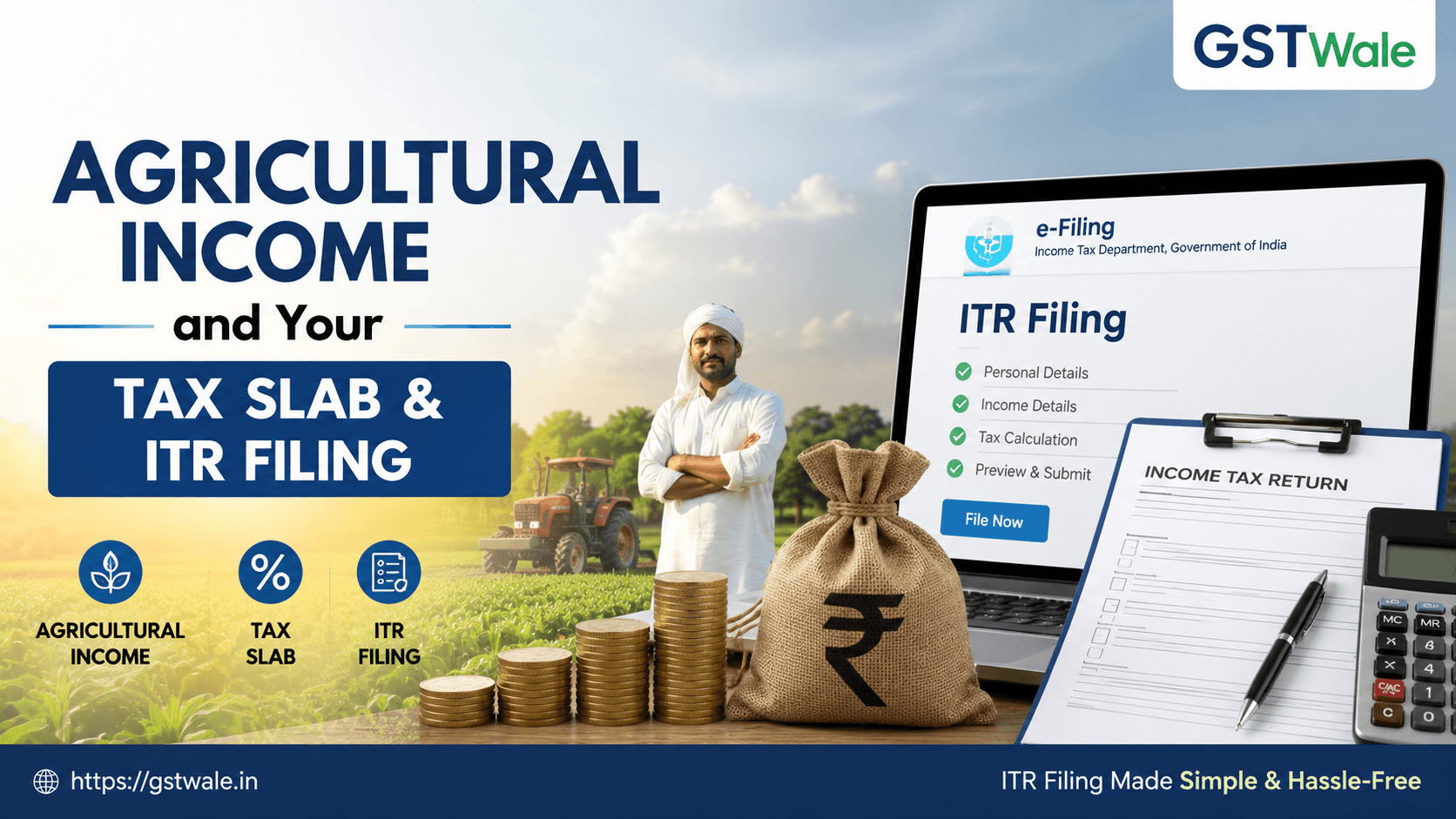
When people hear that agricultural income is tax-free in India, many assume they do not need to worry about it during itr filing. However, that is only half the story. While agricultural income is generally considered exempted income under the Income Tax Act, it can still impact your tax liability through a concept known as tax integration.
At GST Wale, we often meet taxpayers who earn both salary or business income along with farming income and are confused about whether they should disclose it during itr filing. The truth is that incorrect reporting can lead to notices, higher taxes, or errors in your return.
If you are planning your ITR Filing, understanding the treatment of agricultural income is extremely important for accurate tax computation and compliance.
What is Agricultural Income Under Income Tax?
Agricultural income refers to income earned from agricultural land situated in India. This land must be used for agricultural purposes.
Common Examples of Agricultural Income
- Income from cultivation of crops
- Rent received from agricultural land
- Income from sale of produce directly grown on land
- Income from basic processing of agricultural products
- Earnings from nurseries under certain conditions
However, not every rural or land-based earning qualifies as farming income. The Income Tax Department carefully examines whether actual agricultural operations were carried out.
Why Agricultural Income Matters in ITR Filing
Even though agricultural income is exempt from tax, it still plays an important role in itr filing when your non-agricultural income crosses the basic exemption limit.
This happens because of the partial integration method used under Indian tax laws.
When Does Agricultural Income Affect Tax Slab?
Agricultural income impacts your tax slab if:
- Agricultural income exceeds ₹5,000 annually
- Non-agricultural income exceeds the basic exemption limit
In such cases, the government combines both incomes only for rate calculation purposes.
This process is called tax integration.
Understanding the Partial Integration Method
The partial integration method ensures that taxpayers with large farming income do not unfairly enjoy lower tax rates on their non-agricultural earnings.
How Tax Integration Works
The calculation is done in three steps:
Step 1: Combine Both Incomes
Add:
- Non-agricultural income
- Agricultural income
Step 2: Calculate Tax on Combined Income
Compute tax on the total amount.
Step 3: Calculate Tax on Agricultural Income + Basic Exemption Limit
Now add:
- Agricultural income
- Basic exemption limit
Compute tax on this amount.
Finally, subtract the second tax amount from the first. The balance becomes your actual tax liability.
Practical Example of Agricultural Income in ITR Filing
Let us understand this with a real-world example.
Example
Mr. Sharma earns:
- Salary income: ₹9,00,000
- Agricultural income: ₹4,00,000
Since:
- Agricultural income exceeds ₹5,000
- Salary exceeds exemption limit
The partial integration method will apply during itr filing.
Calculation
Tax on Combined Income
₹9,00,000 + ₹4,00,000 = ₹13,00,000
Tax calculated on ₹13 lakh.
Tax on Agricultural Income + Basic Exemption
₹4,00,000 + ₹2,50,000 = ₹6,50,000
Tax calculated on ₹6.5 lakh.
Final Tax
Tax on ₹13 lakh minus tax on ₹6.5 lakh = Actual tax payable.
This increases the effective tax slab applicable to salary income.
Agricultural Income That Does Not Qualify for Exemption
Many taxpayers mistakenly classify unrelated income as exempted income. This can create serious problems during itr filing scrutiny.
The following generally do not qualify as agricultural income:
- Income from poultry farming
- Dairy business income
- Fisheries
- Income from trading agricultural products
- Renting farmhouses for events
- Processing beyond basic agricultural operations
Proper classification is very important while preparing your return.
Importance of Reporting Agricultural Income in Schedule EI
Even though agricultural income is exempt, it must still be disclosed correctly in Schedule EI of your income tax return.
What is Schedule EI?
Schedule EI stands for “Exempt Income Schedule.”
It is the section where taxpayers report:
- Agricultural income
- PPF interest
- Tax-free dividends
- Other exempted income
Incorrect or non-reporting in Schedule EI may trigger mismatches or notices from the Income Tax Department.
Documents Required to Support Agricultural Income
At GST Wale, we always advise clients to maintain proper records of farming income, especially if the amount is substantial.
Important Documents Include
- Proof of ownership of agricultural land
- Land revenue receipts
- Sale bills of crops
- Bank statements showing receipts
- Agricultural expense records
- Crop cultivation proof
If your agricultural income is unusually high compared to land size, authorities may request additional evidence during itr filing verification.
Agricultural Income and Different Types of Taxpayers
Salaried Individuals
Employees with inherited agricultural land often forget to disclose farming income during itr filing. This can affect slab calculation later.
Business Owners
Businesspersons sometimes mix agricultural receipts with business turnover. Proper separation is necessary for accurate taxation.
NRIs
Agricultural income earned from land situated in India may still qualify as exempted income, subject to conditions.
Common Mistakes People Make During ITR Filing
Not Reporting Agricultural Income
Many taxpayers assume exempt income need not be declared.
Wrong Classification
Declaring business income as farming income can invite penalties.
Lack of Supporting Documents
The department may ask for proof if agricultural income appears excessive.
Ignoring Tax Integration Rules
This can lead to underpayment of taxes.
How GST Wale Helps in Accurate ITR Filing
At GST Wale, we help individuals, professionals, and business owners handle itr filing correctly by ensuring:
- Proper classification of agricultural income
- Accurate tax integration calculations
- Correct disclosure in Schedule EI
- Documentation support
- Tax planning guidance
- Compliance with latest income tax provisions
Our expert team ensures that your return is accurate, compliant, and filed without unnecessary risks.
FAQs on Agricultural Income and ITR Filing
Is agricultural income completely tax-free?
Yes, agricultural income is generally exempt from tax if it satisfies the conditions under the Income Tax Act. However, it may still affect your tax slab through tax integration.
Is it mandatory to disclose agricultural income in itr filing?
Yes, agricultural income must be disclosed in Schedule EI if you are filing an income tax return.
What is the minimum agricultural income for partial integration?
The partial integration method applies when:
- Agricultural income exceeds ₹5,000
- Non-agricultural income exceeds the exemption limit
Can fake agricultural income create legal issues?
Yes. Wrongly claiming exempted income as agricultural income can result in scrutiny, penalties, and tax notices.
Are land revenue records important?
Yes, land revenue receipts help establish ownership and agricultural usage of land.
Agricultural income may be exempt from direct taxation, but it can significantly influence your overall tax liability through the partial integration method. That is why understanding tax integration rules is essential during itr filing.
Whether you earn salary income, business income, or farming income, proper disclosure in Schedule EI and accurate calculations are critical for avoiding notices and ensuring compliance.
At GST Wale, we simplify itr filing for taxpayers across India with expert guidance, practical tax planning, and complete compliance support. If you want stress-free and accurate return filing, connect with GST Wale today and let experienced professionals handle your taxes the right way.
 Previous