


Breaking Down the Corporate Income Tax Return Filing Process for Small Businesses
Breaking Down the Corporate Income Tax Return Filing Process for Small Businesses
Running a small company in India means wearing many hats. You may be handling sales, employees, customers, vendors and cash flow while also trying to stay on top of statutory compliance. Among these responsibilities, income tax return filing is one area where small businesses should avoid last-minute decisions. A return is not simply a form to submit; it is a summary of the company's financial performance, taxable income, taxes paid and important financial information.
For companies that need professional support, ITR Filing can make the compliance process more organised and reduce the risk of avoidable mistakes. At GST Wale, we generally advise business owners to start preparing well before the filing deadline rather than waiting until the accounts are finalised at the last moment.
The process becomes much easier when you understand what happens at each stage. From closing the books and preparing the balance sheet to checking the profit and loss statement, completing the tax computation and finally submitting the return, every step has a purpose. This guide explains the complete income tax return filing process for small businesses in practical terms.
What Does Income Tax Return Filing Mean for a Small Company?
For a company, income tax return filing means reporting its income and financial information to the Income Tax Department in the prescribed return form. Unlike an individual taxpayer, a company has a separate legal identity, and its tax compliance is closely connected with its books of accounts and statutory records.
The starting point is the company's financial data for the relevant financial year. Revenue, expenses, depreciation, investments, loans, assets, liabilities, taxes and other transactions need to be properly accounted for before the income tax computation can be prepared.
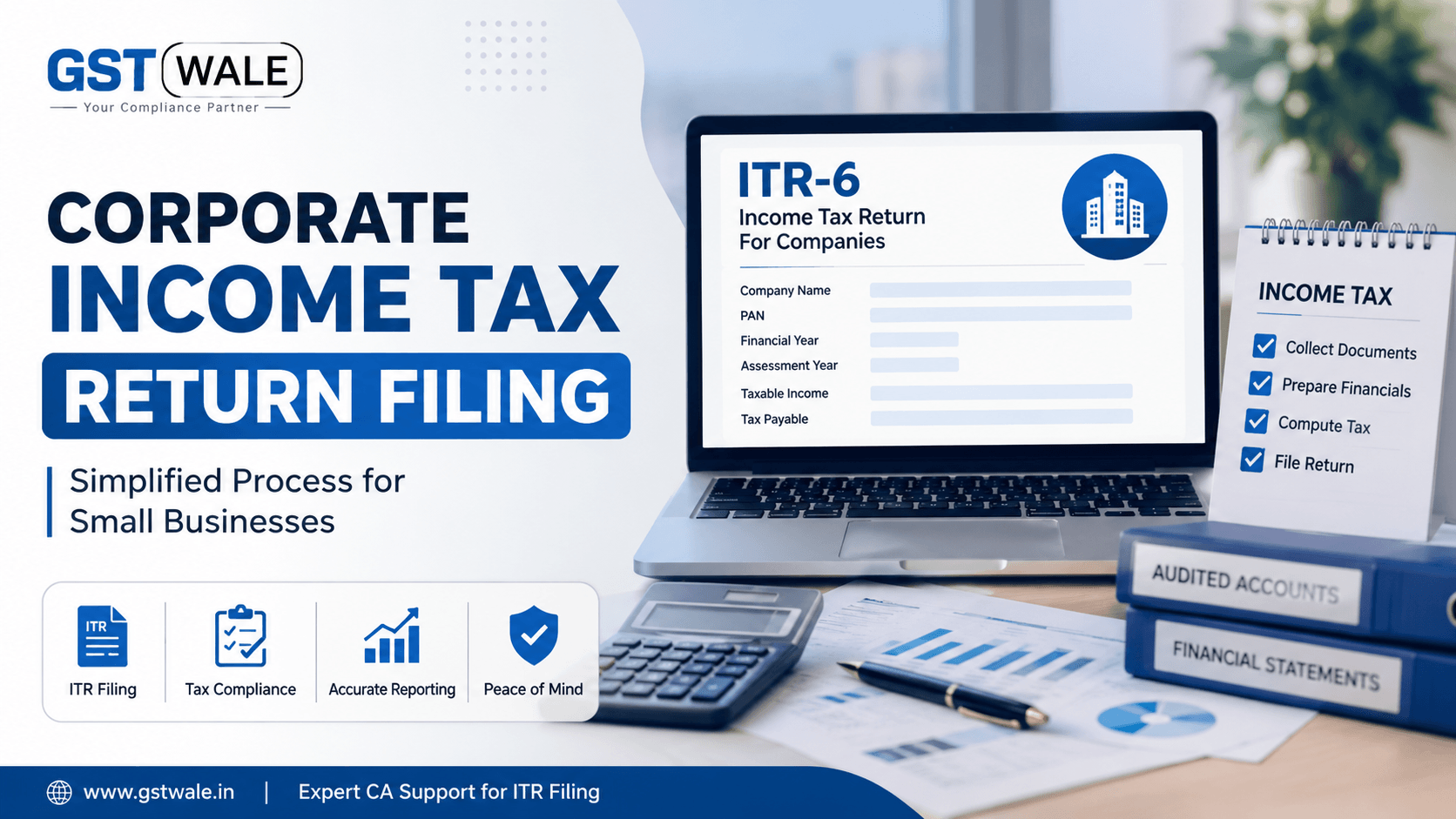
For most companies other than companies claiming exemption under Section 11, ITR 6 is the applicable return form. The Income Tax Department currently identifies ITR 6 specifically for such companies.
Therefore, income tax return filing should ideally be treated as a year-round accounting exercise rather than a once-a-year formality.
Income Tax Return Filing: Step 1 – Close Your Books of Accounts
The first practical step is to make sure the company's books are complete and reconciled.
Before beginning income tax return filing, your accountant or CA should review whether all major transactions have been recorded correctly. This includes sales, purchases, salaries, rent, professional charges, bank transactions, loans, interest and other business expenses.
A proper closing process generally includes:
- Reconciling all bank accounts.
- Checking outstanding receivables and payables.
- Recording depreciation and other year-end adjustments.
- Reconciling GST-related figures with books.
- Checking TDS deductions and credits.
- Reviewing loans and interest expenses.
- Verifying fixed assets and investments.
- Identifying unusual or large transactions.
This stage is important because mistakes in the accounts can flow directly into the tax computation and ultimately affect income tax return filing.
Preparing the Balance Sheet and Profit and Loss Statement
Once the books are reviewed, the financial statements need to be prepared.
The balance sheet provides a snapshot of the company's financial position. It generally includes assets, liabilities and shareholders' funds. The profit and loss statement, on the other hand, shows the company's income and expenditure during the financial year.
During income tax return filing, these financial statements become an important foundation for determining taxable income.
For example, imagine a small manufacturing company reports ₹80 lakh in sales and ₹65 lakh in business expenses. Its accounting profit may appear to be ₹15 lakh. However, taxable income may not necessarily be exactly ₹15 lakh because certain expenses may be disallowed under income-tax provisions, while some deductions or adjustments may be available.
This is why simply taking the net profit from the profit and loss statement and entering it into the return is not a proper approach.
Income Tax Return Filing: Step 2 – Check Whether Tax Audit Applies
The next major question is whether the company is required to undergo a tax audit.
For FY 2025-26, the Income Tax Department states that the tax-audit threshold for business is generally turnover or gross receipts exceeding ₹1 crore, with the threshold increasing to ₹10 crore where cash receipts and cash payments each remain within the prescribed 5% condition.
However, turnover is not the only factor that should be considered. Other provisions can also trigger an audit requirement. Therefore, a CA should review the company's circumstances rather than relying only on a turnover figure.
Where a tax audit applies, the audited accounts and tax-audit report need to be completed before income tax return filing.
For FY 2025-26 relevant to AY 2026-27, the Income Tax Department states that the tax audit report is due on 30 September 2026.
Why Audited Accounts Matter
Audited accounts provide an additional level of verification over the company's financial records. The auditor examines whether the financial information and required particulars have been properly reported.
For a small business owner, this is also an opportunity to identify accounting weaknesses before they become tax problems.
Do not wait until the tax audit deadline to start collecting documents. Bank statements, invoices, expense records, fixed-asset details, loan statements, TDS records and other supporting documents should be organised much earlier.
Income Tax Return Filing: Step 3 – Calculate Taxable Income
After the financial statements are prepared, the next stage is tax computation.
The accounting profit shown in the profit and loss statement is adjusted according to the applicable income-tax provisions. Certain expenses may be disallowed, while specific deductions, depreciation and other tax adjustments may need to be considered.
A professional tax computation generally looks at:
- Accounting profit or loss.
- Depreciation under the Income-tax Act.
- Disallowable expenses.
- TDS and TCS credits.
- Advance tax payments.
- Applicable deductions.
- Brought-forward losses.
- Tax incentives or concessional tax provisions.
- Applicable surcharge and health and education cess.
This calculation is one of the most important parts of income tax return filing because the final tax liability depends on the taxable income rather than merely the accounting profit.
Understanding Minimum Alternate Tax
Another area that small company owners should not ignore is minimum alternate tax, commonly known as MAT.
Broadly, MAT ensures that certain companies with low taxable income compared with their book profits pay a minimum level of tax based on book profit. For companies to which the MAT provisions apply, the rate is generally 15% of book profit, subject to applicable provisions, surcharge and cess.
There are important exceptions. For example, companies opting for certain concessional tax regimes may receive relief from MAT, subject to the applicable conditions.
Where MAT provisions apply, Form 29B may also become relevant. The Income Tax Department states that a company covered by the applicable MAT provisions and having income below 15% of book profit is required to obtain the prescribed CA report in Form 29B.
This is another reason why income tax return filing should be handled after a complete tax computation rather than being treated as a simple online submission.
Income Tax Return Filing: Step 4 – Reconcile TDS, Advance Tax and AIS
Before submitting the return, reconcile the company's tax credits.
The TDS appearing in the company's records should be checked against the information available through the Income Tax Department. Advance tax payments should also be matched with the company's challans and tax records.
The Annual Information Statement, or AIS, can provide additional transaction information that may need to be reviewed.
If there is a mismatch, it is better to investigate it before income tax return filing instead of discovering the issue after receiving a tax notice.
For example, if a customer deducted ₹50,000 as TDS but the company's books show a different amount, the discrepancy should be investigated. Supporting documents and reconciliation can help determine whether the difference is an accounting issue, reporting issue or credit issue.
Income Tax Return Filing: Step 5 – Prepare and Submit the Return
Once the accounts, tax computation and supporting information are ready, the appropriate ITR form can be prepared.
For a company generally falling under ITR 6, the return contains considerably more information than a basic individual income-tax return. Depending on the company's activities, the filing may include details relating to financial statements, depreciation, tax computation, deductions, losses, tax payments and other disclosures.
The return should be reviewed carefully before submission. Particular attention should be given to:
- Company name and PAN.
- Assessment year.
- Nature of business.
- Turnover and financial figures.
- Taxable income.
- TDS and advance-tax credits.
- Losses and depreciation.
- Audit information, where applicable.
- MAT-related information, where applicable.
- Bank account details.
- Tax payable or refund amount.
A careful review at this stage can prevent errors that may otherwise result in notices, additional tax demands or unnecessary follow-up.
Income Tax Return Filing: Step 6 – Verify the Return
Submitting the return is not necessarily the end of the compliance process.
After income tax return filing, the company must ensure that the return is properly verified through the prescribed process. For companies, digital signature requirements can be particularly important.
The company should also retain copies of the submitted return, acknowledgement, tax computation, financial statements, audit reports and supporting records.
Good documentation is extremely useful if the Income Tax Department later asks for clarification.
Common Mistakes Small Businesses Should Avoid
Many tax problems are not caused by complicated transactions. They often arise because basic compliance steps are overlooked.
Some common mistakes include:
- Waiting until the last week to begin preparation.
- Not reconciling bank accounts.
- Ignoring TDS mismatches.
- Treating accounting profit as taxable income without adjustments.
- Missing tax-audit requirements.
- Incorrectly claiming business expenses.
- Forgetting advance-tax payments.
- Not reviewing AIS information.
- Using the wrong ITR form.
- Failing to properly verify the return.
A structured income tax return filing process helps reduce these risks significantly.
Practical Example for a Small Business
Consider a private limited company with annual turnover of ₹3 crore. Its books show an accounting profit of ₹25 lakh.
Before income tax return filing, the CA reviews the accounts and discovers ₹2 lakh of expenses that are not allowable under the tax provisions. Depreciation and other adjustments are also considered. The final taxable income may therefore differ from the accounting profit.
The company also checks TDS credits and advance tax payments before calculating the remaining liability.
This example shows why income tax return filing is not simply about copying numbers from the balance sheet. It involves reviewing financial information and applying the relevant tax provisions correctly.
FAQs About Income Tax Return Filing
Is ITR 6 mandatory for every small company?
ITR 6 is generally applicable to companies other than those claiming exemption under Section 11. The exact return form should always be determined based on the company's legal and tax circumstances.
Does every small business company need audited accounts?
Not necessarily in the same manner for every company. Tax-audit requirements depend on applicable provisions and circumstances. A company should have its accounts and audit requirements reviewed by a qualified professional before the income tax return filing deadline.
What is the tax audit deadline for FY 2025-26?
For AY 2026-27, the Income Tax Department states that the tax audit report due date is 30 September 2026.
What is minimum alternate tax?
Minimum alternate tax is a mechanism applicable to certain companies where tax computed under normal provisions is lower than the prescribed percentage of book profit. The applicable MAT rate is generally 15%, subject to the relevant provisions and exceptions.
Can a company file its return without checking its profit and loss statement?
It should not. The profit and loss statement, balance sheet and supporting accounting records are fundamental inputs for accurate income tax return filing. Errors in financial statements can result in incorrect tax reporting.
Make Income Tax Return Filing a Planned Process
For a small company, income tax return filing should never be treated as a last-minute compliance task. When the books are maintained properly throughout the year, the balance sheet and profit and loss statement are reconciled, tax-audit requirements are checked early and tax credits are verified, the entire process becomes far more manageable.
The key is preparation. Start reviewing your accounts before the tax audit deadline, keep your documents organised and take professional advice whenever the company's transactions involve complex tax provisions, losses, related-party transactions or MAT considerations.
At GST Wale, our approach is simple: make compliance understandable, organised and practical for business owners. Whether you are preparing your first corporate return or looking for a more reliable way to manage recurring tax compliance, professional guidance can help you complete income tax return filing with greater confidence.
 Previous